When shortlisting for investments to add to our portfolio, it is only natural for us to gravitate towards those that have performed well in the past.
After all, if a particular stock, sector, or fund has consistently generated impressive returns over the last few years, surely it must be doing something right?
Perhaps.
However, there is one important thing investors should always bear in mind:
‘Yesterday’s winners aren’t necessarily going to be tomorrow’s.’
In fact, placing too much emphasis on past performance could sometimes lead us to invest at precisely the time when the conditions responsible for those strong returns are starting to change.
In this post, let us take a closer look at some of the reasons why.
What Worked Yesterday May Not Work Tomorrow
Every investment operates within a particular economic and market environment.
For instance, some companies may benefit tremendously from a low interest rate environment, while others may thrive when commodity prices are rising, consumer spending is strong, or a particular technology is seeing rapid adoption.
However, as these conditions change, the fortunes of these investments can change along with them.
A company that enjoyed several years of exceptional growth may eventually find itself facing stronger competition. Similarly, an industry that experienced a prolonged boom may attract so much investment that supply eventually catches up with, or even exceeds, demand.
Changes in interest rates, government policies, consumer preferences, and technological developments can also significantly alter the outlook of a business that had previously performed well.
This is why looking at what performed strongly over the past 3, 5, or even 10 years does not necessarily tell us what will perform equally well over the next 3, 5, or 10 years.
Strong Performance Can Create Expensive Valuations
There is another potential problem with chasing yesterday’s winners.
The better an investment performs, the more attention it tends to attract. As more investors jump on the bandwagon, its share price may start rising much faster than the underlying earnings of the business.
Eventually, it may reach a point where even an excellent company becomes a less attractive investment simply because we are paying too high a price for it.
As I have always shared, everything has a fair value price – and companies are no exception.
Suppose a company’s share price has doubled over the past few years because investors expect its earnings to continue growing rapidly.
If much of this expected growth has already been priced into its valuation, even a decent set of results may not be enough to send its share price significantly higher.
Worse still, should the company’s growth unexpectedly slow, investors may begin to reassess how much they are willing to pay for its shares.
This is why it is important to distinguish between a good company and a good investment at the current price.
The two are not necessarily the same.
Today’s Losers Can Become Tomorrow’s Winners Too
The reverse can happen as well.
A sector that has underperformed for several years may eventually become overlooked by investors. However, should its underlying conditions improve, it could subsequently emerge as one of the market’s stronger performers.
This is also one of the reasons why leadership in the stock market changes over time.
Different economic and market environments favour different companies and sectors.
The challenge, however, is that we only know which investments were the winners after those strong returns have already been achieved.
As such, continuously shifting our money towards whichever investment has performed the best recently could leave us constantly one step behind the market.
We may end up buying only after prices have already risen significantly, before subsequently selling when performance begins to disappoint.
Focus on What Comes Next, Not What Came Before
Having said all of that, I would like to clarify that studying a company’s past performance is certainly not useless.
In fact, its historical results can provide us with valuable insights into the quality of the underlying business, the capabilities of its management, its financial resilience, and its ability to navigate different economic environments.
What matters is how we use this information when making our investment decisions.
Instead of simply asking:
“Which investment has performed the best?”
Perhaps a more useful question to ask would be:
“What needs to happen for this investment to continue performing well from here?”
Look at the company’s future growth prospects.
Consider whether its competitive advantages remain intact.
Study its balance sheet and financial performance.
Understand the key risks that could affect the business.
And importantly, consider whether its current valuation already reflects an overly optimistic outlook for the future.
After all, when we invest our money today, it is what happens from this point onwards that will determine the returns we eventually receive.
Closing Thoughts
It is easy to look at an investment that has delivered spectacular returns and wish we had invested in it several years earlier.
However, those historical returns belong to investors who owned the investment during that period.
They do not automatically become our returns simply because we decide to invest in it today.
Economic conditions can change, industries can evolve, competition can intensify, and growth can slow. At the same time, prolonged periods of strong share price performance can push a company’s valuation to increasingly expensive levels.
On the flip side, investments that have disappointed in the past may eventually recover when their underlying fundamentals and operating environment improve.
This is why I believe investors should avoid selecting investments simply by looking at which stocks, sectors, or funds have performed the best recently.
Instead, before investing in something because of its impressive track record, take some time to understand what drove those returns in the first place.
Then ask yourself whether those conditions are likely to continue, whether the fundamentals remain sound, and whether its current valuation still offers a reasonable margin of safety.
Past performance can certainly provide us with useful information.
But ultimately, it is what happens in the future, rather than what happened in the past, that will determine the returns we receive from an investment.
Stop Spending Hours Reading REIT Reports Every Quarter!
What if you could assess a REIT's portfolio occupancy, debt profile, valuation, and overall health in less than 30 seconds - without having to comb through a single quarterly report?
That's the problem the REIT Screener was built to solve.
Developed through a collaboration between ShareInvestor and The Singaporean Investor, the REIT Screener consolidates many of the key metrics and indicators I personally use when analysing REITs into one easy-to-use platform. Instead of spending hours extracting data manually every earnings season, you can now monitor the REITs you own and research new opportunities in just a few clicks.
If you're serious about REIT investing but don't have the time to manually track quarterly developments, the REIT Screener could be the shortcut you've been looking for:
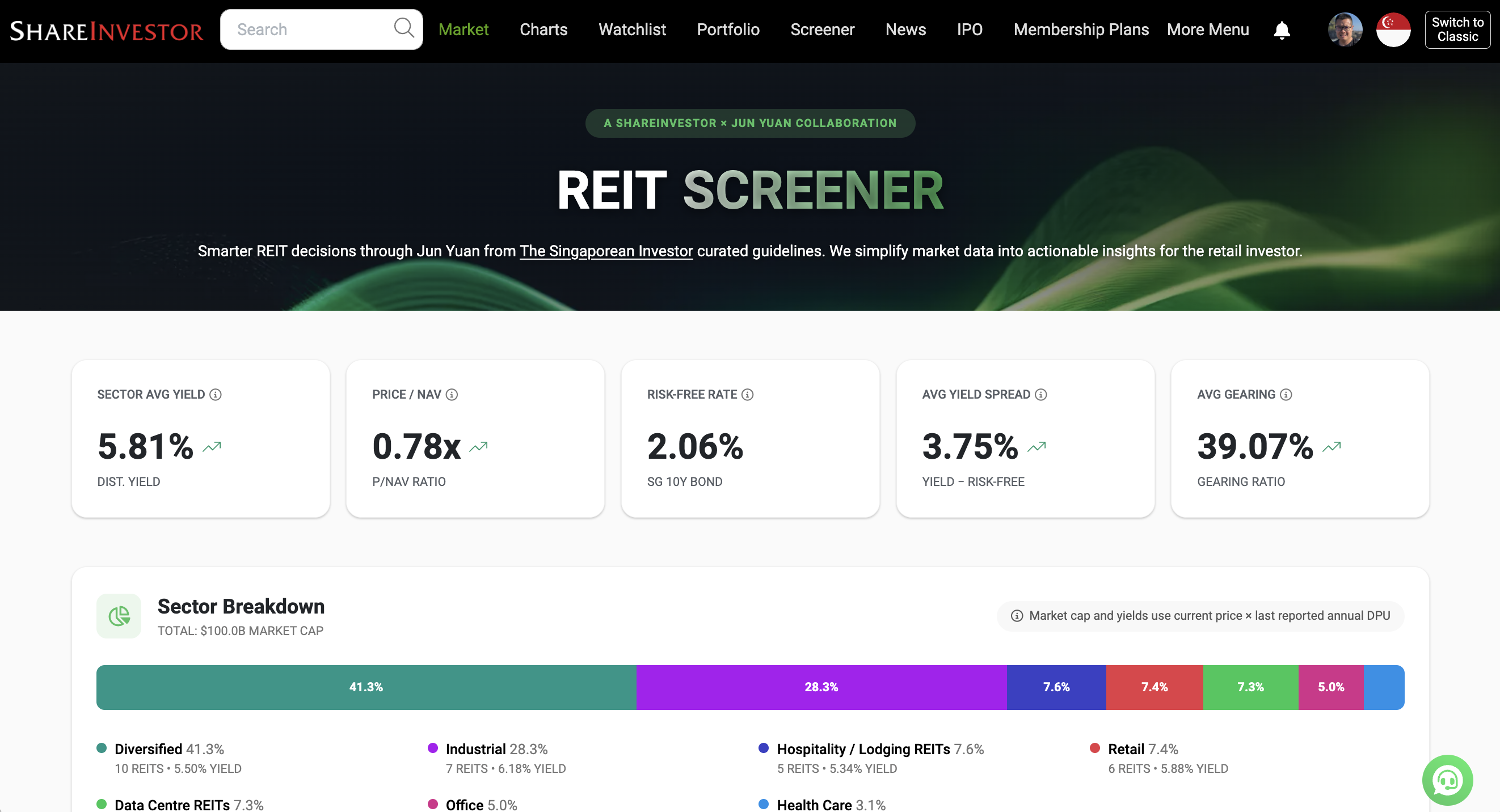
Take a closer look at the REIT Screener here...



Comments (0)