1. What is the Amova MSCI AC Asia ex Japan ex China Index ETF?
Listed on the Singapore Exchange on 2 April 2025, the Amova MSCI AC Asia ex Japan ex China Index ETF, managed by Amova Asset Management Asia Limited, provides investors with a convenient way to diversify their portfolio across large- and mid-cap companies predominantly listed in developed and emerging Asian markets.
If you are wondering what the ‘AC’ in the ETF’s name stands for, it simply means ‘All Country’.
As its name suggests, the ETF excludes companies from both Japan and China. Instead, its portfolio comprises companies from several other Asian markets, including Taiwan, South Korea, India, Singapore, Hong Kong, Malaysia, Thailand, Indonesia, and the Philippines.
Investors can trade the ETF in either Singapore Dollars (SGX: A93) or United States Dollars (SGX: A94).
2. Which Index Does the ETF Track?
The Amova MSCI AC Asia ex Japan ex China Index ETF tracks the MSCI AC Asia ex Japan ex China Index.
According to MSCI, the Index is designed to capture approximately 85% of the free float-adjusted market capitalisation of each country included in it.
As at 31 July 2026, the Index comprised approximately 420 companies.
3. Why are Companies from Japan and China Excluded from the Index?
That is definitely an interesting question.
In Japan’s case, the country has traditionally been treated as a separate market in many regional Asian ETFs. This is partly due to the sheer size of its stock market, as well as its status as a developed market with monetary, economic and demographic characteristics that are quite different from many of the other markets in Asia.
As for China, its stock market has grown to become a significant component of many broad Asian and emerging-market indexes. As a result, some investors may prefer to manage their exposure to China separately, allowing them to decide for themselves how much of their portfolio they want to allocate to the country.
By excluding both Japan and China, the Index instead places greater emphasis on other major Asian markets such as Taiwan, South Korea and India.
4. What is the Level of Concentration of Each Asian Country in the ETF?
Geographically, the ETF is heavily concentrated in 3 markets – Taiwan, South Korea and India.
As at 31 July 2026, companies from Taiwan accounted for 38.9% of the ETF, followed by South Korea at 29.8%, and India at 15.7%.
Collectively, these 3 markets made up a sizeable 84.4% of the ETF. This means that the ETF’s performance is, to a large extent, dependent on how companies from these 3 markets perform.
The remaining geographical exposures comprised Singapore (5.2%), Hong Kong (4.9%), Others (3.8%) and France (1.7%).
Cash and/or derivatives made up the remaining 0.1%.
5. What is the Sector Allocation of the ETF?
Sector-wise, the ETF is heavily tilted towards companies in the Information Technology sector, which accounted for 56.5% of its portfolio as at 31 July 2026.
This was followed by companies in the Financials sector, which made up another 17.5%.
The remaining sector allocations were: Others (which include sectors such as energy, consumer staples, utilities and health care) at 9.9%, Industrials at 7.4%, Consumer Discretionary at 3.6%, Materials at 2.9%, and Communication Services at 2.1%.
This is something investors should take note of, because despite the ETF investing across hundreds of companies, more than half of its portfolio is concentrated in just one sector.
6. What are the Top 10 Holdings in the ETF?
As at 31 July 2026, the ETF’s top 10 holdings had a combined weightage of approximately 51.6%.
The top 2 holdings had double-digit weightages – Taiwan Semiconductor Manufacturing Co Ltd at 22.7% and Samsung Electronics Co Ltd at 10.6%.
Meanwhile, each of the remaining holdings had a weightage of less than 8.2%.
Here are the top 10 holdings in the Amova MSCI AC Asia ex Japan ex China Index ETF:
1. Taiwan Semiconductor Manufacturing Co Ltd (22.7% Weightage)
Taiwan Semiconductor Manufacturing Co Ltd, or TSMC, is the world’s largest dedicated semiconductor manufacturer. It manufactures advanced computer chips designed by other companies for use in products such as smartphones, AI servers, cars and other electronic devices.
It is listed on the Taiwan Stock Exchange (TWSE: 2330), while its American Depositary Shares (ADSs) are listed on the New York Stock Exchange (NYSE: TSM).
2. Samsung Electronics Co Ltd (10.6% Weightage)
Samsung Electronics Co Ltd is a South Korean technology giant that manufactures a wide range of products, including smartphones, televisions and home appliances, as well as semiconductor chips such as memory chips and processors, display panels and automotive electronics.
It is listed on the Korea Exchange (KRX: 005930), while Global Depositary Receipts (GDRs) representing its common shares are listed on the London Stock Exchange (LSE: SMSN).
A GDR is similar to an American Depositary Receipt (ADR), except that ADRs specifically refer to depositary receipts traded in the United States, while GDRs can be listed on stock exchanges in other international markets.
3. SK Hynix Inc (8.2% Weightage)
SK Hynix Inc is a South Korean semiconductor company specialising in memory chips, particularly dynamic random access memory (DRAM), NAND flash and high-bandwidth memory (HBM). These chips are used in products such as AI servers, data centres, smartphones and computers.
It is one of the world’s leading memory-chip manufacturers and has also become a major beneficiary of the growing demand for HBM used in AI computing.
It is listed on the Korea Exchange (KRX: 000660), on the NASDAQ (NASDAQ: HYNX) through ADSs, as well as on the Luxembourg Stock Exchange (LuxSE: HYXS) through GDRs.
4. MediaTek Inc (2.0% Weightage)
MediaTek Inc is a Taiwanese semiconductor company that designs chips used in smartphones, smart TVs, Wi-Fi devices, tablets, cars and other connected electronic devices.
Unlike manufacturers such as TSMC, MediaTek is primarily a fabless chip designer, meaning it designs its chips but outsources their actual manufacturing to semiconductor foundries.
It is listed on the Taiwan Stock Exchange (TWSE: 2454).
5. Amundi MSCI India Swap UCITS ETF USD Acc (1.7% Weightage)
The Amundi MSCI India Swap UCITS ETF USD Acc is an ETF that provides investors with broad exposure to large- and mid-sized Indian companies by seeking to track the performance of the MSCI India Index.
Instead of directly owning all the Indian shares in the Index, the ETF primarily uses swap agreements to obtain the returns of the Index.
6. DBS Group Holdings Ltd (1.4% Weightage)
DBS Group Holdings Ltd, or DBS, is the largest bank in Southeast Asia by assets and one of the largest banks in Asia.
It provides a wide range of banking and financial services to individuals and businesses, including savings and deposits, loans, credit cards, wealth management, investment banking and treasury services.
DBS is listed on the Singapore Exchange (SGX: D05).
7. Samsung Electronics Co Ltd Preferred Non-Voting Shares (1.4% Weightage)
The key difference between Samsung Electronics’ common shares and its preferred non-voting shares lies in the rights attached to them.
While the common shares generally carry voting rights, the preferred shares do not. In return, the preferred shares are entitled to an annual dividend that is KRW50 per share higher than that paid on the common shares.
Samsung Electronics’ preferred non-voting shares are listed on the Korea Exchange (KRX: 005935).
8. AIA Group Ltd (1.3% Weightage)
AIA Group Ltd is one of Asia’s largest life insurance and financial services groups, providing products such as life, health and accident insurance, savings plans, employee benefits and pension services across multiple Asian markets.
It is listed on the Hong Kong Stock Exchange (HKEX: 1299), while its Level 1 American Depositary Receipts (ADRs) are traded on the US OTC market (OTC: AAGIY).
9. Delta Electronics Inc (1.2% Weightage)
Delta Electronics Inc is a Taiwanese electronics company specialising in power management and energy-efficient technologies. Its products and systems are used in areas such as data centres, industrial automation, electric vehicles, EV charging, renewable energy and energy storage.
It is listed on the Taiwan Stock Exchange (TWSE: 2308).
10. Hon Hai Precision Industry Co Ltd (1.1% Weightage)
Hon Hai Precision Industry Co Ltd, better known as Foxconn, is a Taiwanese company and the world’s largest electronics manufacturer. It assembles and manufactures products such as smartphones, computers, servers and other electronic devices for major global technology companies.
The company has also been expanding into areas such as AI servers, electric vehicles, semiconductors and robotics.
It is listed on the Taiwan Stock Exchange (TWSE: 2317), while its GDRs are listed on the London Stock Exchange (LSE: HHPD).
7. Does the ETF Pay Dividends?
Currently, unitholders of the ETF do not receive dividend distributions.
From my understanding, dividends received from the ETF’s underlying investments (such as TSMC, Samsung Electronics, DBS and AIA) are reinvested back into the fund rather than being distributed to unitholders as cash.
This means investors looking for regular passive income from their investments will need to take note that the ETF currently does not provide them with dividend payouts.
8. What are Some of the Key Risks to Consider?
1. Sector & Single-Stock Concentration
With the Information Technology sector making up more than half of the ETF at 56.5%, and TSMC alone accounting for approximately 22.7%, the ETF is, in my personal opinion, considerably more concentrated than what investors may typically expect from a ‘diversified’ ETF.
The concentration becomes even more apparent when we consider that TSMC, Samsung Electronics and SK Hynix collectively account for more than 40% of the ETF.
As a result, a sharp downturn in global semiconductor demand, a Taiwan, or South Korea-specific shock, or company-specific issues affecting any of these 3 companies could have a disproportionate impact on the ETF’s performance, regardless of how well the rest of its portfolio performs.
2. Emerging Market Risk
A meaningful portion of the ETF is invested in emerging Asian markets, including India, Taiwan, South Korea, Malaysia, Thailand, Indonesia and the Philippines.
Compared with developed markets, emerging markets may be more susceptible to political and regulatory changes, currency fluctuations and greater stock-market volatility.
As such, these markets could experience larger price swings, particularly during periods when investors become more risk-averse, which could in turn affect the ETF’s performance.
3. Currency Risk
While the ETF can be traded in either Singapore Dollars or United States Dollars, most of its underlying investments are denominated in other currencies.
These include the Taiwan Dollar, South Korean Won, Indian Rupee, Hong Kong Dollar and various Southeast Asian currencies.
As a result, fluctuations in these currencies against the Singapore Dollar or United States Dollar could affect the value of the ETF’s underlying investments.
This is something investors should take note of, as buying the ETF through its Singapore Dollar trading counter does not necessarily mean that you are free from foreign currency risks.
9. What are the Fees Associated with the ETF?
The ETF charges a management fee of 0.50% per annum, while its total expense ratio is capped at 0.60% per annum.
These fees are deducted from the fund’s assets and will therefore have an impact on investors’ overall returns over time.
10. What is the Performance of the ETF since its Inception?
The following is the monthly unit price movement of the Amova MSCI AC Asia ex Japan ex China Index ETF (SGX: A93) since its listing in April 2025:
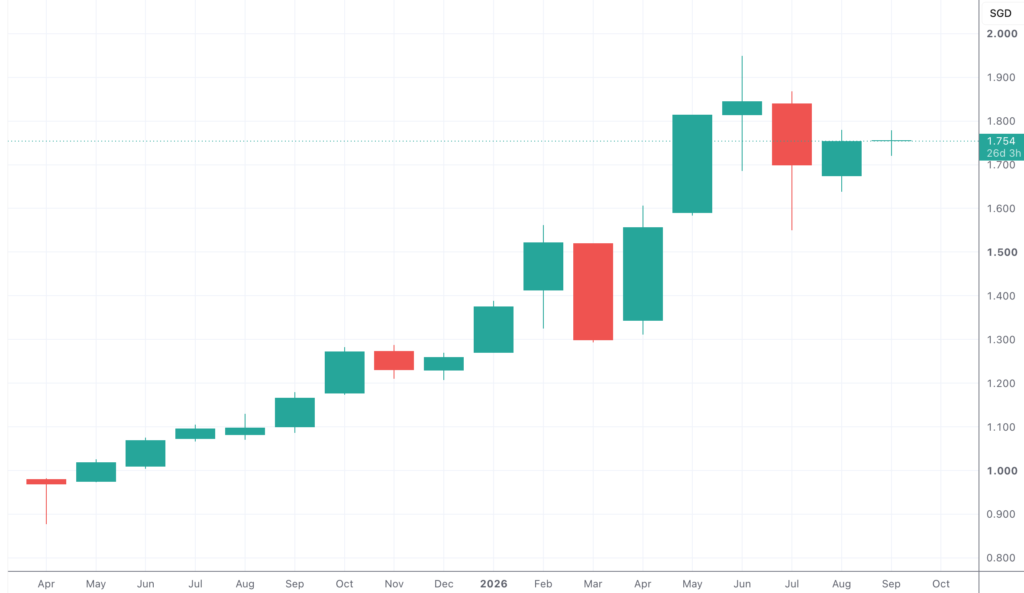
Since its listing, the unit price of the ETF has generally been on a steady upward climb.
Investors who had invested in the ETF at its opening price of S$0.980 on 2 April 2025, and held on to their investment through the end of the year, when it closed at S$1.26 on 31 December 2025, would have recorded an unrealised capital gain of approximately 28.6% in just 8 months.
Of course, past performance is not necessarily an indication of how the ETF will perform in the years ahead, particularly given its heavy exposure to the technology and semiconductor sectors.
Closing Thoughts
The Amova MSCI AC Asia ex Japan ex China Index ETF provides investors with a convenient way to gain exposure to some of Asia’s most prominent listed companies through a single investment.
These include TSMC, which is listed in Taiwan with ADSs traded in the United States; Samsung Electronics and SK Hynix from South Korea; AIA Group from Hong Kong; DBS from Singapore; and Foxconn from Taiwan.
Another useful feature is that investors have the flexibility of trading the ETF in either Singapore Dollars through SGX: A93, or United States Dollars through SGX: A94.
In terms of individual holdings, I like that apart from the top 3 companies with the heaviest weightages (TSMC, Samsung Electronics and SK Hynix) each of the remaining holdings accounts for no more than around 2% of the ETF.
However, this does not necessarily mean that the ETF is broadly diversified in every respect.
The Information Technology sector alone accounts for 56.5% of the ETF, while companies from Taiwan, South Korea and India collectively make up 84.4% of its portfolio. Investors therefore need to be comfortable with the significant sector and geographical concentrations present in the ETF.
In particular, with TSMC, Samsung Electronics and SK Hynix forming such a large part of the portfolio, the fortunes of the semiconductor industry could have a significant influence on how the ETF performs.
Another important consideration is that the ETF currently does not pay dividends to unitholders. Instead, income received from its underlying investments is reinvested into the fund. This may appeal to investors who are looking for capital growth and compounding over the longer term, but it is something income investors looking for regular cash distributions will need to take note of.
Overall, the Amova MSCI AC Asia ex Japan ex China Index ETF may be worth a closer look for investors seeking exposure to Asian equities outside of Japan and China. However, before investing, it is important to understand that despite holding a large number of companies, its performance remains heavily influenced by the technology sector and by just a handful of Asian markets.
Disclaimer: At the time of writing, I do not have any units of the Amova MSCI AC Asia ex Japan ex China Index ETF.
Are You Worried about Not Having Enough Money for Retirement?
You're not alone. According to the OCBC Financial Wellness Index, only 62% of people in their 20s and 56% of people in their 30s are confident that they will have enough money to retire.
But there is still time to take action. One way to ensure that you have a comfortable retirement is to invest in real estate investment trusts (REITs).
In 'Building Your REIT-irement Portfolio' which I've authored, you will learn everything you need to know to build a successful REIT investment portfolio, including a list of 9 things to look at to determine whether a REIT is worthy of your investment, 1 simple method to help you maximise your returns from your REIT investment, 4 signs of 'red flags' to look out for and what you can do as a shareholder, and more!

You can find out more about the book, and grab your copy (ebook or physical book) here...


Comments (0)