For most people, the first thing that comes to mind when they hear of the S&P 500 Index is that it tracks the performance of 500 leading American companies by market capitalisation – it is like Singapore’s benchmark Straits Times Index, or STI for short, but in this case, it tracks the performance of just the top 30 Singapore companies by market capitalisation.

The S&P 500 index tracks the performance of the top 500 American companies by market capitalisation – Photo by Tyler Prahm on Unsplash
Another thing you’re probably aware about the index is that, the top 10 companies (comprising of Apple, Microsoft, Amazon, NVIDIA, Alphabet, Meta Platforms, Tesla, Berkshire Hathaway, and UnitedHealth Group) in total has a weightage of about 32%.
However, you may not be aware that the S&P 500 Index comprise of companies in 11 different sectors, and each of these sectors have an index tracking it – if you prefer, you can also invest in them (I know of some investors who prefer to invest in individual sector indexes, as they are not too comfortable with many of the companies with the heaviest weightage in the S&P 500 index being the big technology companies.)
In the rest of this post, I will be sharing with you what each of the 11 sectors are (organised by alphabetical order), along with some basic information about them (as I understand some of you who are reading this may be unfamiliar with US companies, I will try to explain them in as layman as I can, so as to allow you to be able to better follow through).
Let’s begin:
1. Basic Materials (NYSE ARCA:XLB)
It tracks the performance of companies in the S&P 500 index that is involved in the production and processing of raw materials, such as chemicals (used in plastics and pharmaceuticals), construction materials (such as steel and cement), containers and packaging (like cardboard and glass), metals (for instance copper and aluminium), as well as paper and forest products (such as lumber and pulp).
There are 31 companies in the index, with Linden plc (a leading global industrial gases and engineering company, where they produce clean hydrogen and carbon capture systems critical to the energy transition, life saving medical oxygen, and high-purity and specialty gases for electronics, with their customers in the chemical & energy, food & beverage, electronics, healthcare, manufacturing, as well as in the metals and mining businesses) having the largest weightage, at about 22%.
You can find out more about the index here.
2. Communication Services (NYSE ARCA:XLC)
As the name suggests, the index comprises of companies in the ‘communication services’ sector, such as those involved in telecommunications, media, entertainment, and interactive media and services (it was previously classified in the consumer discretionary or tech sectors, before being moved to the ‘communication services’ sector in September 2018 as these companies have evolved and are now also providing telecommunication services, such as the streaming of video content over the Internet).
While there are 23 companies in the index, but the top 10 companies, namely Meta Platforms, Alphabet, Walt Disney Company, AT&T Inc, Verizon Communications Inc, T-Mobile US Inc, Netflix Inc, Charter Communications Inc, and Comcast Corporation, have a 82% weightage (approximately) in total.
You can find out more about the index here.
3. Energy (NYSE ACRA:XLE)
Again, this is pretty much self-explanatory, where companies in this index are those in the energy sector – they are involved in the exploration, production, and transportation of oil, gas, and other energy sources.
There are 25 companies in the index, but the top 10 companies have a total weightage of about 73% – with Exxon Mobil Corporation (where its principal business involves the exploration for, and production of, cruel oil and natural gas, along with the manufacture, trade, transport, and sale of crude oil, natural gas, petroleum products, petrol chemicals, and a wide variety of specialty products, as well as the pursuit of lower-emission business opportunities including carbon capture and storage, hydrogen, and lower-emission fuels; they are also the company behind our Esso petrol stations here in Singapore) having the biggest weightage, at about 22.5% – hence the movement of the company’s share price (positively or negatively) will have a certain influence on how the index moves.
You can find out more about the index here.
4. Financials (NYSE ACRA:XLF)
Previously also comprising of companies in the real estate industry (where it has a 20% weightage), it was spun off in September 2016 (where a separate real estate index was formed, which we will be looking at later on), the financials index now comprises only of companies in the financial services industry, such as banks, insurance companies, and investment firms.
There are 74 companies in the index, with the top 10 companies (by market capitalisation) as follows (many of them I’m sure you’re familiar with): Berkshire Hathaway, JPMorgan Chase & Co., Visa Inc., Mastercard Incorporated, Bank of America Corp, Wells Fargo & Company, S&P Global Inc., Goldman Sachs Group Inc., Morgan Stanley, and BlackRock Inc. In total, these 10 companies have a weightage of 54.42%.
You can find out more about the index here.
5. Industrials (NYSE ACRA:XLI)
Companies in the industrials index are those from the industry groups of the industrial sector, such as aerospace and defence, building products, construction and engineering, electrical equipment, and machinery.
There are 79 companies in the index, with the top 10 companies having a weightage of about 37%, and the remaining 69 companies having a weightage of about 63%.
Top 10 companies in the index are United Pacific Corporation, General Electric Company, Caterpillar Inc, Honeywell International Inc, Boeing Company, RTX Corporation, United Parcel Service (or UPS for short), Deere & Company, Lockheed Martin Corporation, as well as Automatic Data Processing – each of the companies have a weightage of no more than 4.22%.
You can find out more about the index here.
6. Technology (NYSE ARCA:XLK)
The Technology Index tracks the performance of technology stocks in the S&P 500 index. Companies in this index comprises of those in a variety of industries, including hardware, software, semiconductors, as well as telecommunications.
It is made up of 66 companies, with 2 companies with the heaviest weightage (in Microsoft Corporation and Apple Inc.) at about 47% – all of us will remember the former for its Microsoft Windows operating system, Microsoft Office suite of products, and its Xbox gaming console, and the latter for its iPhone (which is the company’s biggest contributor), iPad tablets, and Mac Computers.
The other 8 companies are (again, I’m sure you are familiar most of them): NVIDIA Corporation, Broadcom Inc, Adobe Incorporated, Cisco Systems Inc, Accenture Plc, Advanced Micro Devices Inc (more commonly known as AMD), and Oracle Corporation – each of them have a weightage of no more than 4.7%.
You can find out more about the index here.
7. Consumer Defensive (NYSE ARCA:XLP)
As the word ‘defensive’ goes, companies in this index are those in the consumer-staples industry – such as those in food and beverages, personal care products, household products, and tobacco products. Regardless of how the economy is, demand for the companies’ products will very likely remain unaffected.
39 companies make up the index, and the following 10 companies (where they have the largest market capitalisation) have a weightage of about 68% – Procter & Gamble Company (commonly referred to as P&G), Costco Wholesale Corporation, Walmart Inc, PepsiCo Inc, Mondelez International Inc (products include Cadbury, Toblerone, Oreo, Ritz), Coca-Cola Company, Philip Morris International Inc (products include Marlboro, L&M, iQOS), Altria Group Inc, Colgate-Palmolive Company (products include Colgate, Softlan), and Target Corporation.
You can find out more about the index here.
8. Real Estate (NYSE ARCA:XLRE)
As the name suggests, companies in the index are in the real estate industry (including but not limited to real estate management and development companies, homebuilders, along with hotels and resort companies), as well as REITs (Real Estate Investment Trusts) listed in the S&P 500 Index.
There are 33 companies in the index, with the top 10 companies having a combined weightage of about 61% – particularly, the top 2 companies (Prologis Inc, a REIT that invests in logistics facilities, as well as American Tower Corporation, a REIT that owns and operates wireless and broadcast communications infrastructures in several countries) have a combined weightage of about 21%. The other 8 companies are Equinix Inc, Welltower Inc, Crown Castle Inc, Public Storage, Digital Realty Trust Inc (the Sponsor of Singapore-listed Digital Core REIT), Simon Property Group Inc, Realty Income Corporation, and CoStar Group Inc.
You can find out more about the index here.
9. Utilities (NYSE ARCA:XLU)
The Utilities Index tracks the performance of companies in the utilities sector (such as those that deal with electric, natural gas, water) that are listed in the S&P 500 Index. Apart from the Consumer Defensive sector you have read about earlier, this sector is another ‘defensive’ one, where they tend to hold up well during times of economic downturn.
31 companies make up the index, with the top 10 companies (by market capitalisation) having a combined weightage of about 59% – besides NextEra Energy Inc (the world’s largest electric utility holing company by market capitalisation; the company is also the only one that has a double-digit percentage weightage in the index, at about 13%), the remaining 30 companies have a weightage of no more than 8.3%.
You can find out more about the index here.
10. Healthcare (NYSE ARCA:XLV)
Companies in the healthcare index tracks the performance of companies in the following businesses: pharmaceutical, health care equipment and supplies, health care providers and services, biotechnology, life sciences tools and services, and health care technology.
Due to an aging population, and increase in demand for healthcare services, this sector is poised to continue to grow in the coming years and decades ahead. On the flip side, it is susceptible to changes in government regulations, and healthcare policies.
There are 55 companies in the index, with the top 10 companies (by market capitalisation) having a total weightage of about 56% – out of which, 2 companies (in UnitedHealth group Incorporated, an American multinational managed healthcare and insurance company, as well as Eli Lily and Company, an American pharmaceutical company that is in the news lately for its weight loss drug) have a combined weightage of about 21%; the remaining 8 companies (Johnson & Johnson, Merck & Co Inc, AbbVie Inc, Thermo Fisher Scientific Inc, Abbott Laboratories, Amgen Inc, and Danaher Corporation) have a total weightage of 35%, with no one single company having a weightage of more than 7.5%.
You can find out more about the index here.
11. Consumer Cyclical (NYSE ARCA:XLY)
Last but not least, we have consumer cyclical – to explain in layman terms, companies in this sector make products and services that are more of ‘wants’ than ‘needs’.
Top 10 companies in this sector include Amazon.com Inc, Tesla Inc, McDonald’s Corporation, Home Depot Inc, NIKE Inc, Starbucks Corporation, Lowe’s Companies Inc, Booking Holdings Inc, TJX Companies Inc, and Chipotle Mexican Grill Inc (as a Singaporean, I’m sure you’ll immediately recognise more than half of them) – together, these 10 companies have a combined weightage of about 71% (with Amazon.com Inc having a weightage of 24%, and Tesla Inc having a weightage of 18%) – meaning any movements in their share prices (positively or negatively) will have a big influence on how the sector’s price moves.
Finally, there are 54 companies in this index.
You can find out more about the index here.
Closing Thoughts
As I have mentioned earlier, for those who do not prefer to invest in the S&P 500 Index due to it being ‘heavy’ in the big technology companies (where apart from Berkshire Hathaway and UnitedHealth Group Incorporated, the remaining 8 companies with the biggest market capitalisation are technology companies), you have the option to invest in the individual sectors.
To recap, there are a total of 11 sectors where companies in the S&P 500 Index are comprised of, and there are individual index for each of the sector which tracks the performances of these companies. They are:
- Basic Materials (NYSE ARCA:XLB)
- Communication Services (NYSE ARCA:XLC)
- Energy (NYSE ACRA:XLE)
- Financials (NYSE ACRA:XLF)
- Industrials (NYSE ACRA:XLI)
- Technology (NYSE ARCA:XLK)
- Consumer Defensive (NYSE ARCA:XLP)
- Real Estate (NYSE ARCA:XLRE)
- Utilities (NYSE ARCA:XLU)
- Healthcare (NYSE ARCA:XLV)
- Consumer Cyclical (NYSE ARCA:XLY)
Among the 11 sectors, I would say consumer defensive, utilities, and healthcare are considered to be ‘recession resilient’ – where, regardless of the economy, the demand for these sectors’ products ad/or services will continue to remain unaffected.
With that, I have come to the end of my post today. I hope the information presented above have given you a good understanding of each of the 11 sectors comprising the S&P 500 Index.
Disclaimer: At the time of writing, I am not invested in any of the companies or indexes discussed above.
Join Me for a FREE Live Online Chit-Chat on Thursday, 12 November, from 8–9pm (SGT)!
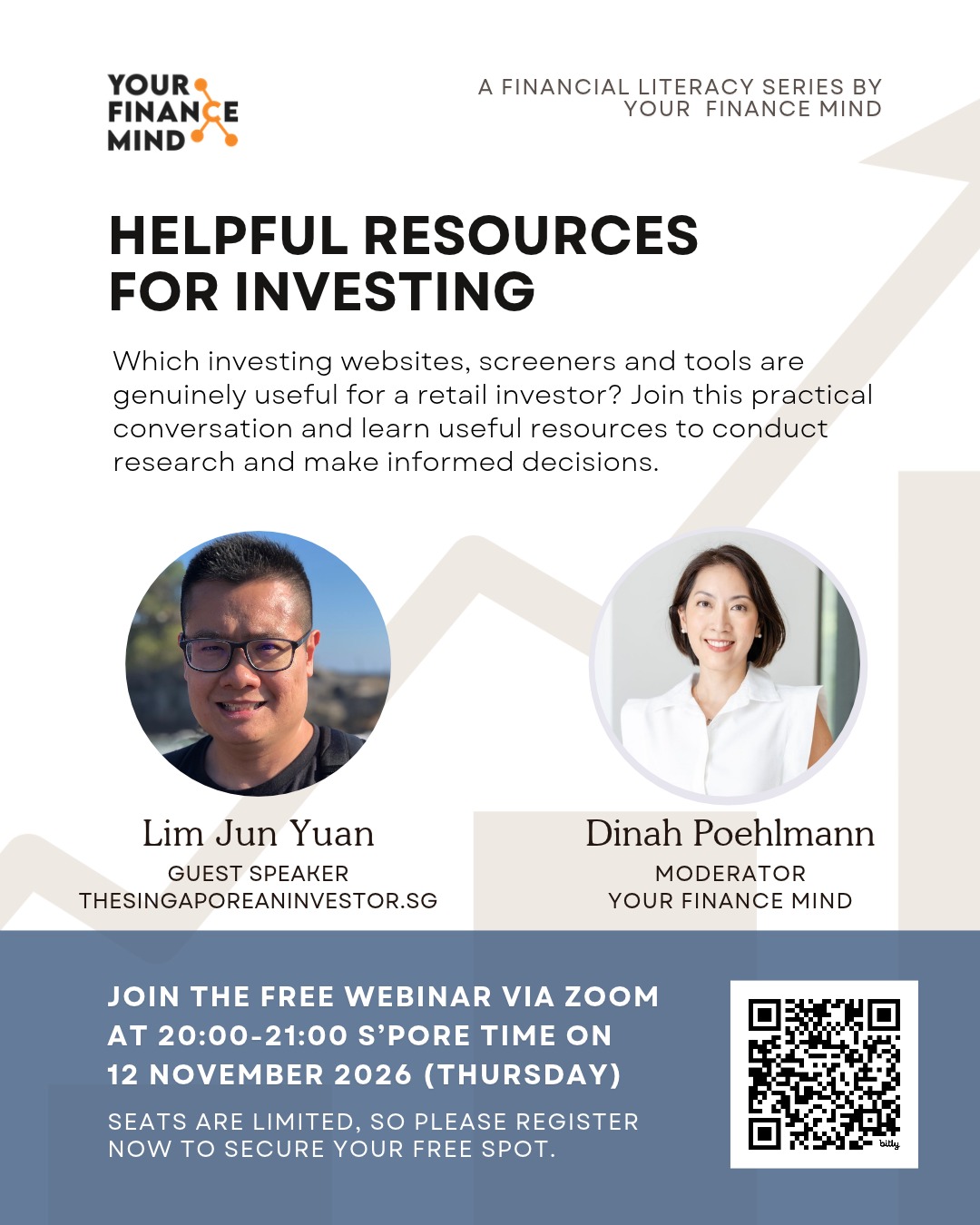
It's been quite some time since I last had a live chit-chat with the investing community, and I’m excited to be back for another session! A big thank you to my friend, Dinah Poehlmann from Your Finance Mind, for inviting me once again!
This time, we’re taking a little break from REITs and exploring some interesting topics surrounding investing, including my go-to investing resources, when is a stock considered 'investable', my thoughts about using AI for stock analysis and trading, and much more.
Whether you're just starting your investing journey or have been investing for years, I hope this session will offer some useful perspectives and practical takeaways that you can apply to your own investing journey.
Best of all, the session is completely FREE to attend! All you need to do is register in advance to receive the Zoom link:
👉 Click here to reserve your spot!
Are You Worried about Not Having Enough Money for Retirement?
You're not alone. According to the OCBC Financial Wellness Index, only 62% of people in their 20s and 56% of people in their 30s are confident that they will have enough money to retire.
But there is still time to take action. One way to ensure that you have a comfortable retirement is to invest in real estate investment trusts (REITs).
In 'Building Your REIT-irement Portfolio' which I've authored, you will learn everything you need to know to build a successful REIT investment portfolio, including a list of 9 things to look at to determine whether a REIT is worthy of your investment, 1 simple method to help you maximise your returns from your REIT investment, 4 signs of 'red flags' to look out for and what you can do as a shareholder, and more!

You can find out more about the book, and grab your copy (ebook or physical book) here...

Comments (2)