After trading hours yesterday (29 July), there was a news article on The Edge Singapore (you can read the article in full here) where the Monetary Authority of Singapore (or MAS for short) called on the local banks to cap their dividend payout to 60% of what was paid for FY2019. They also suggested for the banks to consider offering shareholders the option of receiving scrip instead of cash (for those of you who do not know what “scrip” is, it basically means instead of receiving your dividend payouts in cash, you receive your dividends in terms of shares of the company – thereby increasing your shareholdings.)
The reason for the guidance, according to MAS, is for prudence in light of the uncertainties ahead (especially when global economies are currently not showing any signs of recovery.) Also, in so doing, the banks will be in a better position to support the credit needs of businesses and individuals adversely affected by the Covid-19 pandemic.
Following the guidance, DBS Group Holdings (SGX:D05) later in the evening released an announcement stating that the cap restricted the bank’s cumulative dividends to 72 cents/share for the next four quarters starting from the second quarter of FY2020, or 18 cents/share per quarter. You can read the announcement in full here.
At the time of writing, the other 2 banks – namely UOB (SGX:U11) and OCBC (SGX:O39) have not released any official announcements.
While I am invested in all 3 Singapore banks (and fully intend to hold onto them for the long-term), I am interested in how their share prices may move in the short-term, in light of the news – which in my opinion is a negative one for the banks, and we may see some near-term volatility as far as their share price goes.
I’ve done a technical analysis of the 3 Singapore banks’ share price movements (based on a daily timeframe) and in my post today, I’d like to share my analysis with you (for educational purposes only – and that they are by no means any recommendation to buy or sell shares of the banks.)
Let’s begin…
DBS Group Holdings (SGX:D05)
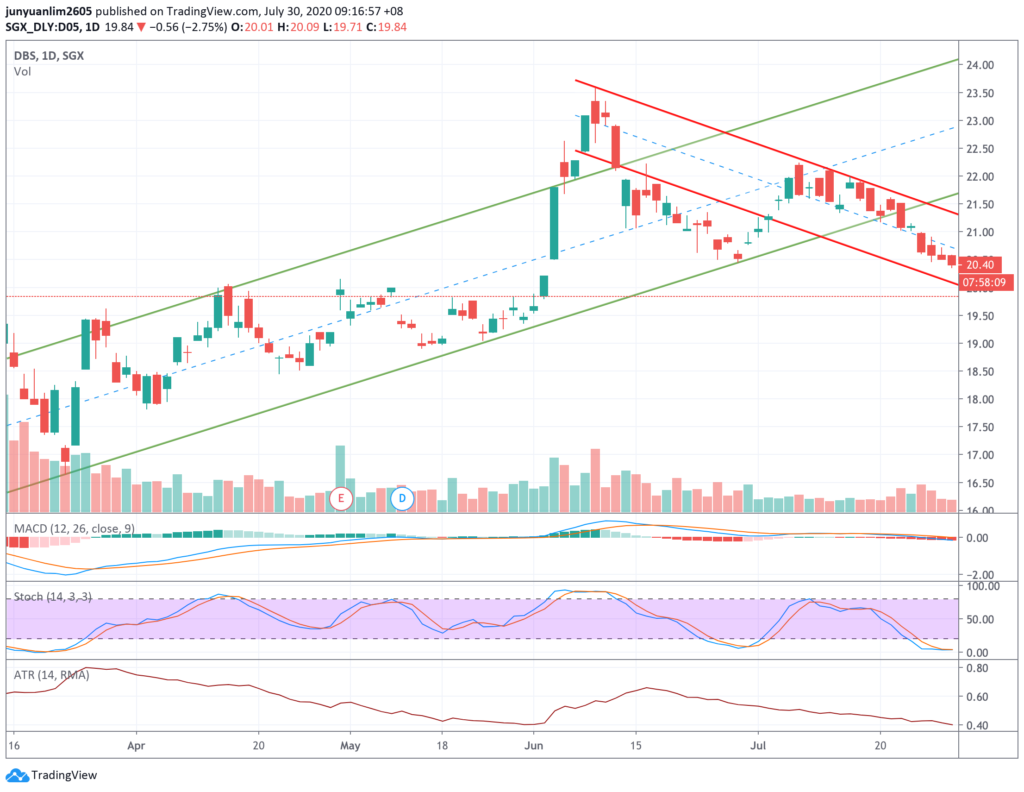
After bottoming around mid-March at S$16.65, its share price moved very nicely along the uptrend channel, where it even broke above the resistance and reached a high of S$23.58 in early-June.
Following that, the bank’s share went on a downward slide (look at how its share price have been moving down the red downtrend channel.) The share price of the bank closed at S$20.40 yesterday (29 July.)
Looking at the technical indicators MACD and stochastic, they are both in a downtrend position, indicating there’s a huge possibility of the bank’s share price weakening further in the near-term. Should the share price of the bank drop under the S$20.40 support line of the red downtrend channel, it could possibly tank further.
Personally, if I were to look to go “long” on the bank, I’ll wait for the share price to go back to the green uptrend channel at above S$22.00.
United Overseas Bank (SGX:U11)
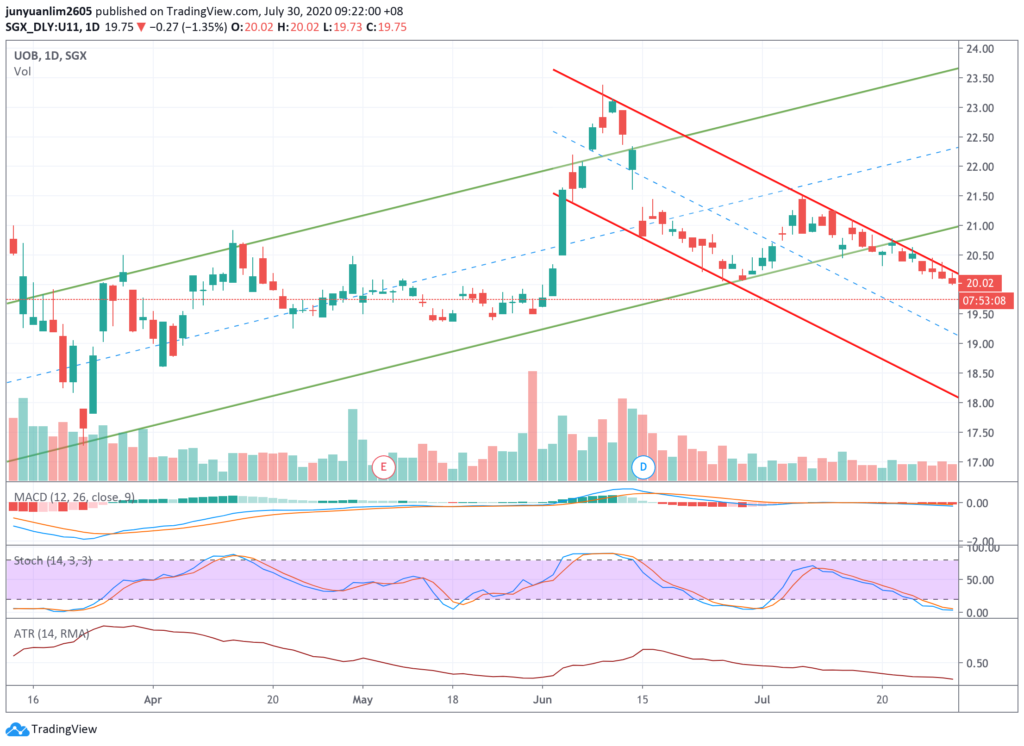
Can you see the similarity of UOB’s recent share price movements with DBS’?
Just like DBS, UOB’s share price saw the bottom around the middle of March at S$17.28. Subsequently, its share price started to recover and moved nicely along the green uptrend channel, where it even break above the resistance to peak at S$23.38 before reversing.
As at market close yesterday (29 July), the bank’s share price closed at S$20.02. Notice how after peaking in early-June, its share price have moved along the red downtrend channel, and of late, its share price have been moving along the resistance line of the channel.
Looking at the technical indicators MACD and stochastic, just like DBS, both are also in a downtrend position. As such, in the near-term, I am of the opinion that the bank’s share price is likely to weaken, where it could fall to around S$19.20 blue dotted line (where there is a support around that point.)
In case you’re wondering when will I go “long” on the bank, similar to DBS, I’ll wait for the share price of UOB to once again go back into the green uptrend line at above S$21.00.
Overseas-Chinese Banking Corporation (SGX:O39)
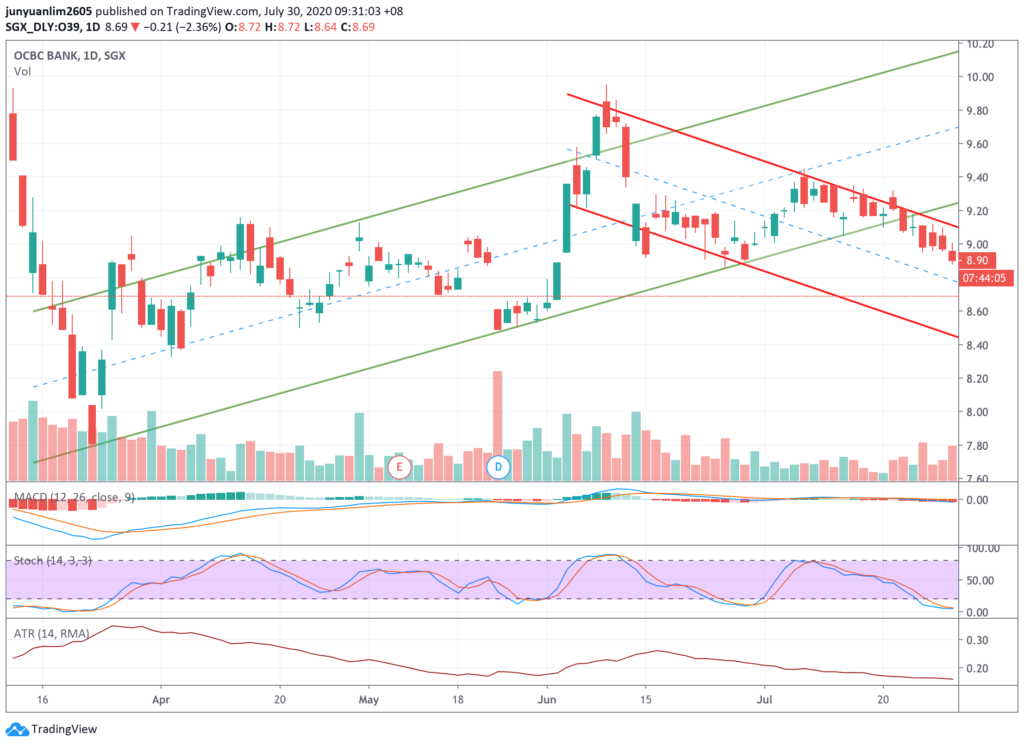
OCBC’s share price movements also resembles that of the other 2 Singapore banks – DBS and UOB, in that they have bottomed at around the same time period (at around mid-March), peaked at around the same time (around early-June), and started its downward slide since.
In OCBC’s case, it reached at S$7.80 in mid-March, a high of S$9.95 in early-June, and as at market close yesterday (29 July), its share price closed at S$8.90. Its share price also dropped out of the green uptrend channel, and hoovering somewhere near the resistance of the red downtrend channel.
Looking at the technical indicators MACD and stochastic, both are in a downtrend position, suggesting that in the near-term, the bank’s share price is also likely to see further weakening, where it could possibly move down to the blue dotted line (which is a support line) at around S$8.75.
At this juncture, I’d definitely not look at going “long” on the bank. If I were to do so, I’ll wait till the share price goes back up into the green uptrend line above S$9.25.
In Conclusion
Personally, the announcement by MAS came as a surprise to me, and as a shareholder, while I expected the dividends of UOB and OCBC to fall when the management gave a guidance that they will be paying out 50% of their earnings as dividends in FY2020 (during their respective AGMs), I was expecting the dividends of DBS to remain stable at 33 cents/share per quarter.
In my opinion, along with a weaker set of financial results (I will be providing a summary and my thoughts on their results when they are released), plus a relatively big drop in their dividend payouts, I foresee the share prices of all 3 Singapore banks to remain weak in the near-term.
That said, whatever you may find in this post is purely for educational purposes only. They do not serve as recommendations to buy or sell shares of the 3 banks. Please do your own due diligence before you make any trading/investing decisions.
Disclaimer: At the time of writing, I am a shareholder of DBS Group Holdings, United Overseas Bank Limited, and Overseas-Chinese Banking Corporation.
Join Me for a FREE Live Online Chit-Chat on Thursday, 12 November, from 8–9pm (SGT)!

It's been quite some time since I last had a live chit-chat with the investing community, and I’m excited to be back for another session! A big thank you to my friend, Dinah Poehlmann from Your Finance Mind, for inviting me once again!
This time, we’re taking a little break from REITs and exploring some interesting topics surrounding investing, including my go-to investing resources, when is a stock considered 'investable', my thoughts about using AI for stock analysis and trading, and much more.
Whether you're just starting your investing journey or have been investing for years, I hope this session will offer some useful perspectives and practical takeaways that you can apply to your own investing journey.
Best of all, the session is completely FREE to attend! All you need to do is register in advance to receive the Zoom link:
👉 Click here to reserve your spot!
Are You Worried about Not Having Enough Money for Retirement?
You're not alone. According to the OCBC Financial Wellness Index, only 62% of people in their 20s and 56% of people in their 30s are confident that they will have enough money to retire.
But there is still time to take action. One way to ensure that you have a comfortable retirement is to invest in real estate investment trusts (REITs).
In 'Building Your REIT-irement Portfolio' which I've authored, you will learn everything you need to know to build a successful REIT investment portfolio, including a list of 9 things to look at to determine whether a REIT is worthy of your investment, 1 simple method to help you maximise your returns from your REIT investment, 4 signs of 'red flags' to look out for and what you can do as a shareholder, and more!

You can find out more about the book, and grab your copy (ebook or physical book) here...


Comments (2)