1. What is the CGS Fullgoal Singapore Next 50 Active ETF?
When investors think about Singapore equities, the first companies that usually come to mind are the large blue-chip names that dominate the Straits Times Index (STI) – particularly the 3 local banks, DBS, OCBC and UOB.
However, beyond these well-established companies lies another segment of the market comprising businesses that may not yet have reached blue-chip status but could potentially become the next generation of Singapore-listed leaders.
This is where the CGS Fullgoal Singapore Next 50 Active ETF (SGX: Q50) comes in.
Listed on the Singapore Exchange in September 2026, the ETF aims to provide investors with exposure to Singapore-listed companies outside the largest blue-chip universe. Specifically, at least 80% of the ETF’s portfolio will be invested in constituents of the iEdge Singapore Next 50 Index, which represents the next tier of sizeable Singapore-listed companies beyond the STI.
The ETF is expected to hold between 30 and 50 companies in its portfolio.
In case you are wondering why this ETF is classified as an ‘Active ETF’, it is because it does not simply replicate the iEdge Singapore Next 50 Index by buying every constituent according to their respective index weightings.
Instead, the ETF uses a quantitative investment model to evaluate companies based on factors such as business quality, valuation, growth potential, share price momentum, along with risk characteristics.
Based on these factors, the fund may choose to allocate a higher weighting towards companies that the model identifies as having stronger potential, while reducing exposure to companies that appear less attractive.
In other words, while a passive ETF simply follows a predetermined list, an active ETF has the flexibility to make investment decisions in an attempt to generate better returns.
As for the name ‘CGS Fullgoal’, the ETF is managed by CGS International Securities Singapore Pte Ltd, with investment advisory support from Fullgoal Asset Management (HK) Limited.
2. What is the iEdge Singapore Next 50 Index?
The ETF is benchmarked against the iEdge Singapore Next 50 Index, which was launched by the Singapore Exchange in September 2025.
The objective of the index is to track the performance of the next 50 largest and most tradable companies listed on the SGX Mainboard, excluding the top 30 companies by market capitalisation (which are already represented in the STI).
Essentially, while the STI captures Singapore’s largest blue-chip companies, the iEdge Singapore Next 50 Index focuses on the companies immediately below this tier – providing investors with exposure to a broader group of established Singapore-listed businesses.
To qualify for inclusion in the index, companies must meet several requirements, including:
1. Minimum Market Capitalisation: Companies must have a market capitalisation of at least S$100 million. This ensures that the index focuses on relatively sizeable businesses rather than smaller speculative counters.
2. Minimum Trading Liquidity: Companies must have a minimum trading turnover of S$100,000. This helps ensure that constituents are sufficiently liquid and easier for investors to buy and sell.
3. Minimum Free Float Requirement: At least 15% of shares must be available for public trading. Generally, a higher free float is preferred as it means there are more shares available in the market for investors to trade.
The index is reviewed and rebalanced quarterly in March, June, September and December, allowing companies that grow into the eligible universe to be included, while companies that no longer meet the requirements may be removed.
3. What is the Sector Breakdown of the ETF?
At the time of writing, the official sector breakdown of the CGS Fullgoal Singapore Next 50 Active ETF was not available.
However, based on the composition of the iEdge Singapore Next 50 Index highlighted in CGS’ investor presentation, the Index has relatively meaningful exposure to the following sectors: Real Estate/REITs (at 39.4%), Consumer Staples (at 12.6%), and Technology (at 10.6%).
This sector composition differs significantly from the STI, which is heavily concentrated in the financial sector, particularly the 3 local banks.
Therefore, one of the key attractions of the CGS Fullgoal Singapore Next 50 Active ETF is that it provides investors with exposure to a wider range of Singapore-listed businesses beyond the banking sector.
However, investors should also note that the ETF has significant exposure towards real estate-related companies, which means factors affecting the property sector (such as interest rates and property market conditions) could have an impact on its performance.
4. What are the Top 10 Companies in the ETF?
Based on information from FSM Global (you can read the post in full here), as at 17 July 2026, the top 10 holdings accounted for approximately 62.18% of the ETF’s portfolio.
1. Keppel Infrastructure Trust (SGX: A7RU) (9.15% Weightage): Owns essential infrastructure assets such as power generation, renewable energy, waste management, water treatment and gas networks that provide recurring income.
2. iFast Corporation (SGX: AIY) (8.64% Weightage): Operates a digital wealth management platform that allows investors, advisers and institutions to access investment products such as funds, bonds and equities.
3. Keppel REIT (SGX: K71U) (8.11% Weightage): Owns premium office properties located mainly in Singapore, Australia, South Korea and Japan.
4. Parkway Life REIT (SGX: C2PU) (7.19% Weightage): Invests in healthcare properties such as hospitals, nursing homes and medical facilities across Singapore, Japan and France.
5. Sheng Siong Group Ltd (SGX: OV8) (6.09% Weightage): Operates one of Singapore’s largest supermarket chains, selling groceries, fresh produce and household necessities.
6. Keppel Ltd (SGX: BN4) (5.65% Weightage): Invests in and operates businesses across infrastructure, real estate and connectivity, including energy solutions and digital infrastructure such as data centres.
7. CapitaLand Ascott Trust (SGX: HMN) (5.07% Weightage): Owns hospitality-related properties such as serviced residences, hotels, rental housing and student accommodation globally.
8. Starhill Global REIT (SGX: P40U) (4.27% Weightage): Owns retail and office properties across Singapore and other Asia-Pacific markets.
9. DBS Group Holdings Limited (SGX: D05) (4.01% Weightage): Singapore’s largest bank providing banking, lending, wealth management and corporate financing services.
10. CapitaLand India Trust (SGX: CY6U) (4.00% Weightage): Owns commercial and technology-related properties in India, including IT parks, logistics facilities and data centres.
Among these 10 companies, only DBS Group Holdings and Keppel Ltd are also constituents of the Straits Times Index.
The remaining 8 companies are part of the iEdge Singapore Next 50 Index.
5. What is the Dividend Payout Frequency of the ETF?
As an investor in the ETF, unitholders can expect dividend distributions on a semi-annual basis, typically around June and December.
However, at the time of writing this article in October 2026, no dividend distribution information was available as the ETF was only listed in September 2026 and no payout has been declared yet.
Therefore, investors should note that the ETF does not have any historical dividend track record at this point.
6. What are Some of the Key Risks Associated with Investing in the ETF?
While the CGS Fullgoal Singapore Next 50 Active ETF provides an interesting opportunity for investors seeking exposure beyond the STI, there are several risks worth considering.
1. Active Management Risk: Unlike a traditional passive ETF, the performance of the ETF depends on whether its quantitative investment strategy can successfully identify companies with stronger long-term potential. There is no guarantee that the model will outperform the broader index.
2. Limited Track Record: The ETF was only listed on the Singapore Exchange in September 2026. As a result, investors have limited information regarding its long-term unit price performance, performance during different market cycles, and consistency of its investment strategy.
3. Dividend Growth Uncertainty: Although the ETF intends to distribute dividends semi-annually, there is currently no historical dividend record. Therefore, investors have limited visibility on dividend yield, dividend stability, and long-term dividend growth potential.
4. Liquidity Risk: As a newly launched ETF, another uncertainty is whether it can attract sufficient investor interest over the longer term. If trading volume remains low, investors may experience wider bid-ask spreads, which could negatively affect investment returns.
5. Significant Exposure to Real Estate: Based on the ETF’s holdings, REITs and real estate-related companies form a significant portion of the portfolio. As a result, factors affecting the property sector, such as rising interest rates, higher borrowing costs, and weakening property demand, could impact the ETF’s performance.
7. What are the Fees Associated with the ETF?
The ETF charges a management fee of 0.65% per annum, with total expenses capped at 1.50%.
This is higher compared with many passive ETFs due to the additional cost associated with active management.
Closing Thoughts
For investors looking to diversify beyond the STI, particularly given the STI’s heavy concentration in the 3 local banks, the CGS Fullgoal Singapore Next 50 Active ETF is certainly an interesting ETF worth watching.
By investing in companies outside the traditional blue-chip universe, the ETF provides exposure to a wider range of businesses, including REITs, technology companies, consumer businesses and infrastructure-related companies.
However, investors should also recognise that this ETF is still relatively new, having only been listed in September 2026. Therefore, important information such as its long-term performance track record, dividend growth potential and ability to maintain sufficient trading liquidity remains unknown.
Furthermore, as an actively managed ETF, its success ultimately depends on whether its quantitative investment strategy can consistently identify companies that outperform the broader market.
Personally, while the CGS Fullgoal Singapore Next 50 Active ETF is an ETF that I find interesting due to its exposure to Singapore’s next generation of companies, I would prefer to wait for more historical data – particularly regarding its price performance, dividend track record and trading liquidity – before making any investment decision.
Disclaimer: At the time of writing, I do not have any units of the CGS Fullgoal Singapore Next 50 Active ETF.
Stop Spending Hours Reading REIT Reports Every Quarter!
What if you could assess a REIT's portfolio occupancy, debt profile, valuation, and overall health in less than 30 seconds - without having to comb through a single quarterly report?
That's the problem the REIT Screener was built to solve.
Developed through a collaboration between ShareInvestor and The Singaporean Investor, the REIT Screener consolidates many of the key metrics and indicators I personally use when analysing REITs into one easy-to-use platform. Instead of spending hours extracting data manually every earnings season, you can now monitor the REITs you own and research new opportunities in just a few clicks.
If you're serious about REIT investing but don't have the time to manually track quarterly developments, the REIT Screener could be the shortcut you've been looking for:
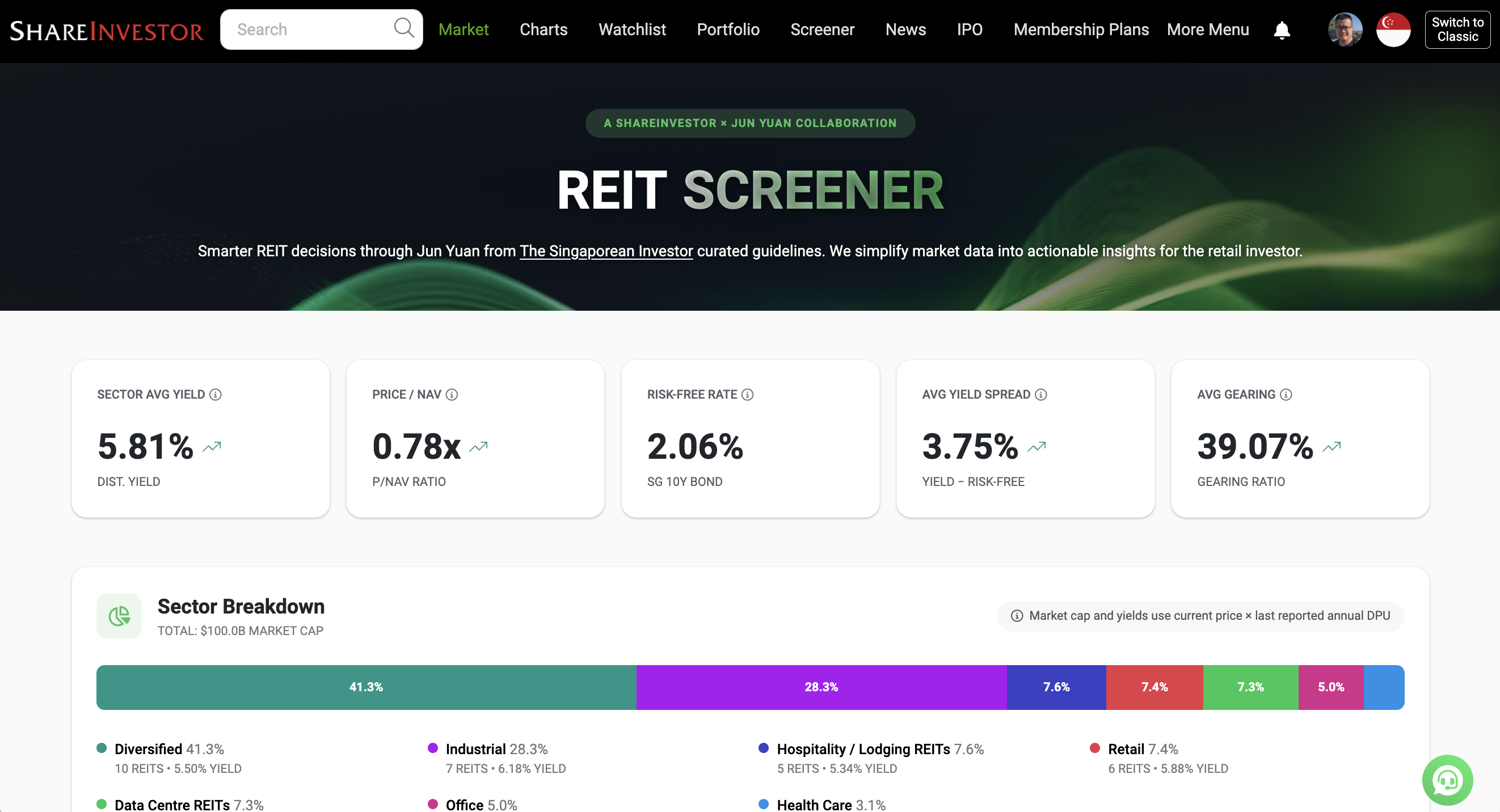
Take a closer look at the REIT Screener here...



Comments (0)