1. Brief Introduction:
Launched in November 2006, the Vanguard High Dividend Yield ETF (NYSE ARCA: VYM) is a passively managed exchange-traded fund that seeks to track the performance of the FTSE High Dividend Yield Index.
With assets under management exceeding US$80 billion, the ETF is one of the largest dividend-focused ETFs available to investors today. It provides exposure to a diversified portfolio of large-cap US companies that have above-average forecast dividend yields, allowing investors to gain access to hundreds of established dividend-paying businesses through a single investment.
2. How are Stocks Selected for the ETF:
The Vanguard High Dividend Yield ETF tracks the FTSE High Dividend Yield Index. To construct the index, it begins with a broad universe of US stocks, primarily large- and mid-cap companies within the FTSE USA Index.
Real Estate Investment Trusts (REITs) are excluded from the selection process. The reason is because as REITs are required to distribute a significant portion of their earnings to shareholders, they tend to have relatively high dividend yields. Hence, including them could result in the ETF being overexposed the real estate sector.
From the remaining companies, only those that have paid dividends over the previous 12 months and are expected to continue paying dividends over the next 12 months are eligible for inclusion. These companies are then ranked according to their forecast dividend yields.
Unlike some dividend-focused ETFs that assign larger weightings to stocks with the highest yields, the Vanguard High Dividend Yield ETF weights its holdings according to their float-adjusted market capitalisation. As a result, larger companies receive larger weightings, while smaller companies receive smaller allocations.
This methodology naturally favours established businesses with strong market positions, proven profitability, and long track records of paying dividends. It also reduces the risk of the ETF becoming overly concentrated in smaller companies offering unusually high yields, which may sometimes be the result of financial distress or unsustainable dividend policies.
3. Sector Allocation:
As at 31 May 2026, the Vanguard High Dividend Yield ETF held 605 stocks across a wide range of industries:
- Financials (19.6%)
- Technology (16.9%)
- Industrials (13.9%)
- Health Care (11.7%)
- Energy (9.0%)
- Consumer Staples (8.0%)
- Consumer Discretionary (7.8%)
- Utilities (5.7%)
- Telecommunications (4.3%)
- Basic Materials (3.1%)
At first glance, the ETF appears well-diversified, with no single sector accounting for an excessively large proportion of the portfolio. This contrasts with the Vanguard S&P 500 ETF, where the Technology sector alone represents more than one-third of the index.
However, investors should note that the Financials, Technology, Industrials, and Health Care sectors collectively account for 62.1% of the ETF’s total portfolio. As a result, developments affecting these sectors could have a meaningful impact on the ETF’s overall performance.
The sector composition also highlights an important characteristic of the ETF. While the Vanguard High Dividend Yield ETF is often viewed as a dividend-focused investment, it still maintains meaningful exposure to sectors such as Technology and Industrials, allowing investors to participate in broader economic growth while receiving regular dividend income.
4. Top 10 Holdings:
One of the strengths of the Vanguard High Dividend Yield ETF is that its largest holdings are spread across multiple sectors rather than being concentrated in a single industry. As at 31 May 2026, the ETF’s top 10 holdings collectively accounted for approximately 26.1% of the portfolio, with the remaining 73.9% distributed across another 595 companies.
This level of diversification means that the ETF is not overly dependent on the performance of any single company. Even though Broadcom is the largest holding, it accounts for only 8.5% of the portfolio, while all other holdings individually represent less than 4% of the ETF’s assets.
The top 10 holdings are also diversified across the Information Technology (3), Health Care (3), Energy (2), Financials (1), and Industrials (1) sectors, providing investors with exposure to a broad range of industries and economic activities.
The following are the ETF’s 10 largest holdings and an overview of their businesses:
i. Broadcom Inc. (NASDAQ: AVGO) – Information Technology – 8.5%
Broadcom is the ETF’s largest holding and one of the world’s leading semiconductor and infrastructure software companies. Its products are used in data centres, cloud computing platforms, broadband networks, wireless communications, and enterprise software applications.
The company has been a major beneficiary of the rapid growth in artificial intelligence, as many of its networking and connectivity solutions are critical components within AI-focused data centres. Its strong profitability and growing dividend payments have made it a popular holding with investors.
ii. JPMorgan Chase & Co. (NYSE: JPM) – Financials – 3.1%
JPMorgan Chase is the largest bank in the US by assets and one of the world’s most diversified financial institutions.
Its operations span consumer banking, credit cards, mortgages, commercial lending, investment banking, wealth management, and asset management services. The company’s scale, diversified revenue streams, and strong market position have enabled it to remain a consistent dividend payer through multiple economic cycles.
iii. Exxon Mobil Corporation (NYSE: XOM) – Energy – 2.5%
Exxon Mobil is one of the world’s largest integrated energy companies. Its operations cover the entire energy value chain, including oil and natural gas exploration, production, transportation, refining, and marketing.
The company generates substantial cash flows during periods of elevated energy prices, allowing it to return significant amounts of capital to shareholders through dividends and share buybacks. Exxon Mobil has also maintained a long track record of dividend payments, making it a common holding in dividend-focused portfolios.
iv. Johnson & Johnson (NYSE: JNJ) – Health Care – 2.2%
Johnson & Johnson is a global healthcare company specialising in pharmaceutical products and medical technologies.
Its pharmaceutical division develops treatments for areas such as oncology, immunology, cardiovascular disease, and neuroscience, while its medical technology business provides products used in surgery, orthopaedics, vision care, and other healthcare applications. The company is widely regarded as a defensive business due to the relatively stable demand for healthcare products and services.
v. Cisco Systems, Inc. (NASDAQ: CSCO) – Information Technology – 2.0%
Cisco Systems is a leading provider of networking equipment, cybersecurity solutions, and enterprise software.
Its products help businesses, governments, and organisations connect their computers, devices, and applications securely through both public and private networks. Given the increasing importance of digital infrastructure and cybersecurity, Cisco continues to play an important role in supporting global internet and enterprise connectivity.
vi. Caterpillar Inc. (NYSE: CAT) – Industrials – 1.7%
Caterpillar is one of the world’s largest manufacturers of heavy machinery and equipment used in construction, mining, energy, transportation, and infrastructure projects.
Its products include excavators, bulldozers, wheel loaders, mining trucks, diesel engines, and power systems. Because demand for its equipment is often linked to economic growth and infrastructure spending, Caterpillar is frequently viewed as a bellwether for global industrial activity.
vii. AbbVie Inc. (NYSE: ABBV) – Health Care – 1.6%
AbbVie is a global biopharmaceutical company focused on developing medicines for autoimmune diseases, cancer, neurological disorders, eye care, and aesthetics.
The company is best known for blockbuster drugs used to treat chronic conditions, as well as products within its aesthetics business acquired through its purchase of Allergan. Strong cash generation and a commitment to returning capital to shareholders have helped AbbVie become a popular dividend stock.
viii. Oracle Corporation (NYSE: ORCL) – Information Technology – 1.6%
Oracle is a leading provider of database software, enterprise applications, and cloud computing services.
Many large organisations rely on Oracle’s software to store, manage, analyse, and secure critical business data. In recent years, the company has expanded aggressively into cloud infrastructure and artificial intelligence-related services, creating new growth opportunities while continuing to generate substantial recurring revenue from its existing customer base.
ix. UnitedHealth Group Incorporated (NYSE: UNH) – Health Care – 1.4%
UnitedHealth Group is one of the largest healthcare companies in the US, serving millions of customers through its health insurance and healthcare services businesses.
In addition to providing health insurance coverage, the company operates clinics, pharmacies, healthcare technology platforms, and medical service networks through its Optum division. This diversified business model allows it to participate in multiple segments of the healthcare ecosystem.
x. Chevron Corporation (NYSE: CVX) – Energy – 1.4%
Chevron is one of the world’s largest integrated energy companies, with operations spanning oil and natural gas exploration, production, refining, transportation, and marketing.
The company supplies fuel, lubricants, petrochemical products, and other energy-related products to customers around the world. Like Exxon Mobil, Chevron is known for its strong balance sheet, disciplined capital allocation, and long history of returning cash to shareholders through dividends.
5. Dividend Payout to Unit Holders:
Investors in the Vanguard High Dividend Yield ETF receive dividend distributions on a quarterly basis, typically in the middle of March, June, September, and December:
The following is the dividend payout of the ETF to unit holders over the past 5 years (between 2021 and 2025):
| Financial Year | Dividend Per Unit (US$) | Dividend Yield |
|---|---|---|
| 2021 | US$3.0961 | 2.8% |
| 2022 | US$3.2518 | 3.0% |
| 2023 | US$3.4780 | 3.1% |
| 2024 | US$3.4945 | 2.7% |
| 2025 | US$3.5008 | 2.4% |
Over the past 5 years, the ETF’s annual dividend payout per unit increased from US$3.0961 in 2021 to US$3.5008 in 2025. This represents a compound annual growth rate (CAGR) of approximately 2.5%, reflecting the underlying growth in dividends paid by the companies held within the portfolio.
While dividend growth has been relatively steady, the ETF’s dividend yield has ranged between 2.4% and 3.1% over the same period. This may come as a surprise to some investors, given the ETF’s name. However, because the portfolio is weighted by market capitalisation rather than dividend yield, many large companies with moderate dividend yields receive significant weightings within the fund.
For Singapore-based investors, it is also important to consider the impact of the 30% U.S. withholding tax on dividends. As the tax is deducted before distributions are received, the effective dividend yield will be lower than the headline figures shown above.
6. Fees & Expenses:
One of the biggest attractions of the Vanguard High Dividend Yield ETF is its exceptionally low cost structure.
The ETF has an expense ratio of just 0.04% per annum, meaning that an investor with US$10,000 invested would incur only about US$4 in annual management fees.
This makes the Vanguard High Dividend Yield ETF one of the lowest-cost dividend-focused ETFs available in the market today. Over the long term, keeping investment costs low can have a meaningful impact on overall returns, particularly when compounded over many years.
7. Unit Price Performance:
The following is the unit price performance of the Vanguard High Dividend Yield ETF on a monthly timeframe since January 2021:
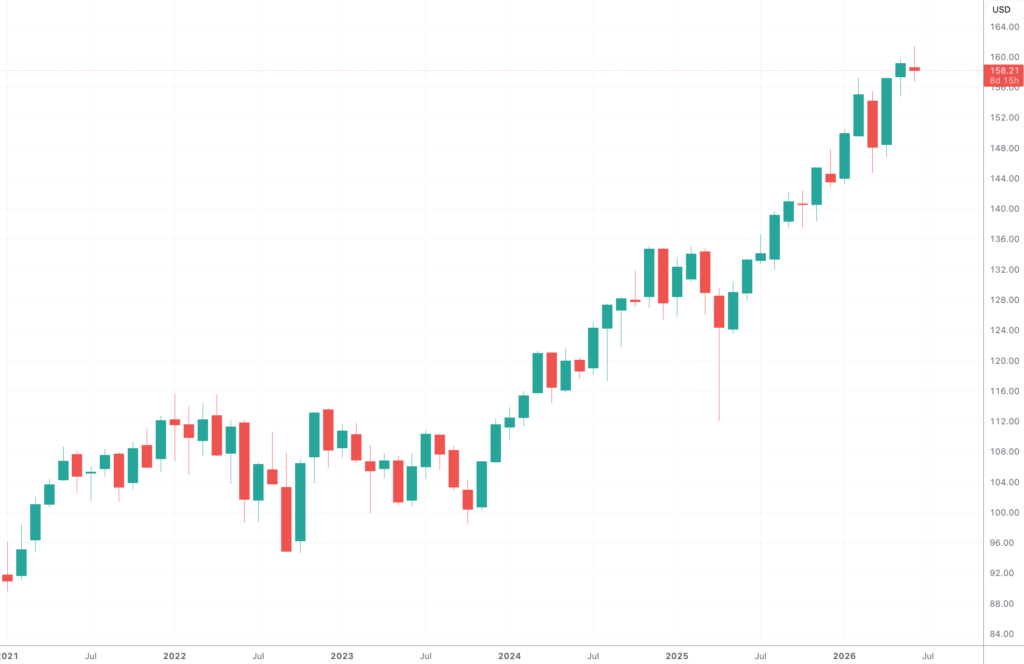
From January 2021 to December 2025, the Vanguard High Dividend Yield ETF delivered strong capital appreciation for investors.
An investor who purchased units at the ETF’s opening price of US$91.79 on the first trading day of 2021 and remained invested through to the end of 2025, when the ETF closed at US$143.52, would have achieved an unrealised capital gain of approximately 56.4%. This translates to a CAGR of around 9.4%.
When dividends received over the same period are included, the total return increases to approximately 74.7%, highlighting the contribution that dividend reinvestment can make towards long-term wealth accumulation.
While these returns are impressive in absolute terms, they lagged the performance of the Vanguard S&P 500 ETF over the same period (which was at 81.8% excluding dividends). This is largely due to the strong performance of mega-cap technology companies, which represent a much larger portion of the S&P 500 Index than they do within the Vanguard High Dividend Yield ETF.
However, this difference also illustrates one of the trade-offs investors face. While broader market ETFs may deliver stronger returns during periods when growth stocks dominate market performance, dividend-focused ETFs such as the Vanguard High Dividend ETF may offer a more balanced exposure across sectors and potentially lower volatility during market downturns.
For this reason, investors should evaluate Vanguard High Dividend ETF not only on the basis of absolute returns, but also on the role it plays within a diversified investment portfolio.
8. Possible Risks:
While the Vanguard High Dividend Yield ETF provides investors with exposure to a diversified portfolio of established dividend-paying companies, it is important to understand that the ETF is not risk-free. Like any equity investment, its unit price and dividend payouts can fluctuate depending on market and economic conditions.
The following are some of the key risks investors should take into consideration before investing:
i. Market Risk:
As an equity ETF, the Vanguard High Dividend Yield ETF is exposed to fluctuations in the broader stock market. During periods of economic uncertainty, recessions, geopolitical tensions, or market corrections, the prices of the underlying companies held within the ETF may decline, resulting in a fall in the ETF’s unit price.
While dividend-paying companies are often viewed as being more stable than high-growth companies, they are not immune to market downturns. Investors should therefore be prepared for periods where the value of their investment may decline significantly in the short term.
ii. Dividend Cuts & Reductions:
Although the ETF focuses on companies that pay dividends, dividend payments are never guaranteed.
Companies may reduce, suspend, or completely eliminate their dividends if they encounter financial difficulties, experience declining profits, or decide to preserve cash during challenging economic conditions. If multiple companies within the portfolio were to reduce their dividends simultaneously, the ETF’s overall dividend distribution could also decline.
Investors who rely heavily on dividend income should therefore understand that the income generated by the ETF can fluctuate over time.
iii. Underperformance During Growth-Led Markets:
The companies held within the Vanguard High Dividend Yield ETF are generally mature businesses that generate stable cash flows and pay regular dividends. While this can provide investors with a degree of stability, it may also cause the ETF to underperform during periods when growth stocks are driving market returns.
This was evident between 2021 and 2025, where the Vanguard S&P 500 ETF outperformed the Vanguard High Dividend Yield ETF, largely due to the strong performance of mega-cap technology companies benefiting from developments in artificial intelligence, cloud computing, and digital transformation.
As a result, investors seeking maximum capital appreciation may find Vanguard High Dividend Yield ETF lagging behind broader market indices during certain market cycles.
iv. Sector Concentration Risk:
Although the ETF holds more than 600 companies, its exposure is not evenly distributed across all sectors.
As discussed earlier, the Financials, Technology, Industrials, and Health Care sectors collectively account for 62.1% of the portfolio. Consequently, events affecting any of these sectors could have a disproportionate impact on the ETF’s performance.
For example, a banking crisis could negatively affect financial institutions, while regulatory changes could impact healthcare companies. Similarly, a slowdown in business spending could affect industrial and technology companies.
While the ETF remains diversified at the company level, investors should still be aware of its concentration towards these sectors.
v. Interest Rate Risk:
Dividend-paying stocks often become more attractive when interest rates are low because investors may struggle to find alternative sources of income.
However, when interest rates rise, bonds and other fixed-income investments may offer more competitive yields. This can lead some investors to shift their capital away from dividend-paying stocks and into fixed-income assets, placing downward pressure on the share prices of dividend-focused investments such as the Vanguard High Dividend Yield ETF.
In addition, higher interest rates can increase borrowing costs for companies, which may affect their profitability and future dividend growth.
vi. Methodology Limitations:
The ETF’s stock selection methodology is intentionally simple and rules-based.
While this helps keep costs low and ensures transparency, it also means that the ETF does not explicitly screen companies based on factors such as dividend sustainability, payout ratios, cash flow coverage, debt levels, or balance sheet strength.
As a result, companies can qualify for inclusion as long as they meet the index’s dividend-related criteria, even if there are concerns about the long-term sustainability of their dividend payments.
Investors who place significant emphasis on dividend quality may therefore prefer ETFs that incorporate additional screening criteria relating to financial strength and dividend growth.
Closing Thoughts:
The Vanguard High Dividend Yield ETF offers investors a simple and low-cost way to gain exposure to a diversified portfolio of established dividend-paying US companies. One of its key strengths lies in its diversification, with over 600 holdings spread across multiple sectors and no single company dominating the portfolio.
Historically, the ETF has delivered respectable returns. Investors who purchased units at the beginning of 2021 and remained invested through the end of 2025 would have enjoyed a capital gain of approximately 56.4%, or a total return of 74.7% after including dividends. While these returns lagged those of the Vanguard S&P 500 ETF over the same period, they were achieved with less dependence on a small group of mega-cap technology stocks.
That said, investors should be aware that the ETF remains meaningfully exposed to the Financials, Technology, Industrials, and Health Care sectors, which collectively account for more than 60% of the portfolio. Any prolonged weakness in these sectors could negatively affect the ETF’s performance.
From an income perspective, the ETF’s dividend yield has ranged between 2.4% and 3.1% over the past 5 years. While the dividend payouts have grown steadily over time, the yield may not be particularly attractive to Singapore-based income investors, especially after taking into account the 30% U.S. dividend withholding tax. Investors whose primary objective is to maximise income may therefore find higher-yielding alternatives elsewhere, such as Singapore-listed REITs.
In my view, the Vanguard High Dividend Yield ETF is best suited for investors seeking a balance between capital appreciation and dividend income, rather than investors who are purely chasing yield. Despite being marketed as a ‘High Dividend Yield’ ETF, its long-term appeal lies more in its exposure to financially established companies and its potential for steady wealth accumulation over time than in the level of income it generates.
Disclaimer: At the time of writing, I do not have units of the Vanguard High Dividend Yield ETF.
Stop Spending Hours Reading REIT Reports Every Quarter!
What if you could assess a REIT's portfolio occupancy, debt profile, valuation, and overall health in less than 30 seconds - without having to comb through a single quarterly report?
That's the problem the REIT Screener was built to solve.
Developed through a collaboration between ShareInvestor and The Singaporean Investor, the REIT Screener consolidates many of the key metrics and indicators I personally use when analysing REITs into one easy-to-use platform. Instead of spending hours extracting data manually every earnings season, you can now monitor the REITs you own and research new opportunities in just a few clicks.
If you're serious about REIT investing but don't have the time to manually track quarterly developments, the REIT Screener could be the shortcut you've been looking for:
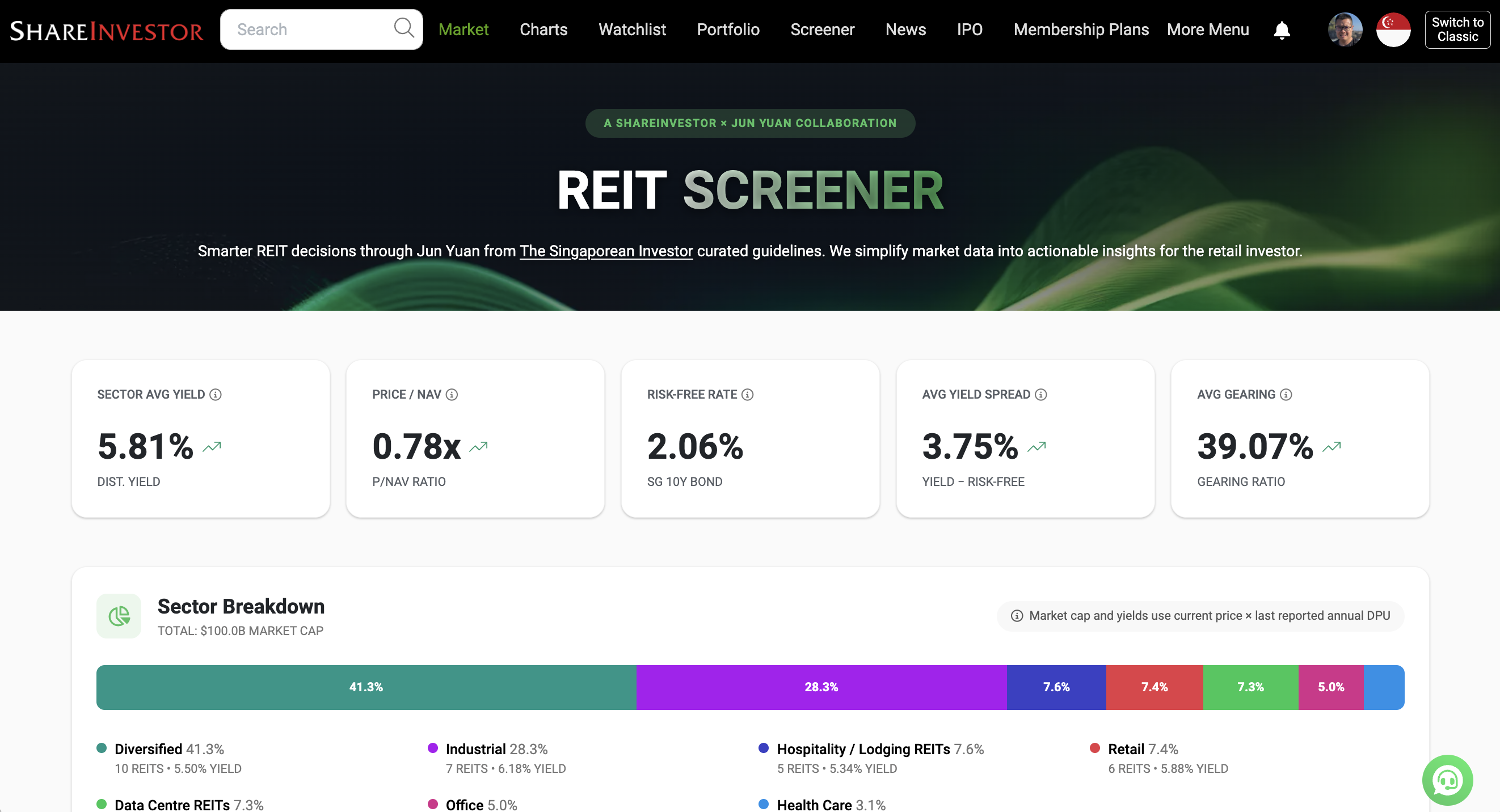
Take a closer look at the REIT Screener here...



Comments (0)