Investing is often perceived as a numbers game.
We analyse a company’s historical financial performance, review its latest quarterly earnings, study its valuation metrics, and consider broader market trends before making an investment decision.
Yet, despite having access to more information and tools than ever before, many investors still make poor investment decisions.
Why is this the case?
The answer lies in the fact that investing is not only about numbers. It is also about human behaviour.
Our emotions, biases, and psychological tendencies can significantly influence the way we make financial decisions, often without us even realising it.
Understanding these psychological traps is therefore an important part of becoming a better investor.
In this post, let us explore some of the most common mental biases investors face, and how we can overcome them.
The Fear of Losing Money
One of the strongest emotions investors experience is fear.
This is especially evident during periods of market volatility, when share prices decline sharply and negative news dominates headlines.
During such periods, many investors feel the urge to sell their investments in an attempt to avoid further losses.
However, this emotional reaction can often work against them.
History has shown us that market downturns are a normal part of investing. Throughout the years, markets have experienced numerous corrections (when share prices fall by 10% from their most recent highs) and bear markets (when share prices decline by 20% or more from their most recent highs). However, these periods of decline have also been followed by recoveries, with markets eventually rebounding and reaching new highs over the long term.
Selling in panic during a market downturn can turn a temporary decline into a permanent loss, causing investors to miss out on the eventual recovery.
The key is to recognise that market volatility is a natural part of investing, rather than something that should be completely avoided.
The Danger of Following the Crowd
Humans naturally seek guidance from others, especially when faced with uncertainty.
Often, we gravitate towards people who share similar opinions and viewpoints, as this provides a sense of reassurance and confidence.
This behaviour is commonly known as ‘herd mentality’.
In investing, herd mentality can lead investors to buy assets simply because everyone else is buying them.
During periods of strong market performance, investors may feel pressured to participate in the excitement, fearing that they will miss out on potential opportunities.
However, buying purely based on popularity can result in paying excessive prices for investments that may not justify their valuations.
In my humble opinion, every investment has a fair value. A great company can still be a poor investment if purchased at an overly expensive price.
Similarly, during market downturns, herd mentality can cause investors to rush for the exit simply because others are selling.
Successful investing requires the ability to think independently and make decisions based on fundamentals rather than emotions or market sentiment.
Overconfidence and the Illusion of Control
Another common psychological trap among investors is overconfidence.
Many investors tend to overestimate their ability to predict market movements, identify future winners, or successfully time their entry and exit points.
After experiencing a few successful investments, it is easy to attribute these results entirely to skill.
However, investment outcomes are influenced by many factors, including broader market conditions, economic cycles, and sometimes even an element of luck.
Overconfidence can encourage investors to take unnecessary risks, trade excessively, or concentrate too much of their portfolio into a small number of investments.
A disciplined investment approach recognises that no investor can consistently predict the future with certainty.
Rather than trying to outsmart the market, investors should focus on building a robust investment process that can withstand different market conditions.
Anchoring to Past Prices
Anchoring occurs when investors place too much importance on a specific piece of information, often a previous price level.
For example, an investor may continue holding onto a stock that has declined significantly because they are waiting for it to recover back to their original purchase price.
The investor may feel that selling would mean admitting a loss on their initial investment.
However, the price an investor paid in the past does not determine the future value of an investment.
More importantly, there is no guarantee that a stock will eventually return to the price at which it was originally purchased.
Instead of focusing on the past purchase price, investors should ask themselves:
“Would I still buy this investment today at its current price?”
If the answer is ‘no’, then holding onto the investment purely because of the original purchase price may not be a rational decision.
In such situations, investors may be better off reallocating their capital into investments with stronger future potential.
The Desire for Quick Results
Investing is sometimes portrayed as a way to achieve quick wealth.
Stories of investors making significant gains from a single stock can create unrealistic expectations and encourage others to chase short-term returns.
However, successful investing is usually built through patience, discipline, and allowing time for investments to compound.
As the popular saying goes, ‘time is an investor’s best friend’.
Many of the world’s most successful investors have repeatedly highlighted the importance of maintaining a long-term perspective.
The challenge is that patience is often difficult because progress can appear slow, especially when compared against the excitement of short-term market movements.
However, wealth creation through investing is typically a marathon, not a short sprint.
How Investors Can Overcome These Mental Traps
The first step towards overcoming psychological biases is awareness.
Investors need to recognise that emotions are a natural part of investing. The goal is not to completely eliminate emotions, but to ensure that emotions do not control investment decisions.
Having a clear investment plan can help investors stay disciplined.
This includes understanding your investment objectives, determining an appropriate asset allocation, and knowing the reasons behind each investment decision.
Investors should also focus on the investment process rather than the outcome.
A good investment decision can sometimes result in a poor outcome, while a poor investment decision can occasionally produce good results due to favourable circumstances.
However, by focusing on a disciplined and repeatable process, investors can improve their chances of making better decisions over the long term.
Closing Thoughts
Investing is not only a test of financial knowledge.
It is also a test of behaviour and discipline, and in many cases, these qualities can play an even greater role in determining investment success.
Many investment mistakes are not caused by a lack of information, but by psychological biases that affect how we interpret information and make decisions.
Fear can cause investors to sell at the wrong time.
Herd mentality can push investors to buy when prices are already high.
Overconfidence can lead to unnecessary risks.
Anchoring can prevent investors from making rational decisions about their investments.
The best investors understand that managing their own behaviour is just as important as analysing companies or studying markets.
Rather than attempting to predict every market movement, investors should focus on developing good investing habits, staying disciplined, and maintaining a long-term perspective.
Ultimately, becoming a successful investor does not mean avoiding every mistake.
Instead, it means recognising these psychological traps, learning from them, and continuously improving the investment decision-making process.
For investors looking to build long-term wealth, here’s what you can do: create a clear investment plan, invest consistently, and avoid allowing emotions to dictate your financial decisions.
Join Me for a FREE Live Online Chit-Chat on Thursday, 12 November, from 8–9pm (SGT)!
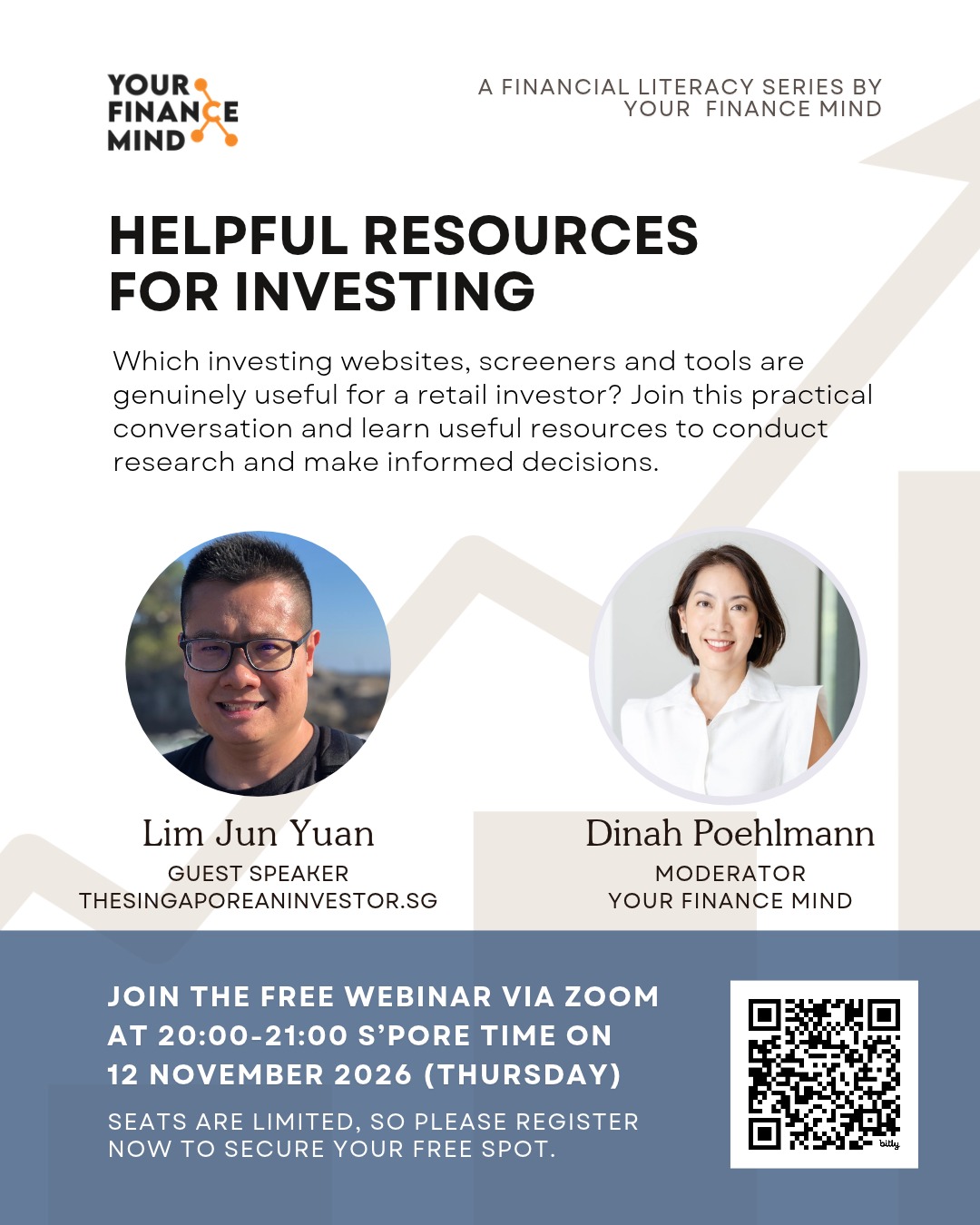
It's been quite some time since I last had a live chit-chat with the investing community, and I’m excited to be back for another session! A big thank you to my friend, Dinah Poehlmann from Your Finance Mind, for inviting me once again!
This time, we’re taking a little break from REITs and exploring some interesting topics surrounding investing, including my go-to investing resources, when is a stock considered 'investable', my thoughts about using AI for stock analysis and trading, and much more.
Whether you're just starting your investing journey or have been investing for years, I hope this session will offer some useful perspectives and practical takeaways that you can apply to your own investing journey.
Best of all, the session is completely FREE to attend! All you need to do is register in advance to receive the Zoom link:
👉 Click here to reserve your spot!
Stop Spending Hours Reading REIT Reports Every Quarter!
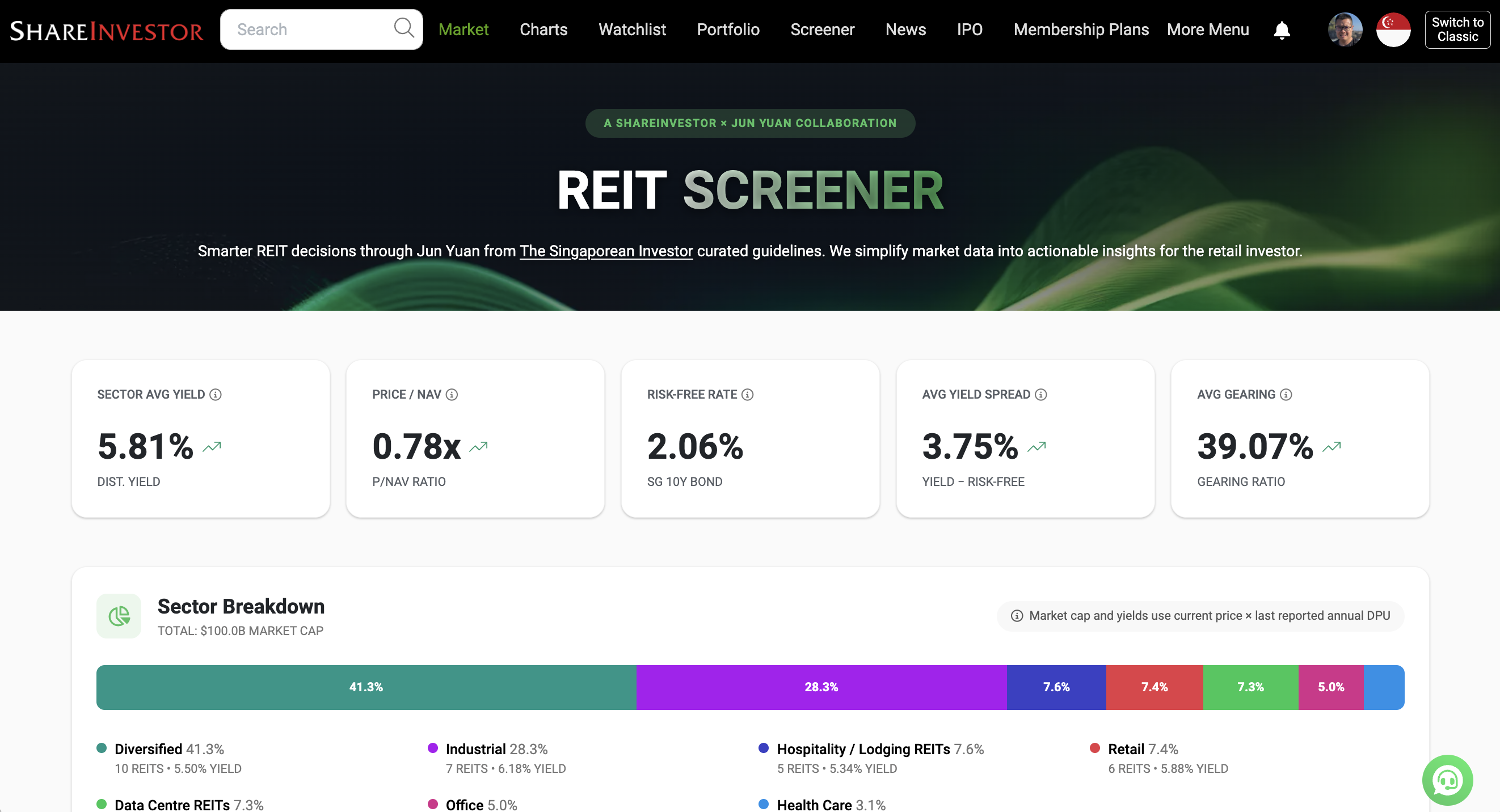
What if you could assess a REIT's portfolio occupancy, debt profile, valuation, and overall health in less than 30 seconds - without having to comb through a single quarterly report?
That's the problem the REIT Screener was built to solve.
Developed through a collaboration between ShareInvestor and The Singaporean Investor, the REIT Screener consolidates many of the key metrics and indicators I personally use when analysing REITs into one easy-to-use platform. Instead of spending hours extracting data manually every earnings season, you can now monitor the REITs you own and research new opportunities in just a few clicks.
If you're serious about REIT investing but don't have the time to manually track quarterly developments, the REIT Screener could be the shortcut you've been looking for:
Take a closer look at the REIT Screener here...



Comments (0)