1. What is the Amova SGD Investment Grade Corporate Bond Index ETF?
Launched in August 2018, the Amova SGD Investment Grade Corporate Bond Index ETF (SGX: MBH) invests in a diversified portfolio of Singapore dollar-denominated investment-grade corporate bonds, while excluding Singapore Government Securities (SGS).
The ETF is managed by Amova Asset Management Asia Ltd (formerly Nikko Asset Management before its rebranding in September 2025), one of Asia’s largest asset managers with an extensive regional and global presence.
2. What Does ‘Investment Grade’ Mean?
When companies issue bonds, they are essentially borrowing money from investors. Naturally, some borrowers are financially stronger than others.
To help investors assess this risk, credit rating agencies such as Moody’s, S&P Global Ratings and Fitch Ratings assign credit ratings to bond issuers. Bonds rated BBB- or above are considered investment grade, meaning they are generally viewed as having a relatively low risk of default. Bonds rated BB+ or below are classified as high-yield (or ‘junk’) bonds, which typically offer higher interest rates in exchange for taking on greater risk.
By investing only in investment-grade bonds, the ETF provides exposure to companies with stronger credit quality while spreading investments across many different issuers.
3. Which Index Does the ETF Track?
The ETF tracks the Markit iBoxx SGD Non-Sovereigns Large Cap Investment Grade Index.
Rather than using derivatives to replicate the index, the ETF adopts a physical replication approach by purchasing the actual bonds held within the index. This makes the fund relatively transparent and straightforward for investors to understand.
4. How are Bonds Selected for the Index?
The Index follows a strict set of rules to ensure that only high-quality and liquid bonds are included.
To qualify, bonds must generally:
- Be denominated in Singapore dollars.
- Have an investment-grade credit rating (BBB- or above).
- Have at least 1 year remaining before maturity.
- Have a minimum issue size of S$300 million to ensure sufficient market liquidity.
The index also excludes Singapore Government Securities, retail bonds, convertible bonds and certain complex bond structures. Additionally, no single issuer can account for more than 20% of the index, helping to maintain diversification.
5. What are the Top 10 Holdings in the ETF?
As at 31 May 2026, the ETF’s top 10 holdings accounted for 15.3% of the portfolio.
- Temasek Financial (I) Ltd 2.8% 17 August 2071 – 2.7%
- HSBC Holdings PLC 5.3% 14 March 2033 – 2.5%
- SingTel Group Treasury Pte Ltd 3.3% Perp – 1.7%
- Temasek Financial (I) Ltd 4.2 02 August 2050 – 1.5%
- United Overseas Bank Ltd 3.0% Perp – 1.4%
- NTUC Income Insurance Co-Operative Ltd 3.1% 20 Jul 2050 – 1.4%
- HSBC Holdings PLC 5.25% 27 Jun 2032 – 1.4%
- ABN Amro Bank N.V. 5.5% 05 Oct 2032 – 1.4%
- AIA Group Ltd 3.58% 11 Jun 2035 – 1.3%
- HSBC Holdings PLC 4.75% 12 Sep 2034 – 1.3%
The remaining approximately 140 bonds make up the other 84.7% of the portfolio, giving investors exposure to a well-diversified basket of investment-grade bonds.
6. How do You Read a Bond’s Name?
At first glance, a bond name such as Temasek Financial (I) Ltd 2.8% 17 August 2071 may appear complicated, but it actually very simple once you understand how to read it.
Basically, the bond’s name contains 3 key pieces of information:
i. Temasek Financial (I) Ltd: The issuer borrowing money from investors.
ii. 2.8%: The annual coupon rate (or dividend yield in simple terms) paid to bondholders.
iii. 17 August 2071: The bond’s maturity date, when the principal is scheduled to be repaid.
Some bonds also include the word ‘Perp’, which is the abbreviation for perpetual. Unlike conventional bonds, perpetual bonds do not have a fixed maturity date. Instead, issuers may redeem them on specified call dates or allow them to remain outstanding indefinitely. As a result, perpetual bonds generally offer higher coupon rates to compensate investors for the additional risk.
7. What Sectors Does the ETF Invest in?
The ETF invests across several sectors, with the largest allocations being:
- Government Agencies & Statutory Boards – 28.2%
- Banks – 17.1%
- Diversified Banks – 16.5%
- Others – 11.9%
- Real Estate – 11.9%
- Life Insurance – 7.3%
- Financial Services – 7.0%
- Cash and/or Derivatives – 0.2%
Some notable Singapore government-related issuers represented in the ETF include the Land Transport Authority (LTA), Housing & Development Board (HDB), National Environment Agency (NEA) and Public Utilities Board (PUB).
8. How Much Dividend Does the ETF Pay?
The ETF distributes dividends twice a year, typically in January and July.
The following table is the dividend payout of the Amova SGD Investment Grade Corporate Bond Index ETF over the past 5 years (between 2021 and 2025), along with the dividend yield (based on the closing price on the final trading day of the respective years):
| Year | Dividend Per Unit (S$’cents) | Dividend Yield (%) |
| 2021 | 4.33 cents | 4.2% |
| 2022 | 2.72 cents | 3.0% |
| 2023 | 3.00 cents | 3.1% |
| 2024 | 3.19 cents | 3.2% |
| 2025 | 3.25 cents | 3.2% |
Apart from a temporary decline in 2022, dividend distributions have generally recovered over the subsequent years. Based on historical payouts, the ETF has generated an annual dividend yield of around 3% in recent years.
Investors seeking a higher level of passive income may find this yield relatively modest compared to some REITs or high-yield bond funds (but in terms of risk, they are higher).
9. What are the Fees?
The ETF charges:
- Management fee: 0.15% per annum
- Trustee fee: 0.02% per annum
Including all operating expenses, the ETF’s latest Total Expense Ratio (TER) was 0.26% per annum (as at 31 December 2025). This works out to roughly S$26 annually for every S$10,000 invested.
The manager also currently intends to cap the TER at 0.30%, with any excess expenses borne by the manager.
10. What are the Key Risks?
Although investment-grade bonds are generally less risky than equities or high-yield bonds, they are not risk-free.
Some of the key risks include:
i. Interest Rate Risk: Rising interest rates generally cause existing bond prices to fall.
ii. Credit Risk: Issuers could experience financial difficulties or default on their debt obligations.
iii. Sector Concentration Risk: Over 60% of the ETF is invested in government-related issuers and banks, making it more exposed to these sectors than a globally diversified bond fund.
iv. Reinvestment Risk: As bonds mature or are called, the fund may need to reinvest at lower yields if interest rates have declined.
v. No Capital Guarantee: Unlike fixed deposits or Singapore Savings Bonds, the ETF’s price fluctuates daily and investors may receive back less than they originally invested.
11. How has the ETF’s Unit Price Moved in the Last 5 Years?
The following is how the Amova SGD Investment Grade Corporate Bond Index ETF unit price have moved since January 2021, on a monthly basis:
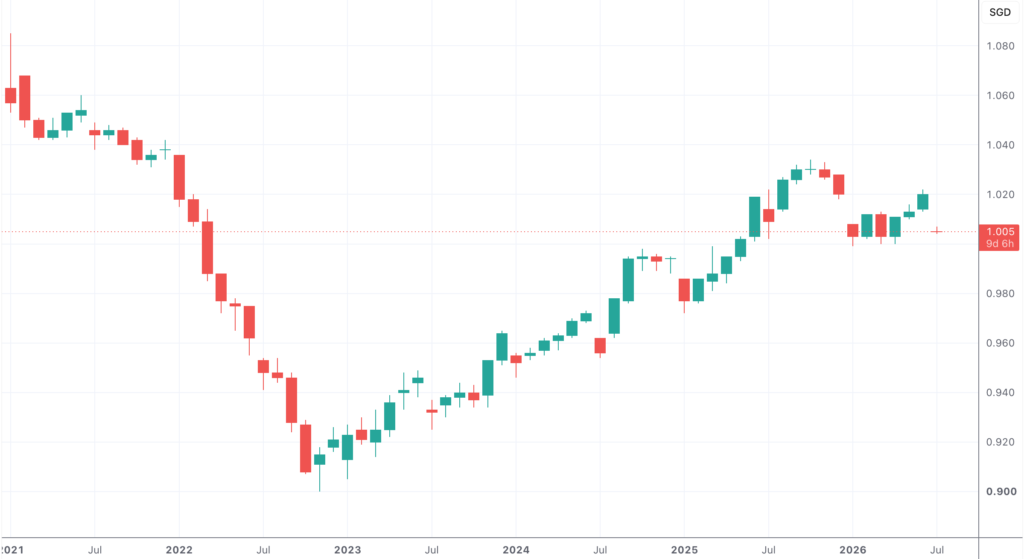
Over the past 5 years, the ETF’s unit price has experienced a classic ‘V-shaped’ recovery.
After reaching S$1.085 in January 2021, the unit price declined to S$0.900 in November 2022 as global interest rates rose sharply before gradually recovering.
An investor who bought the ETF at the start of 2021 and held it until the end of 2025 would have experienced a capital loss of around 4% based purely on the unit price.
However, after including S$0.1649 of dividends received over the same period, the total return would have been approximately 11.5%.
This illustrates an important point: while bond prices may fluctuate, a meaningful portion of investors’ returns often comes from the regular income generated by the bonds.
Closing Thoughts
For investors looking to diversify beyond equities, the Amova SGD Investment Grade Corporate Bond Index ETF provides a simple way to gain exposure to a diversified portfolio of high-quality Singapore dollar bonds through a single investment.
Compared with buying individual bonds, the ETF offers instant diversification across about 150 issuers, including a meaningful allocation to Singapore statutory boards and government-linked entities. While no individual bond accounts for more than 3% of the portfolio, investors should be aware that government-related issuers and banks together make up over 60% of the fund.
Historically, the ETF has generated a dividend yield of around 3%, making it more suitable for investors seeking relatively stable income and lower volatility rather than high returns. At the same time, investors should remember that bond ETFs are still traded on the stock exchange, meaning their prices fluctuate with market conditions. As such, there is no guarantee that investors will always be able to sell at a profit, particularly during periods of rising interest rates.
Overall, the Amova SGD Investment Grade Corporate Bond Index ETF may be worth considering for investors looking to complement an equity portfolio with a diversified basket of investment-grade SGD bonds while generating a steady stream of income.
Disclaimer: At the time of writing, I do not own units of the Amova SGD Investment Grade Corporate Bond Index ETF.
Join Me for a FREE Live Online Chit-Chat on Thursday, 12 November, from 8–9pm (SGT)!
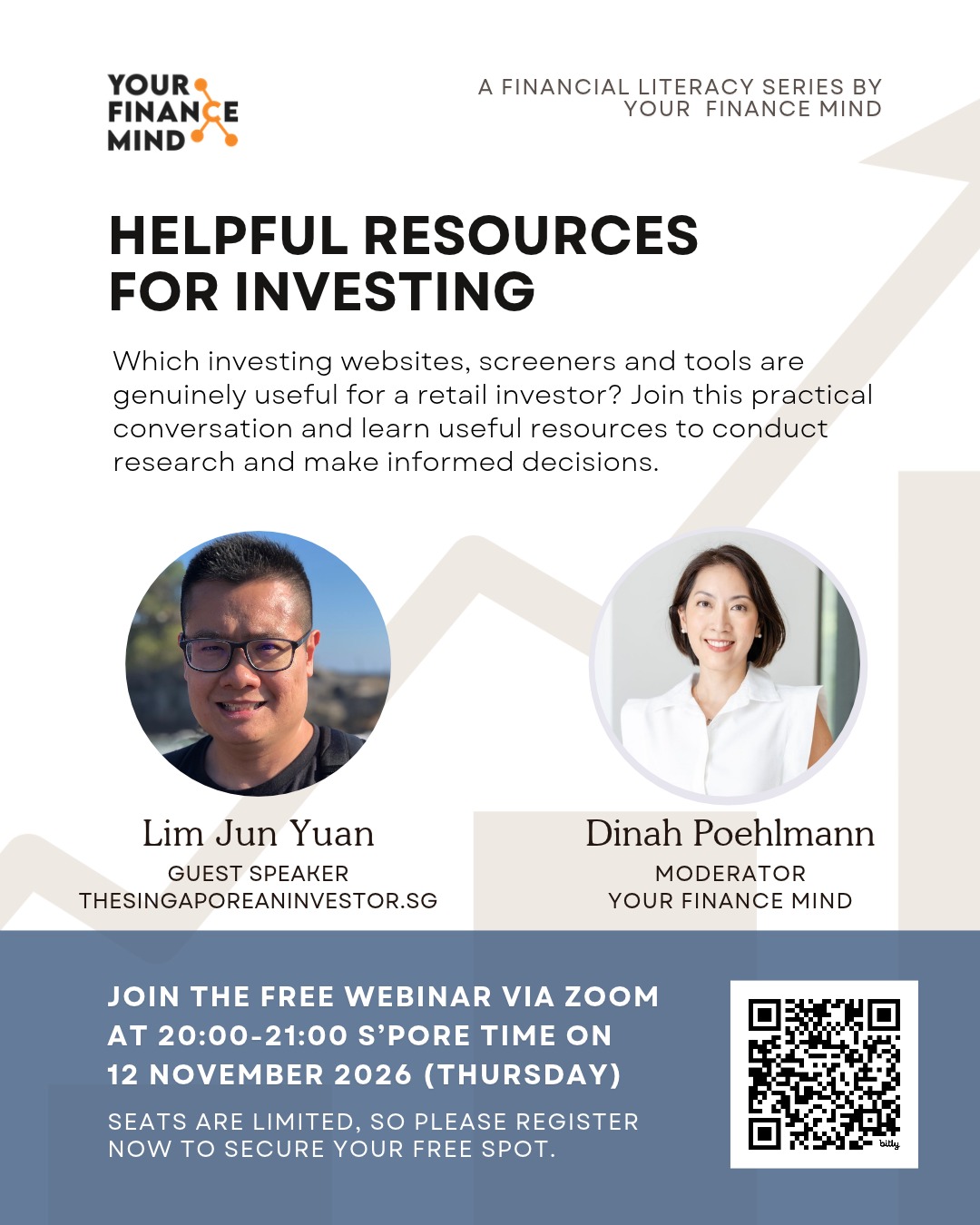
It's been quite some time since I last had a live chit-chat with the investing community, and I’m excited to be back for another session! A big thank you to my friend, Dinah Poehlmann from Your Finance Mind, for inviting me once again!
This time, we’re taking a little break from REITs and exploring some interesting topics surrounding investing, including my go-to investing resources, when is a stock considered 'investable', my thoughts about using AI for stock analysis and trading, and much more.
Whether you're just starting your investing journey or have been investing for years, I hope this session will offer some useful perspectives and practical takeaways that you can apply to your own investing journey.
Best of all, the session is completely FREE to attend! All you need to do is register in advance to receive the Zoom link:
👉 Click here to reserve your spot!
Are You Worried about Not Having Enough Money for Retirement?
You're not alone. According to the OCBC Financial Wellness Index, only 62% of people in their 20s and 56% of people in their 30s are confident that they will have enough money to retire.
But there is still time to take action. One way to ensure that you have a comfortable retirement is to invest in real estate investment trusts (REITs).
In 'Building Your REIT-irement Portfolio' which I've authored, you will learn everything you need to know to build a successful REIT investment portfolio, including a list of 9 things to look at to determine whether a REIT is worthy of your investment, 1 simple method to help you maximise your returns from your REIT investment, 4 signs of 'red flags' to look out for and what you can do as a shareholder, and more!

You can find out more about the book, and grab your copy (ebook or physical book) here...


Comments (0)