When investors think about their biggest investing mistakes, they often look backwards.
They remember the stock they bought that eventually fell 50% below their purchase price, and they sit on massive losses.
They remember the opportunity they missed (one that later became a multi-bagger), because they were too afraid to invest when the opportunity presented itself.
They remember selling too early, only to watch a great investment continue climbing higher, missing out not only on further capital gains, but also the dividends they could have collected along the way.
But here is the uncomfortable truth:
Your greatest investing mistake may not have happened yet.
It may not be the stock you bought that went wrong, or the opportunity you missed in the past.
Instead, it may come at a future moment when fear, uncertainty, and emotions combine to push you into making a decision that you would otherwise never make.
The Most Dangerous Investing Mistakes Are Made During Extreme Moments
Investing mistakes rarely happen when markets are calm.
When markets are steadily rising, almost everyone feels like a successful investor.
Your portfolio value increases.
Your investment decisions appear to be validated.
The companies you own continue reporting strong results, while dividends continue to grow.
During such periods, investing certainly feels easy.
But the true test of an investor is not during the good times.
It is during periods of uncertainty.
A market crash.
A recession.
A geopolitical crisis.
Or simply watching your portfolio decline significantly within a short period of time.
These are the moments when investors are forced to confront their own emotions.
Unfortunately, many investors make their worst decisions precisely when they should be making their best ones.
The Mistake of Abandoning a Good Strategy
One of the most common investing mistakes is abandoning a strategy during the exact period when that strategy is being tested.
A growth investor may begin questioning whether buying quality companies was the right decision after watching their holdings decline for months.
An income investor may lose confidence after seeing their share prices fall despite continuing to receive regular dividend payments.
A value investor may start chasing popular stocks after watching the market reward momentum instead.
But here is the important point:
The problem is not always the strategy.
Rather, the problem is that investors often judge their decisions based on short-term share price movements instead of whether their original investment thesis remains intact.
Every investment approach will experience periods of underperformance.
There will be times when your strategy appears to be wrong.
There will be times when other investors appear to be doing better.
But that is part of the investing journey.
The true test of an investor is whether you have the conviction to remain disciplined when those difficult periods arrive.
The Mistake of Confusing Luck With Skill
Another dangerous mistake investors make is becoming overconfident after experiencing success. To a certain extent, this is human nature.
A rising market has a way of making ordinary investment decisions appear brilliant.
Buying a popular technology stock before a major rally feels like skill.
Taking on more risk during a bull market feels like confidence.
But sometimes, it is simply the market environment working in your favour.
The danger begins when investors start believing that they cannot make mistakes.
That is when they begin taking excessive risks.
They concentrate too much of their portfolio into a handful of investments.
They ignore valuations because, in their minds, “the stock always goes up”.
They assume that recent success will continue indefinitely.
But eventually, the market reminds investors of one important lesson:
Risk never disappears, it only gets delayed.
The Mistake of Waiting Forever for the Perfect Time
Many investors understand the importance of investing, but they continue waiting for what is called the ‘right time’.
They wait for interest rates to fall.
They wait for markets to decline further.
They wait for economic uncertainty to disappear.
They wait for a clearer outlook before committing their capital.
But the reality is that uncertainty is a permanent part of investing.
In my years as a retail investor, I have yet to experience a single year where there were no negative events affecting market sentiment.
There will always be something to worry about.
There will always be reasons to delay investing.
And news headlines will almost always provide reasons to remain cautious.
After all, negative headlines naturally attract more attention than positive ones. Just ask yourself:
When you read the news, are you more likely to click on a headline saying “Markets Face Another Crisis” or “Markets Continue Growing Steadily”?
The investors who succeed over the long term are not those who can predict every market movement correctly. They are the ones who build a sensible investment process and consistently execute it despite uncertainty.
How Can Investors Avoid Their ‘Future Mistake’?
The first step is recognising that emotions such as fear, greed, regret, or overconfidence are part of every investor’s journey.
These emotions are not unique to inexperienced investors. In fact, they affect everyone.
The difference between successful investors and unsuccessful investors is often not the absence of emotions. Instead, it is whether they have systems in place to prevent emotions from controlling their decisions.
This could mean building a diversified portfolio.
It could mean defining your investment criteria before purchasing any investment.
It could mean maintaining sufficient cash reserves so you are not forced to sell during a market downturn.
Most importantly, it means understanding why you own an investment before you buy it.
Because when markets decline, your conviction will determine whether you view the decline as a temporary setback or a reason to panic.
Closing Thoughts
Your greatest investing mistake may not be behind you. It may happen during the next market downturn, when fear replaces confidence, uncertainty challenges your beliefs, and your “lizard brain” takes over – causing you to make emotional decisions instead of rational ones.
The biggest mistakes investors make are often not due to a lack of knowledge. They happen when emotions override a carefully considered investment plan.
So, always remember:
- A good investment strategy will experience difficult periods.
- Past success does not necessarily mean future skill.
- Waiting for perfect conditions can prevent you from participating in long-term wealth creation.
- Having a clear investment process is more important than predicting every market movement.
The best time to prepare for your biggest investing mistake is before it happens.
So, start today.
Review your portfolio.
Understand what you own and why you own it.
Create an investment plan that you can follow even when markets become uncomfortable.
Because when the next crisis arrives, your greatest advantage will not be knowing exactly what the market will do next.
It will be knowing exactly what you should do.
Stop Spending Hours Reading REIT Reports Every Quarter!
What if you could assess a REIT's portfolio occupancy, debt profile, valuation, and overall health in less than 30 seconds - without having to comb through a single quarterly report?
That's the problem the REIT Screener was built to solve.
Developed through a collaboration between ShareInvestor and The Singaporean Investor, the REIT Screener consolidates many of the key metrics and indicators I personally use when analysing REITs into one easy-to-use platform. Instead of spending hours extracting data manually every earnings season, you can now monitor the REITs you own and research new opportunities in just a few clicks.
If you're serious about REIT investing but don't have the time to manually track quarterly developments, the REIT Screener could be the shortcut you've been looking for:
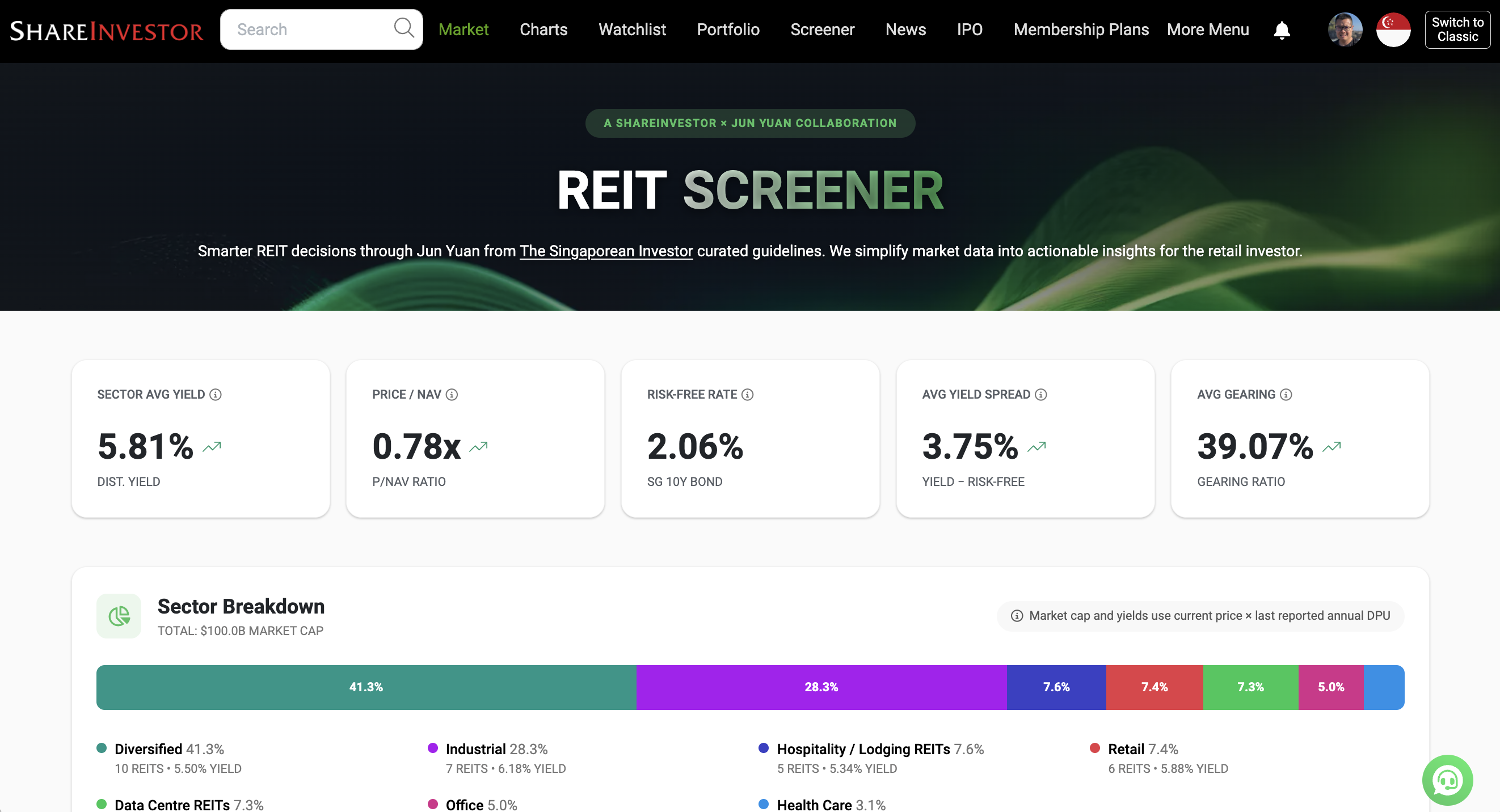
Take a closer look at the REIT Screener here...



Comments (0)