1. What is the VanEck Semiconductor ETF?
The VanEck Semiconductor ETF (NASDAQ: SMH) provides investors with exposure to some of the world’s largest semiconductor companies.
Rather than investing in just one semiconductor company, such as Nvidia Corporation (NASDAQ: NVDA), Taiwan Semiconductor Manufacturing Co Ltd (NYSE: TSM), or Broadcom Inc (NASDAQ: AVGO), investing in the VanEck Semiconductor ETF allows you to gain exposure to a basket of companies operating across different parts of the semiconductor ecosystem.
These include companies that design semiconductor chips, manufacture them, produce memory chips, as well as supply the highly specialised equipment needed to manufacture advanced semiconductors.
2. What Index does the VanEck Semiconductor ETF Track?
The VanEck Semiconductor ETF tracks the MVIS US Listed Semiconductor 25 Index (MVSMHTR).
One thing to note is that the term ‘US Listed’ in the index’s name does not mean it invests solely in American companies.
Foreign companies whose shares are listed on a US stock exchange, either on the New York Stock Exchange or Nasdaq, can also be included in the index.
Examples include Taiwan-based Taiwan Semiconductor Manufacturing Co Ltd, which is listed on the Taiwan Stock Exchange under the ticker symbol TPE: 2330 and in the US under NYSE: TSM, as well as Netherlands-based ASML Holding NV, which is listed on Euronext Amsterdam under AMS: ASML and on Nasdaq under NASDAQ: ASML.
3. How are Companies Chosen to be Included in the Index?
To qualify for inclusion in the MVIS US Listed Semiconductor 25 Index, a new company must derive at least 50% of its revenue from semiconductor production and/or semiconductor equipment. Its securities must also be listed on a US stock exchange.
This means that semiconductor companies based outside the US can still qualify for inclusion as long as they have eligible US-listed securities.
Companies must also meet minimum requirements relating to market capitalisation, free float and trading liquidity.
From the eligible universe, the 50 largest securities by market capitalisation are shortlisted. They are then ranked according to both their free-float market capitalisation and three-month average daily trading volume.
The index ultimately targets 25 companies, favouring semiconductor businesses that are both large and actively traded.
It is reconstituted twice a year, in March and September.
4. Which Companies have the Heaviest Weightage in the ETF?
As of 23 July 2026, the following 10 companies collectively make up 71.26% of the VanEck Semiconductor ETF.
Apart from Nvidia Corporation, which has a significant weightage of 20.70%, Taiwan Semiconductor Manufacturing Co Ltd at 9.16% and Broadcom Inc at 6.20%, each of the remaining top 10 constituents has a weightage of less than 6%:
1. Nvidia Corporation (NASDAQ: NVDA) (20.7% Weightage): Nvidia Corporation is a technology company best known for designing powerful graphics processing units (GPUs) used in gaming, artificial intelligence (AI) and data centres. Its chips have become particularly important for training and running AI models.
2. Taiwan Semiconductor Manufacturing Company Co Ltd (NYSE: TSM) (9.16% Weightage) Taiwan Semiconductor Manufacturing Company, or TSMC, is the world’s largest contract chip manufacturer, producing advanced semiconductor chips designed by companies such as Nvidia, Apple and AMD. It makes money by manufacturing these chips in its highly specialised factories for use in smartphones, computers, AI systems, cars and other electronic devices.
3. Broadcom Inc (NASDAQ: AVGO) (6.20% Weightage): Broadcom Inc is a technology company that designs and sells semiconductor chips used in areas such as data centres, networking, smartphones and broadband equipment. It also provides infrastructure software used by businesses to run, manage and secure their IT systems.
4. Advanced Micro Devices Inc (NASDAQ: AMD) (5.93% Weightage): Advanced Micro Devices Inc, or AMD, is a semiconductor company that designs high-performance computer chips used in PCs, data centres, gaming consoles and AI systems. Its main products include processors (CPUs), graphics processing units (GPUs) and specialised chips used to power servers and other computing devices.
5. Micron Technology Inc (NASDAQ: MU) (5.51% Weightage): Micron Technology Inc designs and manufactures memory and storage chips used to store and process data in products such as data centres, computers, smartphones and cars. Its products include DRAM, NAND flash memory and high-bandwidth memory (HBM), which has become increasingly important for AI computing.
6. ASML Holding NV (NASDAQ: ASML) (5.16% Weightage): ASML Holding NV is a Dutch technology company that makes highly advanced machines used by semiconductor manufacturers to produce computer chips. Its lithography machines help chipmakers print extremely tiny patterns onto silicon wafers, enabling the production of smaller and more powerful chips.
7. Applied Materials Inc (NASDAQ: AMAT) (5.06% Weightage): Applied Materials Inc makes specialised equipment, software and technologies used by semiconductor companies to manufacture advanced chips. Its products help chipmakers build, modify and inspect the tiny layers and components that make up semiconductors.
8. KLA Corporation (NASDAQ: KLAC) (4.58% Weightage): KLA Corporation designs and makes specialised equipment and software that helps semiconductor manufacturers inspect chips and detect defects during production. Its technology helps chipmakers improve manufacturing accuracy and reduce the number of faulty chips.
9. Texas Instruments Incorporated (NASDAQ: TXN) (4.52% Weightage): Texas Instruments Incorporated designs and makes semiconductor chips used in products such as cars, industrial machinery, consumer electronics and communications equipment. Its chips mainly help electronic devices sense and process real-world signals, manage power, and control various functions.
10. Lam Research Corporation (NASDAQ: LRCX) (4.44% Weightage): Lam Research Corporation is a major supplier of equipment used to manufacture semiconductor chips, including machines that deposit materials, etch tiny patterns and clean silicon wafers during chip production. It also provides services, spare parts and upgrades to help chipmakers maintain and improve their manufacturing equipment.
Looking at the above, Nvidia is the standout as this one single company has an approximately one-fifth of weightage towards the VanEck Semiconductor ETF. Therefore, the performance of Nvidia can have a material effect on the overall performance of the ETF.
5. In What Way Does the VanEck Semiconductor ETF Provide Significant Exposure to the AI Boom?
One of the biggest reasons semiconductor stocks have attracted significant investor interest in recent years is the rapid development of artificial intelligence (AI).
Training and running increasingly sophisticated AI models require enormous amounts of computing power, which in turn require increasingly powerful semiconductor chips.
The VanEck Semiconductor ETF provides exposure to this trend at multiple levels of the semiconductor ecosystem.
Nvidia and AMD develop accelerators used for AI computing, while Broadcom has exposure to networking technologies and custom AI accelerators used in large data centres.
TSMC manufactures many of the advanced processors designed by these companies, while Micron produces memory needed for AI computing systems.
Meanwhile, ASML, Applied Materials, Lam Research and KLA Corporation provide the specialised equipment and technologies required to manufacture increasingly sophisticated semiconductors.
In other words, investing in the VanEck Semiconductor ETF does not just give you exposure to companies designing AI chips. It also gives you exposure to companies involved in actually manufacturing these chips, as well as those supplying the critical equipment needed to make them.
6. Does the ETF Pay Dividends?
As a unitholder of the VanEck Semiconductor ETF, you will receive dividends once a year, typically towards the end of December.
The following are the ETF’s dividend payouts over the last 5 years, between 2021 and 2025, along with their respective dividend yields, which I have computed based on the closing unit price on the last trading day of each year:
| Year | Dividend Per Unit (US$) | Dividend Yield (%) |
| 2021 | US$0.7867 | 0.51% |
| 2022 | US$1.2005 | 1.18% |
| 2023 | US$1.0427 | 0.60% |
| 2024 | US$1.0713 | 0.44% |
| 2025 | US$1.1047 | 0.31% |
There are 2 reasons why the VanEck Semiconductor ETF may not appeal to income investors.
First, dividends are paid only once a year. Second, its dividend yield has generally been low, coming in at below 1% in four of the last five years.
As such, investors considering the ETF should focus more on its potential for capital appreciation rather than dividend income.
7. What are Some of the Risks of Investing in the ETF?
Despite the attractive long-term growth prospects of the semiconductor industry, investing in the VanEck Semiconductor ETF comes with several important risks worth highlighting:
1. Semiconductor Industry Concentration Risk: As the ETF concentrates its investments in a single industry, its performance can be adversely affected if the semiconductor industry experiences a downturn. Unlike a broad-market ETF that invests across multiple sectors, there is limited diversification outside the semiconductor industry to cushion the impact of a sector-wide decline.
2. Individual Company Concentration: The 3 largest holdings (Nvidia Corporation, Taiwan Semiconductor Manufacturing Company and Broadcom) collectively account for 36.06% of the ETF. As a result, any material positive or negative developments affecting these three companies can have a significant impact on the ETF’s overall performance. This is particularly the case for Nvidia, which alone accounts for approximately one-fifth of the ETF.
3. Cyclical Nature of the Semiconductor Industry: The semiconductor industry has historically been cyclical. When demand is strong and supply is limited, semiconductor companies can enjoy higher selling prices and stronger profits. However, strong demand can also encourage companies to expand their production capacity. If demand subsequently weakens, the industry could find itself with excess inventory and manufacturing capacity, putting pressure on semiconductor prices and company profits.
4. AI Spending Risk: A substantial part of the enthusiasm surrounding semiconductor stocks today is linked to AI, with major technology companies spending enormous amounts on AI infrastructure. If AI eventually generates less economic value than currently expected, these companies could reduce their capital expenditure on AI infrastructure. This could negatively affect the financial performance of semiconductor companies supplying AI chips, memory and manufacturing equipment, which would in turn weigh on the ETF’s overall performance.
5. US-China Technology Restrictions: The US has introduced restrictions governing the export of certain advanced semiconductor technologies and manufacturing equipment to China. Further restrictions, or retaliatory measures by China, could affect semiconductor companies’ ability to sell their products in certain markets, disrupt existing supply chains or increase compliance costs. Given the global nature of the semiconductor supply chain, geopolitical developments remain an important risk for investors to keep in mind.
8. Why Invest in the ETF Instead of Simply Investing in Nvidia Corporation?
Given Nvidia Corporation’s substantial weightage in the VanEck Semiconductor ETF, one question investors may have is: why invest in the ETF instead of simply buying Nvidia shares directly?
It is a valid question.
With Nvidia accounting for approximately one-fifth of the ETF, any major development affecting the company can still have a meaningful impact on the ETF’s performance.
However, we should also remember that the remaining four-fifths of the ETF are invested across more than 20 other semiconductor companies.
This means investors can still benefit if other parts of the semiconductor ecosystem become more valuable over time.
For example, competition among Nvidia, AMD and custom AI accelerator providers could intensify. Regardless of which chip designer eventually gains market share, semiconductor manufacturers and equipment suppliers could continue to benefit as long as overall semiconductor production continues to grow.
Investing in the ETF therefore reduces the company-specific risk of investing solely in Nvidia while still allowing investors to retain significant exposure to the company and the broader growth of the semiconductor industry.
9. How has the Unit Price of the ETF Moved in the Last 5 Years?
The following shows how the unit price of the VanEck Semiconductor ETF has moved on a monthly basis since January 2021:
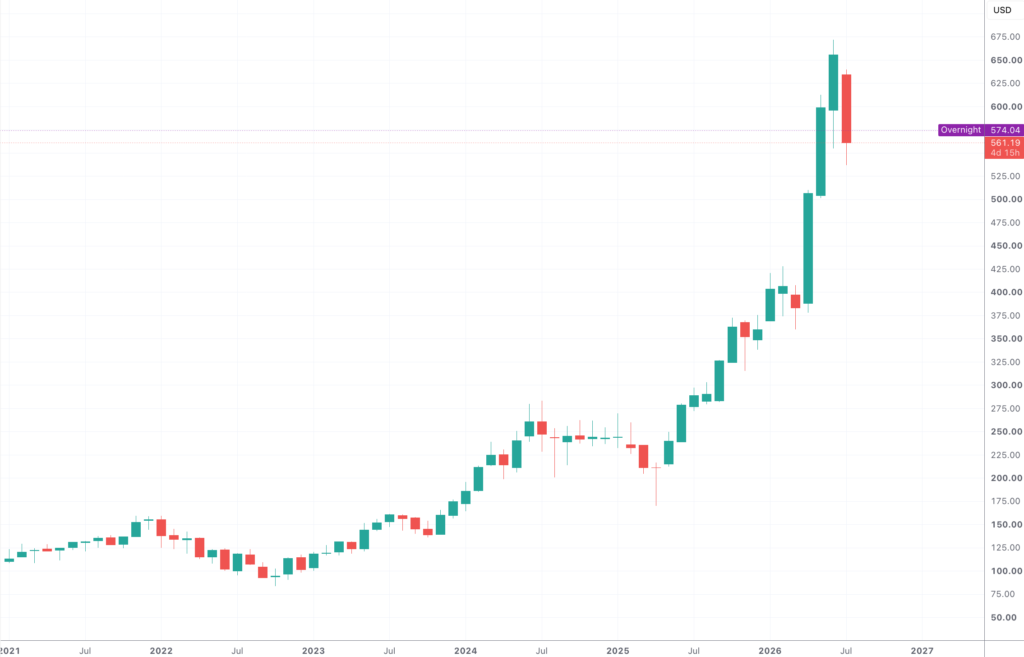
Overall, the VanEck Semiconductor ETF’s unit price has trended upwards over the years, with a particularly strong climb since May 2025.
Investors who bought units of the ETF at its opening price of US$110.28 on the first trading session of 2021, on 4 January 2021, and remained invested until the end of 2025, when its unit price closed at US$360.13 on 31 December 2025, would be sitting on an impressive unrealised capital gain of approximately 226.6% over the 5-year period.
This translates to a compound annual growth rate (CAGR) of approximately 26.7%, which in my opinion represents a very strong performance.
After factoring in the dividends received over the same period, the overall gain improves to approximately 231.3%, translating to a CAGR of around 27.1%.
Of course, investors should bear in mind that past performance does not necessarily indicate how the ETF will perform in the years ahead.
Closing Thoughts
For those of you who want to ride on the AI boom without taking on the company-specific risks that come with investing in an individual semiconductor stock, the VanEck Semiconductor ETF is one option you can consider.
With a single investment, you gain exposure to more than 20 semiconductor companies operating across different parts of the industry – from companies designing AI chips to those manufacturing them and supplying the specialised equipment required for semiconductor production.
That said, do take note that Nvidia has a particularly heavy weightage in the ETF, accounting for approximately one-fifth of its portfolio. As such, any major development affecting Nvidia could have a meaningful impact on the ETF’s overall performance.
Another thing to keep in mind is that this is a semiconductor-focused ETF. Any weakness in the industry, whether due to slowing demand, weaker financial performance among semiconductor companies, or external factors such as geopolitical tensions, could weigh on the ETF’s performance.
On the flip side, if demand for AI infrastructure and advanced semiconductors continues to grow, the companies within the ETF could continue to benefit.
Indeed, the ETF’s performance over the past 5 years has been impressive. Investors who bought the ETF at the beginning of January 2021 and remained invested until the end of December 2025 would have enjoyed an unrealised capital gain of more than 200%.
However, it is important not to assume that such strong historical returns will necessarily be repeated in the years ahead.
Finally, in terms of dividend payouts, in my opinion the VanEck Semiconductor ETF is definitely not one for income investors. It pays a dividend only once a year, and its yield has generally been below 1%.
Therefore, if you are considering an investment in the ETF, the main focus should be on its potential for long-term capital appreciation rather than dividend income.
Disclaimer: At the time of writing, I do not have any units of the VanEck Semiconductor ETF.
Join Me for a FREE Live Online Chit-Chat on Thursday, 12 November, from 8–9pm (SGT)!

It's been quite some time since I last had a live chit-chat with the investing community, and I’m excited to be back for another session! A big thank you to my friend, Dinah Poehlmann from Your Finance Mind, for inviting me once again!
This time, we’re taking a little break from REITs and exploring some interesting topics surrounding investing, including my go-to investing resources, when is a stock considered 'investable', my thoughts about using AI for stock analysis and trading, and much more.
Whether you're just starting your investing journey or have been investing for years, I hope this session will offer some useful perspectives and practical takeaways that you can apply to your own investing journey.
Best of all, the session is completely FREE to attend! All you need to do is register in advance to receive the Zoom link:
👉 Click here to reserve your spot!
Are You Worried about Not Having Enough Money for Retirement?
You're not alone. According to the OCBC Financial Wellness Index, only 62% of people in their 20s and 56% of people in their 30s are confident that they will have enough money to retire.
But there is still time to take action. One way to ensure that you have a comfortable retirement is to invest in real estate investment trusts (REITs).
In 'Building Your REIT-irement Portfolio' which I've authored, you will learn everything you need to know to build a successful REIT investment portfolio, including a list of 9 things to look at to determine whether a REIT is worthy of your investment, 1 simple method to help you maximise your returns from your REIT investment, 4 signs of 'red flags' to look out for and what you can do as a shareholder, and more!

You can find out more about the book, and grab your copy (ebook or physical book) here...


Comments (0)