When we think about the biggest challenges investors face during a market crash, the first thing that usually comes to mind is the impact on our portfolio value.
It is easy to understand why.
When investors see their investments decline by 10%, 20%, or even more, the red numbers on their brokerage accounts can become a constant reminder of their losses. At the same time, financial news often becomes increasingly negative, with headlines highlighting economic uncertainty, market weakness, and concerns about further declines.
It is during these moments that many investors begin questioning whether they made the right investment decisions in the first place.
While market crashes certainly put our financial resilience to the test, the greater challenge often lies beyond the numbers on our portfolio statements – our mindset.
A market crash does not just challenge our ability to tolerate losses. It is also a test of our patience, our conviction in our investment decisions, and our ability to remain rational when fear and uncertainty begin influencing our judgement.
Fact: The Pain of Losing Feels Worse Than the Joy of Gaining
One of the reasons why market crashes are so difficult to endure is because human beings are naturally wired to avoid losses.
Consider these 2 scenarios.
In the first scenario, you invest $10,000 and achieve a 20% gain, increasing your investment value to $12,000.
In the second scenario, you invest $10,000 and suffer a 20% loss, reducing your investment value to $8,000.
Although both situations involve the same $2,000 difference, most investors would experience significantly more emotional pain from the loss compared to the happiness from the gain.
This psychological tendency is known as loss aversion – where the negative emotions associated with losing money are often much stronger than the positive emotions from making money.
During a market crash, this bias becomes even more pronounced.
As portfolio values continue declining and uncertainty increases, the fear of suffering further losses can gradually take control of our decision-making process.
Market Crashes Create Doubt Even When Nothing Has Changed
One of the biggest dangers of a market crash is that it can cause investors to question even their best investment decisions.
Imagine investing in a strong company because you believe in its long-term growth potential. It continues to generate profits, maintains a healthy balance sheet, and its underlying business fundamentals remain unchanged.
However, due to concerns over interest rates, economic conditions, or overall market sentiment, its share price declines by 30%.
Suddenly, the same investment that appeared attractive previously starts to feel like a mistake.
This is where many investors make a critical mistake – they confuse a falling share price with a deteriorating business. However, the reality is that a declining share price does not always mean that a company has become less valuable.
Sometimes, it simply reflects a temporary change in market sentiment rather than a permanent change in the company’s fundamentals.
For long-term investors, market crashes can even present opportunities to invest in quality businesses at more attractive valuations.
The Biggest Risk During a Crash Is Often Our Own Reaction
Many investors believe that the greatest risk during a market downturn is losing money. However, for long-term investors, the bigger risk is often making emotional decisions at the wrong time.
Selling after a significant market decline may provide temporary relief because it removes the stress of watching portfolio values continue to fall. However, if the market eventually recovers (as it always does), investors who sold may find it difficult to decide when to reinvest.
Should they buy back when prices recover by 10%?
Or wait until the market rises another 20%?
Often, the fear of making another wrong decision prevents investors from fully participating in the recovery.
This is how a temporary decline in market prices can eventually become a permanent loss of capital.
The problem was not the market crash itself. Instead, it is how the investor responded to it.
Preparation Before A Crash Matters More Than Your Actions During A Crash
When markets are performing well and investment portfolios are growing, it is easy to believe that we can handle any market downturn.
However, our true risk tolerance is only tested when our investments are under pressure.
This is why preparation before a market crash is so important.
Investors should have a clear understanding of why they own each investment:
- Do you own the company because you have studied its business fundamentals?
- Do you understand the risks involved?
- Are you investing money that you may require in the short term?
Having clear answers to these questions can help investors remain focused when emotions are at their strongest.
A well-prepared investor does not ignore market declines. Instead, they recognise that volatility is an unavoidable part of investing.
Closing Thoughts
Market crashes are inevitable.
Regardless of how strong the economy may be or how promising individual companies appear, there will always be periods of uncertainty where share prices decline.
However, a market crash alone does not determine an investor’s long-term returns. What matters more is how investors respond during these challenging periods.
The greatest challenge during a downturn is not simply watching our portfolio value decline. It is having the discipline to separate emotions from decisions, remain focused on business fundamentals, and avoid making short-term decisions that could negatively impact long-term wealth creation.
Rather than trying to predict when the next market crash will occur, investors should focus on being prepared for when it eventually arrives.
Understand the investments you own, maintain sufficient financial flexibility, and develop the right mindset before the next downturn begins.
The reason is because, at the end of the day, successful investing is not just about selecting the right investments. It is also about having the right behaviour when those investments are tested.
Join Me for a FREE Live Online Chit-Chat on Thursday, 12 November, from 8–9pm (SGT)!
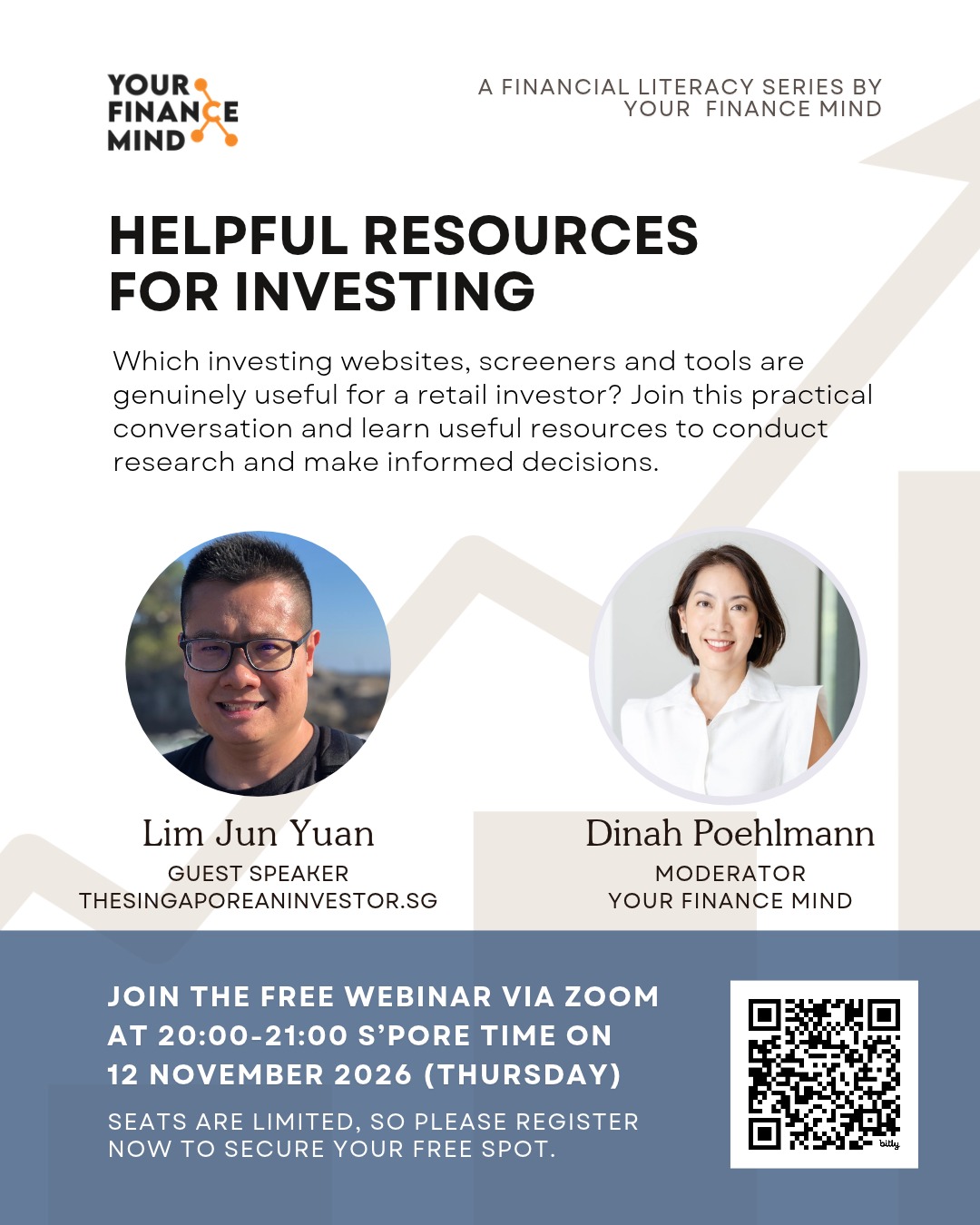
It's been quite some time since I last had a live chit-chat with the investing community, and I’m excited to be back for another session! A big thank you to my friend, Dinah Poehlmann from Your Finance Mind, for inviting me once again!
This time, we’re taking a little break from REITs and exploring some interesting topics surrounding investing, including my go-to investing resources, when is a stock considered 'investable', my thoughts about using AI for stock analysis and trading, and much more.
Whether you're just starting your investing journey or have been investing for years, I hope this session will offer some useful perspectives and practical takeaways that you can apply to your own investing journey.
Best of all, the session is completely FREE to attend! All you need to do is register in advance to receive the Zoom link:
👉 Click here to reserve your spot!
Stop Spending Hours Reading REIT Reports Every Quarter!
What if you could assess a REIT's portfolio occupancy, debt profile, valuation, and overall health in less than 30 seconds - without having to comb through a single quarterly report?
That's the problem the REIT Screener was built to solve.
Developed through a collaboration between ShareInvestor and The Singaporean Investor, the REIT Screener consolidates many of the key metrics and indicators I personally use when analysing REITs into one easy-to-use platform. Instead of spending hours extracting data manually every earnings season, you can now monitor the REITs you own and research new opportunities in just a few clicks.
If you're serious about REIT investing but don't have the time to manually track quarterly developments, the REIT Screener could be the shortcut you've been looking for:
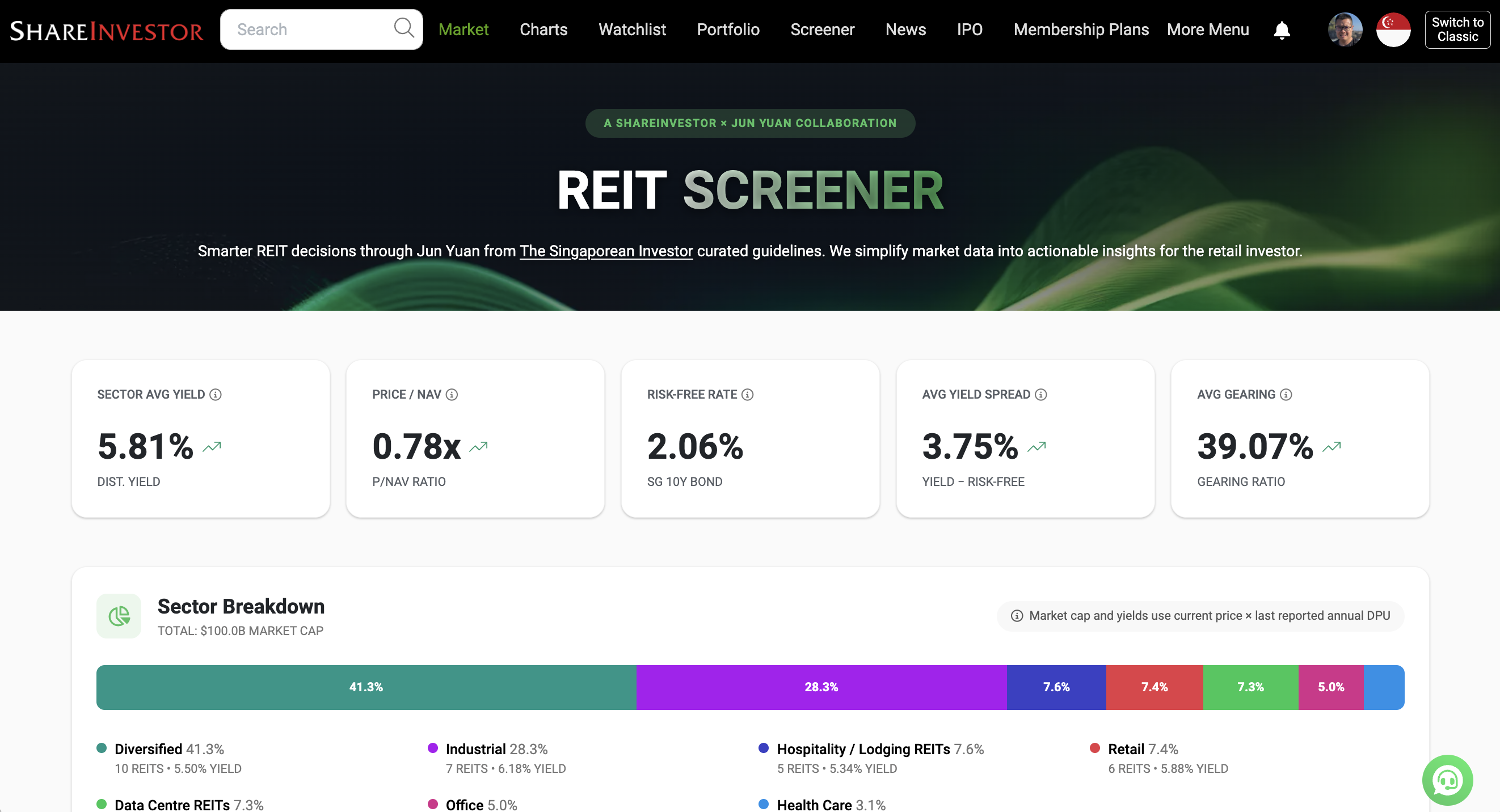
Take a closer look at the REIT Screener here...



Comments (0)