When most people first begin learning about investing, they naturally assume that success comes from identifying the right companies to invest in, buying them at attractive prices, and selling them at the perfect time.
As a result, they spend countless hours reading and analysing annual reports, comparing valuation ratios, and trying to determine where the stock market is heading next.
While having a good understanding of businesses and financial statements is certainly important, I’ve come to realise over the years that technical knowledge alone is rarely what separates successful investors from unsuccessful ones.
Instead, one of the biggest differentiating factors often comes down to psychology.
In fact, I would argue that investing is 80% psychology and only 20% technical knowledge.
The reason is simple.
Most investors already know what they should be doing.
The difficult part is having the discipline and emotional control to continue doing it, especially when markets become volatile and uncertainty begins to dominate the headlines.
Knowing the Right Thing Is Usually the Easy Part
If you were to ask experienced investors what principles lead to long-term investing success, chances are that many of them would give remarkably similar answers:
“Invest for the long term.”
“Diversify your portfolio instead of relying on a handful of investments.”
“Avoid chasing the latest market trends.”
“Remain invested during periods of market weakness.”
“Allow time and compounding to do the heavy lifting.”
None of these ideas are particularly new or controversial.
In fact, they have been repeated countless times in investing books, articles, podcasts, seminars, and interviews over the years.
However, despite knowing these principles, many investors still find themselves abandoning them the moment markets become volatile, and especially if they see their investment portfolios down by 20% or more.
Instead of continuing to invest consistently, they hesitate.
Instead of remaining patient, they become anxious.
Instead of sticking to their long-term investment plan, they begin reacting to short-term news and market movements.
This is because investing is not simply an intellectual exercise.
It is, more often than not, an emotional one.
Our Brains Aren’t Naturally Wired for Investing
Human beings have evolved over last thousands of years to respond quickly whenever we perceive danger.
This survival instinct has undoubtedly served us well throughout history, but it can also become one of our greatest weaknesses when it comes to investing.
Whenever markets experience sharp declines, our brains naturally interpret falling prices as a warning sign that something is wrong.
As a result, many investors instinctively feel the urge to sell their investments, reduce their exposure to risk, or move entirely into cash.
Ironically, history has shown that some of the strongest market recoveries have often occurred shortly after periods of extreme pessimism, meaning that investors who panic and sell during downturns frequently miss out on the subsequent rebound.
In many situations, doing nothing is actually the better decision.
However, psychologically speaking, doing nothing can often feel far more difficult than taking action.
Fear and Greed Continue to Drive Markets
One of the most fascinating aspects of investing is that while businesses, technologies, and economies continue to evolve, human emotions have remained remarkably consistent.
Benjamin Graham, the author of the all-time investment classic ‘The Intelligent Investor’, famously described the stock market as “a voting machine in the short term and a weighing machine in the long term”, and I believe that observation remains just as relevant today.
During bull markets, optimism gradually turns into excitement, and this excitement eventually turns into confidence.
Before long, many investors begin believing that markets can only continue moving higher, and that missing out on the next opportunity is a greater risk than overpaying for an investment.
Conversely, when markets decline sharply, that optimism quickly gives way to fear.
Companies that investors were eager to buy only a few months earlier suddenly appear far less attractive, even though their long-term fundamentals may not have changed significantly.
This emotional cycle repeats itself time and time again.
Successful investors are not necessarily those who never experience fear or greed.
Rather, they are those who recognise these emotions, acknowledge them, and avoid allowing them to dictate their investment decisions.
The Biggest Enemy Is Often Ourselves
It is often tempting to blame disappointing investment performance on external factors such as interest rates, inflation, political uncertainty, or market volatility.
While these factors undoubtedly influence investment returns over shorter periods, there is one factor that remains entirely within our own control – our behaviour.
Many investing mistakes are not caused by a lack of intelligence or technical knowledge.
Instead, they are the result of impatience, overconfidence, fear of missing out, panic selling, or constantly changing investment strategies in response to the latest news headlines.
Sometimes, the biggest improvement we can make is not identifying better investment opportunities.
It is becoming a more disciplined investor.
Patience Is One of the Greatest Investing Advantages
If there is one characteristic that consistently appears among successful long-term investors, it is patience.
Not because they refuse to make decisions, but because they understand that meaningful wealth creation rarely happens overnight.
Compounding is not exciting.
It rarely produces spectacular results within a few months or even a few years.
Instead, it quietly rewards investors who remain disciplined and consistent over long periods of time.
Unfortunately, we now live in a world where almost everything is available instantly:
Food can be delivered within minutes.
Movies can be streamed immediately.
Online purchases often arrive the next day.
It is therefore hardly surprising that many people unconsciously expect investing to produce similarly quick results.
However, investing simply does not work that way.
Those who are willing to think in terms of decades rather than weeks often place themselves in a far stronger position to build meaningful wealth over time.
Don’t Judge Every Investment by Its Short-Term Results
Another common mistake among beginner investors is evaluating every investment decision based solely on whether it has made or lost money over the next few weeks or months.
If an investment rises shortly after they buy it, they conclude that they made an excellent decision.
If it falls, they assume they made a mistake.
In reality, investing is rarely that straightforward.
A well-researched investment can still decline in the short term due to factors entirely beyond your control.
Likewise, a poorly thought-out investment can sometimes generate attractive returns simply because market conditions happened to be favourable.
Rather than focusing purely on short-term outcomes, I believe it is far more useful to evaluate whether your investment process is sound by asking the following 3 questions:
1. Did you understand the business you invested in?
2. Did you diversify your portfolio appropriately?
3. Did you invest with a long-term perspective rather than trying to speculate on short-term price movements?
If the answer to these questions is a resounding ‘yes’, then temporary fluctuations should not automatically cause you to lose confidence in your investment approach.
Developing the Right Mindset Is a Continuous Journey
One of the reasons why investing psychology is so challenging is that it cannot simply be mastered by reading a single book or attending one seminar.
Like investing itself, it is something that develops gradually through experience.
Every market correction teaches patience.
Every period of uncertainty strengthens emotional discipline.
Every investing mistake provides an opportunity to become a better investor.
The objective is therefore not to avoid making mistakes altogether.
Instead, it is to learn from those mistakes, improve your decision-making process, and gradually develop the mindset required to become a successful long-term investor.
Over time, your greatest investment asset may not simply be the portfolio you have built.
It may very well be the discipline, patience, and emotional resilience you have developed throughout the journey.
Closing Thoughts
While technical investing knowledge is undoubtedly important, I believe psychology often plays a much bigger role than many people initially realise.
Understanding how to read financial statements, value companies, or analyse industries is valuable, but these skills alone do not guarantee investing success.
Your ability to remain calm during periods of market volatility, continue investing despite uncertainty, and stay committed to a sensible long-term investment plan will often have a much greater influence on your long-term returns.
If you’ve been thinking about starting your investing journey but aren’t sure where to begin, I’d like to introduce you to a programme run by a friend of mine, Dinah Poehlmann from YourFinanceMind.
Her ‘Start to Invest Group Coaching’ Programme is designed specifically for beginners, providing a structured approach to help you build a strong investing foundation and the confidence to start investing sensibly. You can find out more here:
Start to Invest Group Coaching Programme
As a reader of The Singaporean Investor, you’ll automatically enjoy an exclusive S$100 discount when you sign up via the link above from now till Friday, 24 July 2026 – the discounted price has already been applied, so there’s nothing extra you need to do.
To thank you for your support, simply forward your invoice to ljunyuan@thesingaporeaninvestor.sg after you’ve enrolled, and I’ll send you a complimentary digital copy of my REIT investing book, building your REIT-irement portfolio. I hope it’ll be a valuable resource as you continue building your investing knowledge and work towards achieving your long-term financial goals.
Disclaimer: I will receive a small affiliate commission if you sign up using my referral link or coupon code, at no additional cost to you. I only recommend products, services, or programmes that I believe may provide value to my readers.
Join Me for a FREE Live Online Chit-Chat on Thursday, 12 November, from 8–9pm (SGT)!
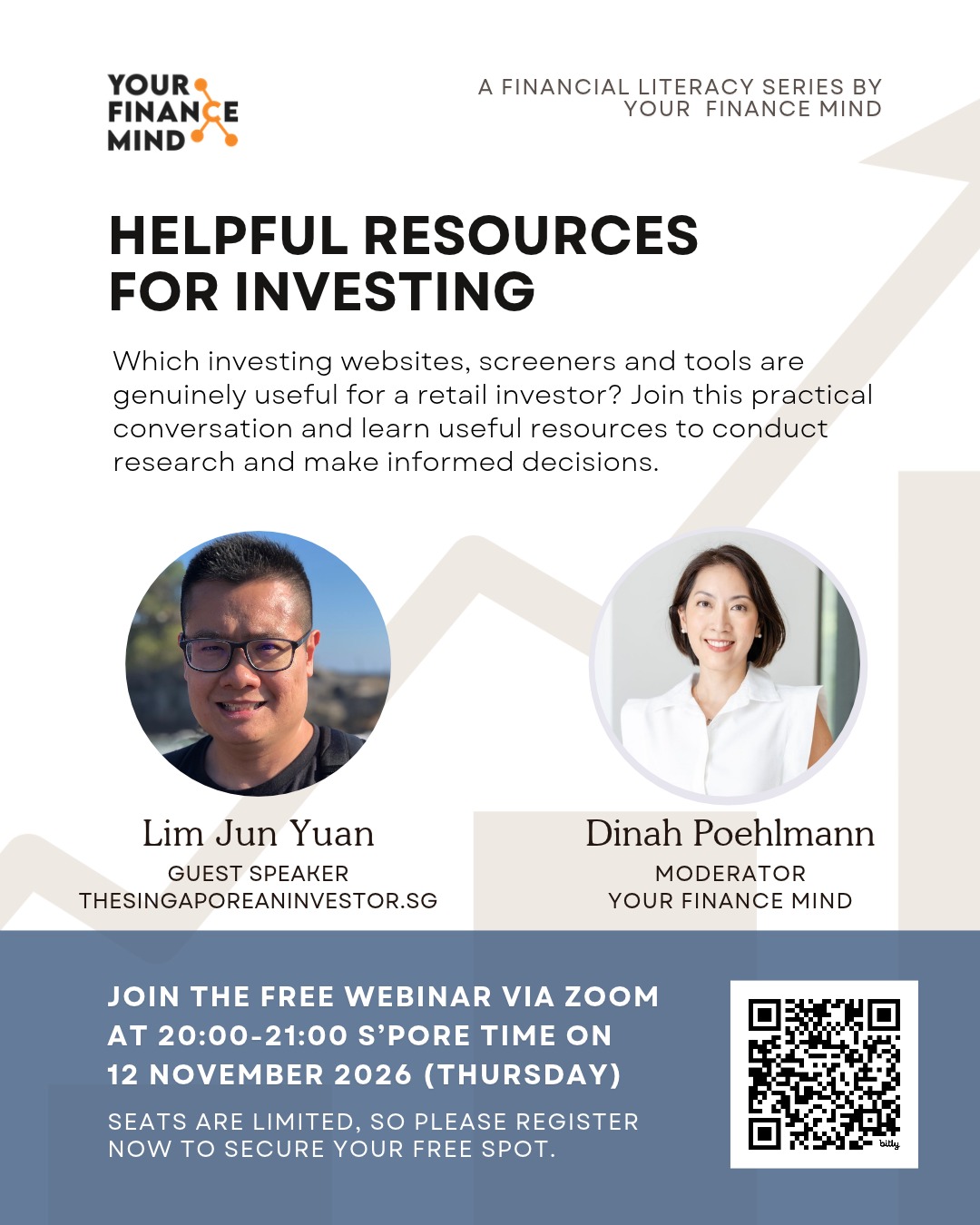
It's been quite some time since I last had a live chit-chat with the investing community, and I’m excited to be back for another session! A big thank you to my friend, Dinah Poehlmann from Your Finance Mind, for inviting me once again!
This time, we’re taking a little break from REITs and exploring some interesting topics surrounding investing, including my go-to investing resources, when is a stock considered 'investable', my thoughts about using AI for stock analysis and trading, and much more.
Whether you're just starting your investing journey or have been investing for years, I hope this session will offer some useful perspectives and practical takeaways that you can apply to your own investing journey.
Best of all, the session is completely FREE to attend! All you need to do is register in advance to receive the Zoom link:
👉 Click here to reserve your spot!
Are You Worried about Not Having Enough Money for Retirement?
You're not alone. According to the OCBC Financial Wellness Index, only 62% of people in their 20s and 56% of people in their 30s are confident that they will have enough money to retire.
But there is still time to take action. One way to ensure that you have a comfortable retirement is to invest in real estate investment trusts (REITs).
In 'Building Your REIT-irement Portfolio' which I've authored, you will learn everything you need to know to build a successful REIT investment portfolio, including a list of 9 things to look at to determine whether a REIT is worthy of your investment, 1 simple method to help you maximise your returns from your REIT investment, 4 signs of 'red flags' to look out for and what you can do as a shareholder, and more!

You can find out more about the book, and grab your copy (ebook or physical book) here...


Comments (0)