Brief Introduction:
Founded in 1980 by 4 siblings and 2 in-laws, and listed on the Mainboard of the Singapore Exchange in 2008, Wee Hur Holdings Limited (SGX: E3B) is a diversified group with interests spanning property development, construction, workers’ and student accommodation, fund management, and alternative investments.
The group’s property development activities are conducted in both Singapore and Australia. In Singapore, its wholly-owned subsidiary, Wee Hur Property Pte Ltd, acquires vacant land parcels and redevelopment opportunities for residential, industrial, commercial, and mixed-use projects. Notable developments include Premier@Kaki Bukit, Mega@Woodlands, Parc Botannia, and Bartley Vue. In Australia, development activities are overseen by Wee Hur (Australia) Pte Ltd, which manages the group’s property projects across the country.
Its construction operations are carried out through its wholly-owned subsidiary, Wee Hur Construction Pte Ltd, which undertakes a broad range of projects across the residential, commercial, industrial, institutional, religious, restoration, and conservation sectors for both public and private clients. Key projects include the Mount Vernon Funeral Parlour Complex, HDB Build-To-Order developments such as MacPherson Blossom and Bartley Beacon, as well as industrial developments including Courts Megastore @ Tampines and DBS Asia Hub.
The group also owns and operates 2 workers’ dormitories in Singapore (Tuas View Dormitory and Pioneer Lodge Workers’ Dormitory), while its student accommodation portfolio spans Australia and, more recently, Hong Kong.
Through its fund management arm, Wee Hur Capital, the group manages purpose-built student accommodation funds, while its alternative investments segment explores opportunities in venture capital, private credit, and private equity.
For FY2025, the largest contributor to the group’s revenue was rental income from its Singapore workers’ dormitories, accounting for 31% of total revenue. This was followed by property development at 28%, building construction at 26%, fund management at 14%, and student accommodation at 1%.
Financial Performance (between FY2021 and FY2025):
With a financial year ending on 31 December, Wee Hur’s financial performance over the past 5 years (FY2021–FY2025) is summarised as follows:
| FY2021 | FY2022 | FY2023 | FY2024 | FY2025 | |
| Gross Revenue (S$’mil) | $200.4m | $215.9m (+7.7%) | $224.8m (+4.1%) | $200.8m (-10.7%) | $295.4m (+47.1%) |
| Gross Profit (S$’mil) | $8.5m | $25.4m (> +100%) | $53.6m (> +100%) | $83.0m (+54.9%) | $135.7m (+63.5%) |
| Net Profit (S$’mil) | $0.7m | $67.9m (> +100%) | $98.6m (+45.2%) | $54.0m (-45.2%) | $68.4m (+26.7%) |
Overall, Wee Hur experienced year-on-year growth in both gross revenue and net profit throughout the period, except for FY2024.
The dip in that year was mainly due to reduced contributions from the construction and property segments, driven by slower construction activity and lower sales of industrial units at Mega@Woodlands. This decline was partially mitigated by stronger rental income from Tuas View Dormitory.
Gross & Net Profit Margins (between FY2021 and FY2025):
| FY2021 | FY2022 | FY2023 | FY2024 | FY2025 | |
| Gross Profit (%) | 4.2% | 11.8% | 23.8% | 41.3% | 45.9% |
| Net Profit (%) | 0.3% | 31.4% | 43.9% | 26.9% | 23.2% |
Over the past 5 years, Wee Hur’s gross profit margin has shown strong and consistent growth, rising from 4.2% in FY2021 to a 5-year high of 45.9% in FY2025.
In contrast, its net profit margin has declined over the last 2 years, falling from a high of 43.9% in FY2023 to 23.2% in FY2025.
Debt Profile (between FY2021 and FY2025):
| FY2021 | FY2022 | FY2023 | FY2024 | FY2025 | |
| Cash & Cash Equivalents (S$’mil) | $53.4m | $38.5m | $107.3m | $101.8m | $250.8m |
| Total Borrowings (S$’mil) | $604.5m | $103.8m | $198.9m | $215.7m | $389.7m |
| Net Cash/Debt (S$’mil) | -$551.1m | -$65.3m | -$91.6m | -$113.9m | -$138.9m |
| Current Ratio | 0.7 | 2.1 | 1.5 | 1.6 | 2.4 |
Wee Hur has remained in a net debt position throughout the 5-year period, which is consistent with industry norms.
Its current ratio has stayed above 1.0 in all years except FY2021, and has improved over the last 2 years. This indicates that the company is well-positioned to meet its short-term debt obligations without difficulty.
Dividend Payout to Shareholders (between FY2021 and FY2025):
As a shareholder of Wee Hur, dividends are paid on an annual basis, typically alongside the release of its full-year financial results.
The table above summarises Wee Hur’s dividend payout over the past 5 financial years, together with its corresponding dividend yield, calculated based on the company’s closing share price on the last trading day of each financial year:
| FY2021 | FY2022 | FY2023 | FY2024 | FY2025 | |
| Dividend Per Share (S$’cents) | 0.5 cent | 0.5 cent | 0.6 cent | 8.0 cents ^^ | 1.0 cent |
| Dividend Yield (%) | 2.5% | 2.4% | 3.1% | 19.0% ** | 1.3% |
^^ – Wee Hur’s dividend payout of 8.0 cents in FY2024 was inclusive of a special dividend payout of 7.0 cents/share due to the distribution of proceeds from the sales of a 37.1% stake in its PBSA Fund I to Greystar. Stripping that out, its dividend would have been at 1.0 cent.
** – Excluding the special dividend, the dividend yield for FY2024 would have been approximately 2.4%.
Adjusting for the special dividend in FY2024, Wee Hur’s ordinary dividend has generally trended upwards over the past 5 years, increasing from 0.5 cent per share in FY2021 to 1.0 cent per share in FY2025.
That said, the company’s dividend yield has remained relatively modest, ranging between 1.3% to 2.5% (excluding the special dividend) over the period. Coupled with its once-a-year payout schedule, the company is unlikely to appeal primarily to investors seeking a high and regular stream of dividend income.
Closing Thoughts:
A few aspects of Wee Hur that stand out include its well-diversified revenue streams, with no single business segment dominating total revenue, a generally stable growth in both top- and bottom-lines, and a consistent improvement in gross profit margin.
Beyond the numbers, the management has demonstrated openness and transparency in my interactions with them – first during a site visit to Pioneer Lodge Workers’ Dorm, and later during a Corporate Highlight recording with its Chief Investment Officer, Mr Goh Wee Ping. In my view, this reflects a strong corporate culture. While Wee Hur remains a family-run business, some of the key management positions are held by non-family professionals, with a focus on capability over familial ties – an important consideration in governance.
On the flip side, the company’s net profit margin has declined over the past 2 years, and it remains in a net debt position, though this is common among peers in the same industry.
Finally, although Wee Hur’s dividend payouts have steadily grown over the past 5 years, the combination of annual payout frequency and a relatively modest yield (ranging from just over 1% to slightly above 2%) may offer limited appeal for income-focused investors.
Corporate Highlight Recording with Wee Hur Holdings Limited:
In partnership with AlphaInvest, I recently recorded a Corporate Highlight episode featuring Wee Hur Holdings Limited.
In this video, you’ll get an inside look at the company’s Pioneer Lodge Workers’ Dormitory, followed by a Q&A session with its Chief Investment Officer, Mr Goh Wee Ping, covering a range of topics such as the company’s operations, growth strategy, challenges, and regulatory compliance.
Disclaimer: At the time of writing, I do not have shares of Wee Hur Holdings Limited.
Stop Spending Hours Reading REIT Reports Every Quarter!
What if you could assess a REIT's portfolio occupancy, debt profile, valuation, and overall health in less than 30 seconds - without having to comb through a single quarterly report?
That's the problem the REIT Screener was built to solve.
Developed through a collaboration between ShareInvestor and The Singaporean Investor, the REIT Screener consolidates many of the key metrics and indicators I personally use when analysing REITs into one easy-to-use platform. Instead of spending hours extracting data manually every earnings season, you can now monitor the REITs you own and research new opportunities in just a few clicks.
If you're serious about REIT investing but don't have the time to manually track quarterly developments, the REIT Screener could be the shortcut you've been looking for:
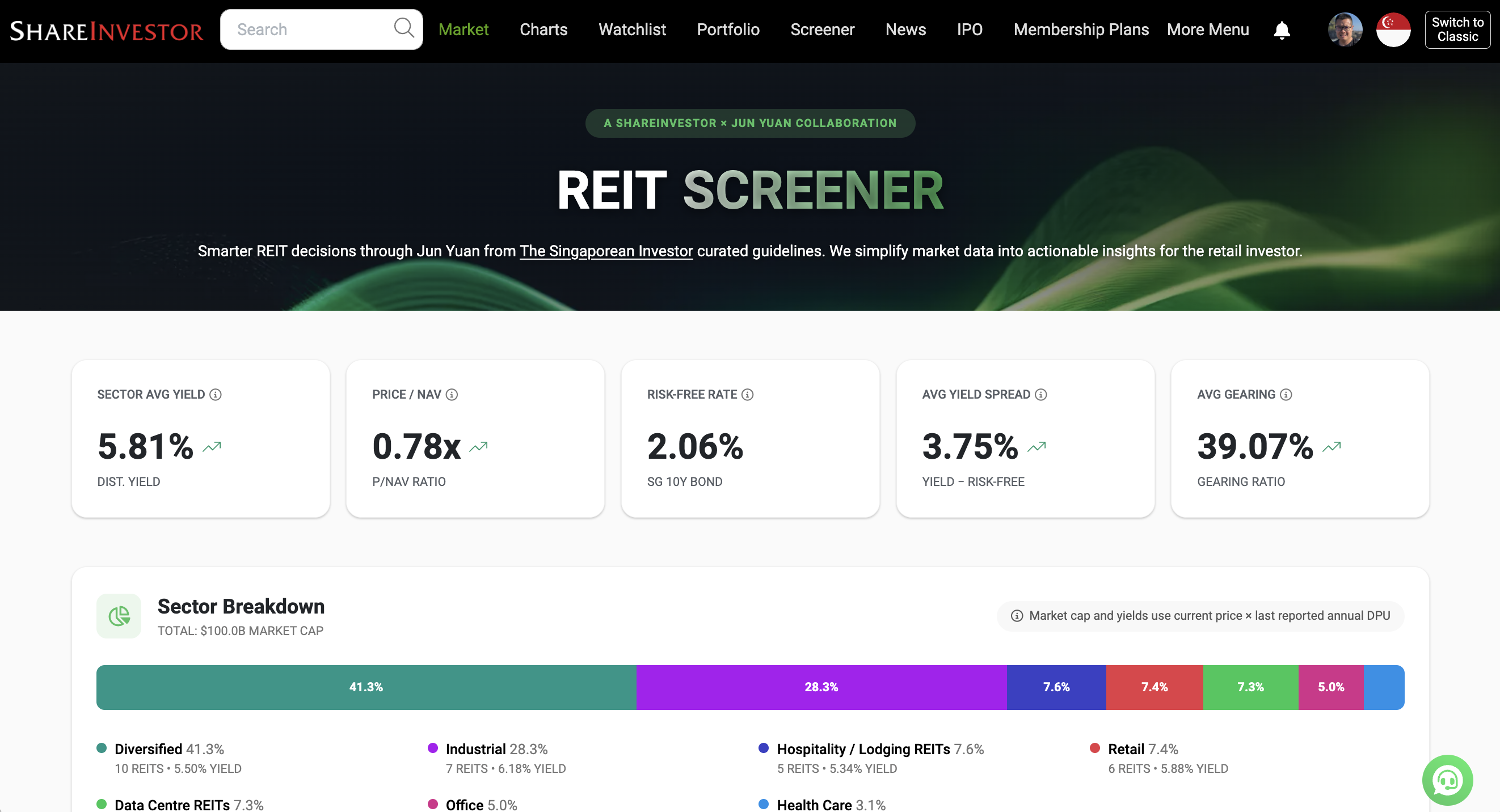
Take a closer look at the REIT Screener here...



Comments (0)