At the invitation of SGListCos, I had the opportunity last week to visit SingPost’s Regional eCommerce Logistics Hub in Tampines to gain a better understanding of its operations.
One of the key highlights of the visit was the chance to view SingPost’s newly installed automated machines in action, including its 3D Sorter and Intelligent Flexi Sorter. These systems will significantly raise the company’s small and medium parcel processing capacity from the current 100,000 parcels per day to 300,000 parcels per day.
During the visit, SingPost’s Chief Financial Officer (CFO), Mr Isaac Mah, also delivered a presentation on the company’s strategy and transformation plans. He also took questions from myself and other attendees.
In this post, I will be sharing a summary of the presentation, some video clips of the new automated machines in operation, as well as highlights from the Q&A session with the CFO.
Highlights from the Presentation by CFO Mr Isaac Mah
1. SingPost is Moving Beyond Traditional Mail
SingPost’s challenges over the past decade have largely stemmed from the structural decline in traditional letter mail volumes, legacy technology systems, and operating models that were not designed for today’s e-commerce-driven logistics landscape.
Over the past year, the company has undergone a restructuring exercise. This included a major leadership change, exits from non-core overseas markets, and the divestment of assets that were no longer aligned with its future direction.
In FY2025 alone, SingPost completed 11 divestment transactions. Management believes these moves have placed the company on a stronger footing to focus on future growth opportunities.
2. Three Strategic Priorities to Guide Growth
Moving forward, SingPost’s transformation will be anchored by 3 strategic priorities.
The first is to strengthen its core fundamentals. This involves optimising operations and technology, with the company targeting a more than 10% reduction in cost-to-serve through AI, automation, and system consolidation.
The second is to build scalable capabilities. This includes investments in IT, customer experience, autonomous vehicles, digital platforms, and commercial partnerships, alongside the modernisation of its Post Office Network.
The third is to capture new growth opportunities. SingPost intends to expand beyond e-commerce into new markets, services, and customer segments.
3. The New Automated Sorting Facility
The centrepiece of the visit was SingPost’s upgraded eCommerce Logistics Hub, which represents a S$30 million investment to boost processing capacity.
The scale of the upgrade is significant. Total daily parcel processing capacity will increase from 200,000 parcels to 400,000 parcels, while small and medium parcel processing capacity will rise from 100,000 parcels to 300,000 parcels per day.
The number of sorting chutes has also increased from 150 to 237, while the 3D Sorter’s sorting totes have expanded from 252 to 580. In addition, 48 Autonomous Ground Vehicles have been introduced, compared to none previously.
With these upgrades, the facility’s workflows are now approximately 75% automated, compared with an almost entirely manual process previously.
There are 3 key automation systems in operation.
The first is the 3D Sorter, which is capable of sorting up to 6,000 parcels per hour. It can handle items as thin as 5mm, as light as 10g, and up to 5kg in weight. Importantly, it uses Optical Character Recognition technology to read parcel labels, while also measuring parcel dimensions and weight. This improves sorting accuracy and helps with revenue capture.
With 580 output chutes now available, SingPost is also able to cover all delivery zones more efficiently, reducing the need for postmen to perform a second layer of manual sorting.
The second is the Intelligent Flexi Sorter, or IFS. This is the larger machine that drives the major uplift in processing capacity. While it takes up more floor space, it delivers the bulk of the throughput improvement.
Management also highlighted that the IFS was designed with future expansion in mind. There is still significant space within the facility, and additional modules can be added if volumes grow.
The third is the Autonomous Ground Vehicles, or AGVs. A total of 48 robots now help move goods between sorting chutes and delivery staging areas — a task that was previously done entirely by contract labour.
Each AGV can carry up to 600kg and, after a 1.5-hour charge, can run for up to 16 hours.
The facility currently operates for around 16 hours a day, with the remaining time used for maintenance. Sortation activity is also tied to collection cut-off times, meaning there is currently no need for the facility to operate round the clock.
The hub is expected to go live with actual freight in July 2026, following the completion of installation works. Management also shared that the facility has been built with spare capacity and modular expansion in mind.
4. Parcel Operations to be Consolidated at the Tampines Hub
Another key benefit arising from SingPost’s investment in automation is the consolidation of its parcel sorting operations.
Currently, parcel sorting activities are conducted at both the Regional eCommerce Logistics Hub in Tampines and SingPost Centre. From July 2026 onwards, these operations are expected to be centralised at the Tampines facility, allowing SingPost to streamline workflows and improve operational efficiency.
As a result of the consolidation, approximately 80,000 square feet of industrial space at SingPost Centre will be freed up. Management shared that it is currently evaluating the best use for the space, with options including supporting new business initiatives, expanding into healthcare-related logistics services, or leasing it out to third parties.
On the healthcare front, SingPost had earlier signed a strategic memorandum of understanding (MOU) with Fullerton Health in May 2026. Regardless of the eventual use, management believes the freed-up space presents opportunities to unlock additional value for shareholders.
Meanwhile, the existing sorting machines at SingPost Centre will be decommissioned as part of the transition. Having been in operation since 2014, the equipment is approaching the latter part of its typical 15- to 20-year operational lifespan. The move to retire these machines and replace them with the newer, more advanced systems at the Tampines hub is in line with SingPost’s broader efforts to modernise its logistics infrastructure and enhance productivity.
5. Autonomous Delivery Vehicles Could be Part of the Future
SingPost has also partnered with Chinese autonomous vehicle company Zelos Technology, which management described as a leading AV player in China with over 20,000 vehicles on the road. Alibaba is also said to have taken a stake in the company.
Currently, 3 autonomous vehicles are operating inside the logistics hub to move goods between floors.
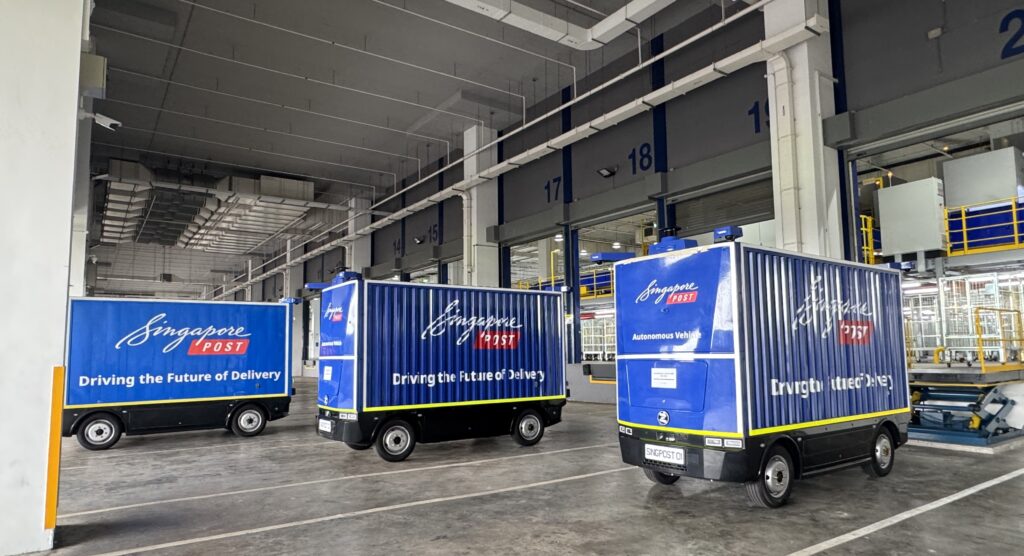
Management shared that SingPost is in active discussions with the Land Transport Authority on potential road trials. The Tampines location is conveniently situated for such trials. At the same time, the government is expected to propose an AV Act next year, which SingPost is closely monitoring.
Question & Answer Highlights
1. On Share Price Catalysts and Timelines
When asked about potential share price catalysts, the CFO asked investors for patience.
He emphasised that SingPost has publicly committed to several KPIs, including a more than 10% reduction in cost-to-serve. The company will provide updates against these targets over time.
The next business update is expected in August 2026, where management is likely to provide more colour on the progress made. A fuller update will come in November 2026, when SingPost releases its financial results for the first half of FY2027.
2. Revenue Impact of the Islandwide Rollout of ‘SingPost@MyBlock’
According to the CFO, the primary objective of the initiative is to enhance convenience for residents while reinforcing SingPost’s role in serving the nation.
While the direct revenue impact may be limited initially, the company expects indirect benefits from increased usage of its SmartPac service. With users able to conveniently drop off parcels at their residential blocks instead of travelling to a post office or mailbox, the ease of access could encourage greater adoption over time.
3. On Competition with SPX Express and Other Last-Mile Players
On competition, management believes SingPost’s key differentiators are density and trust.
Mr Mah highlighted that SingPost is the only operator that delivers to every address every working day, and that it is regulated by strict service level agreements.
The current limitation is that SingPost’s infrastructure has historically been optimised for flats and smaller parcels. The new investments are intended to address this gap. Wider letterbox apertures, lockers, and expanded delivery points are among the areas being considered to unlock larger parcel volumes.
4. On Dividends
SingPost’s dividend policy remains unchanged, with the company committed to paying out 30% to 50% of underlying net profit.
A supplementary dividend was also paid this year as part of a one-off exercise to regularise liabilities.
5. On the Decline in International Parcel Revenues
Mr Mah explained that SingPost previously operated a sizeable international cross-border parcel business by leveraging Changi Airport’s connectivity.
At its peak, this business generated around S$400 million in revenue.
However, during the Covid-19 pandemic in 2020, Changi Airport was temporarily shut, forcing customers to find alternative commercial routes. When the airport reopened, many customers did not return.
At the same time, customer expectations had changed significantly. Previously, customers might have been willing to wait weeks for an international parcel. Today, they expect delivery within days.
Postal routes are generally more cost-effective, but they are slower and less competitive in terms of service-level commitments. As a result, this business has shrunk to around S$18 million today.
SingPost is not trying to rebuild this business in the same form. Instead, it is focusing on domestic opportunities and selected international niches where it has a structural advantage.
6. On the Postal Licence and Segment Profitability
Management shared that SingPost’s postal licence fee comprises both fixed and variable components.
At the segment level, the property business remains profitable. The logistics and letters segment slipped into a loss in the past year, although it was profitable in the prior year. The post office network is also currently loss-making, but management has a clear plan to improve its sustainability.
7. On SingPost’s New CEO, Mr Mark Chong
Mr Mah also shared his thoughts on SingPost’s new CEO, Mr Mark Chong.
Mr Chong came from a telecommunications background, most recently as Group CTO at SingTel, where he oversaw the transition from 4G to 5G.
According to Mr Mah, this experience is relevant to SingPost’s transformation, particularly given the importance of digitalisation, technology implementation, and operational transformation in the company’s future roadmap.
8. On China Partnerships
The upgraded sortation facility was designed and project-managed by a Chinese contractor, with multiple vendors involved.
SingPost views Chinese logistics technology companies as being at the cutting edge, and continues to work with them. Zelos Technology, its autonomous vehicle partner, is one such example.
Closing Thoughts
My key takeaway from the site visit, the presentation, the Q&A session, and my one-on-one conversation with the CFO is that management is fully aware of the challenges facing SingPost.
The most obvious challenge is the structural decline in traditional mail volumes. However, Mr Mah also pointed out that traditional postal services continue to play an important role in Singapore. Examples include the delivery of face masks during the Covid-19 pandemic, polling cards during General Elections, and government letters sent through registered mail.
With Mr Mark Chong having only taken over as CEO in September 2025, management is asking investors for more time to execute its transformation plans.
While the CFO was not able to share details of every initiative, as some are still works in progress, he indicated that management will provide more updates during the upcoming business update in August 2026, followed by the release of SingPost’s first-half FY2027 results in November 2026.
From my personal perspective, I will be keeping a close watch on 2 areas.
The first is whether SingPost can expand its share of Singapore’s last-mile fulfilment market for small and medium parcels.
The second is how the new management team intends to navigate the company’s structural challenges, stabilise its financial performance, and address investors’ concerns over dividends.
Disclaimer: At the time of writing, I do not have shares of Singapore Post Limited.
Are You Worried about Not Having Enough Money for Retirement?
You're not alone. According to the OCBC Financial Wellness Index, only 62% of people in their 20s and 56% of people in their 30s are confident that they will have enough money to retire.
But there is still time to take action. One way to ensure that you have a comfortable retirement is to invest in real estate investment trusts (REITs).
In 'Building Your REIT-irement Portfolio' which I've authored, you will learn everything you need to know to build a successful REIT investment portfolio, including a list of 9 things to look at to determine whether a REIT is worthy of your investment, 1 simple method to help you maximise your returns from your REIT investment, 4 signs of 'red flags' to look out for and what you can do as a shareholder, and more!

You can find out more about the book, and grab your copy (ebook or physical book) here...


Comments (0)