When we think about what separates successful investors from everyone else, one word that often comes to mind is ‘intelligence’.
Perhaps it is the ability to analyse financial statements, understand complicated business models, identify undervalued companies, or anticipate where the economy may be heading next.
While all these abilities can certainly be useful, the reality is that, in investing, being the smartest person in the room does not necessarily mean you will achieve the best results.
In fact, I would argue that there is another quality that matters even more over the long run, and that is ‘consistency’.
You do not need to make brilliant investment decisions all the time. What matters more is having a sensible investment process and being able to stick to it consistently, year after year.
Let us find out why in this post.
A Great Strategy Is Useless If You Cannot Stick to It
Most investors are already familiar with the basic principles of investing – Buy good companies at reasonable valuations. Do your research before investing. Diversify appropriately. Avoid chasing share prices simply because they are rising. And most importantly, do not panic and sell everything just because the markets are falling.
I am sure you will agree with me that none of these principles are particularly complicated or new. In fact, many successful investors around the world follow these very same principles as well!
However, knowing what to do is one thing. Being able to follow these principles consistently is another – and this is often what separates successful investors from the rest.
It is easy to say that you will patiently wait for an attractive valuation before investing. However, it becomes much harder when the share price of a company on your watchlist keeps climbing and you start worrying that you may ‘miss the boat’.
Similarly, it is easy to say that you will remain calm during a market correction. But when your portfolio suddenly falls by 15% or 20%, sticking to your original investment plan can become much more difficult.
This is where consistency becomes so important.
After all, even the best investment strategy will only work if we are able to stick to it when our emotions are telling us to do otherwise.
You Do Not Need to Get Every Decision Right
One common misconception about successful investing is that we need to consistently identify the best stocks before everyone else does.
The truth is, we do not.
Even the most experienced investors make mistakes. They may invest in a company whose earnings subsequently disappoint, underestimate a particular risk, or sell an investment that later goes on to perform extremely well.
The objective should therefore not be perfection.
Rather, what matters is having a repeatable investment process that increases the likelihood of making sensible decisions over a large number of investments.
For example, before investing in a company, you may consistently examine its revenue and profit growth, margins, balance sheet, cash flow, competitive position, and valuation.
Following such a process certainly does not guarantee that every investment will work out. However, it can reduce the likelihood of your decisions being driven purely by excitement, fear, or whatever happens to be popular in the market at that point in time.
Over the long run, consistently making reasonably good decisions can be far more powerful than occasionally making a brilliant one.
Consistency Helps Keep Emotions in Check
Markets have an interesting way of testing our discipline.
When share prices keep rising, we may become increasingly confident and gradually start relaxing the rules we previously set for ourselves.
Perhaps we become willing to pay a higher valuation because we convince ourselves that ‘this company is different’.
We may also increase our position size because our previous few investments have worked out well, giving us greater confidence in our own judgement.
On the other hand, when markets fall, the exact opposite may happen.
Fear takes over, and we suddenly become reluctant to invest – even though valuations may have become much more attractive.
Having a consistent investment process gives us something objective to fall back on during such moments.
Instead of asking ourselves, ‘How do I feel about the market today?’, we can ask whether an investment still meets the criteria we established beforehand.
That simple shift in thinking can go a long way towards preventing emotions from taking complete control of our investment decisions.
Small Good Decisions Compound Over Time
We often associate compounding with investment returns. However, good investing habits can compound over time as well.
These include:
Doing proper research before investing.
Keeping position sizes reasonable.
Reviewing our investment theses periodically.
Avoiding unnecessary trading.
Learning from our mistakes.
And perhaps most importantly, continuing to invest, learn, and improve through different market environments.
None of these actions will transform your portfolio overnight. However, if we consistently repeat them over 5, 10, or even 20 years, their cumulative impact can become significant.
The advantage in investing does not necessarily come from knowing something that nobody else knows.
Sometimes, it simply comes from doing the ordinary things well – and continuing to do them for longer than most people are willing to.
Closing Thoughts
Intelligence is undoubtedly useful in investing. Being able to understand businesses, interpret financial statements, and assess valuations can certainly help us make better investment decisions.
However, intelligence alone is not enough.
A highly intelligent investor who constantly switches strategies, chases whatever is popular in the market, ignores valuations when feeling optimistic, and panics whenever markets fall may still struggle to achieve satisfactory results over the long run.
Meanwhile, an investor with a relatively simple strategy, but who consistently follows a sensible process and continues learning from mistakes, may put themselves in a much stronger position over time.
Investing is not about proving how smart we are.
Rather, it is about making enough sensible decisions, avoiding major unnecessary mistakes, and allowing time and compounding to do their work.
If there is one thing you can do after reading this post, it is to write down your own investment process.
It does not need to be complicated. List down the key things you need to check before making an investment, the circumstances that would cause you to sell, and the mistakes you want to avoid repeating.
Then, the next time markets become unusually exciting (or frightening), go back to that list.
Because over the long run, the investor who consistently follows a sound process may have a much greater advantage than one who is simply trying to be the smartest person in the room.
Stop Spending Hours Reading REIT Reports Every Quarter!
What if you could assess a REIT's portfolio occupancy, debt profile, valuation, and overall health in less than 30 seconds - without having to comb through a single quarterly report?
That's the problem the REIT Screener was built to solve.
Developed through a collaboration between ShareInvestor and The Singaporean Investor, the REIT Screener consolidates many of the key metrics and indicators I personally use when analysing REITs into one easy-to-use platform. Instead of spending hours extracting data manually every earnings season, you can now monitor the REITs you own and research new opportunities in just a few clicks.
If you're serious about REIT investing but don't have the time to manually track quarterly developments, the REIT Screener could be the shortcut you've been looking for:
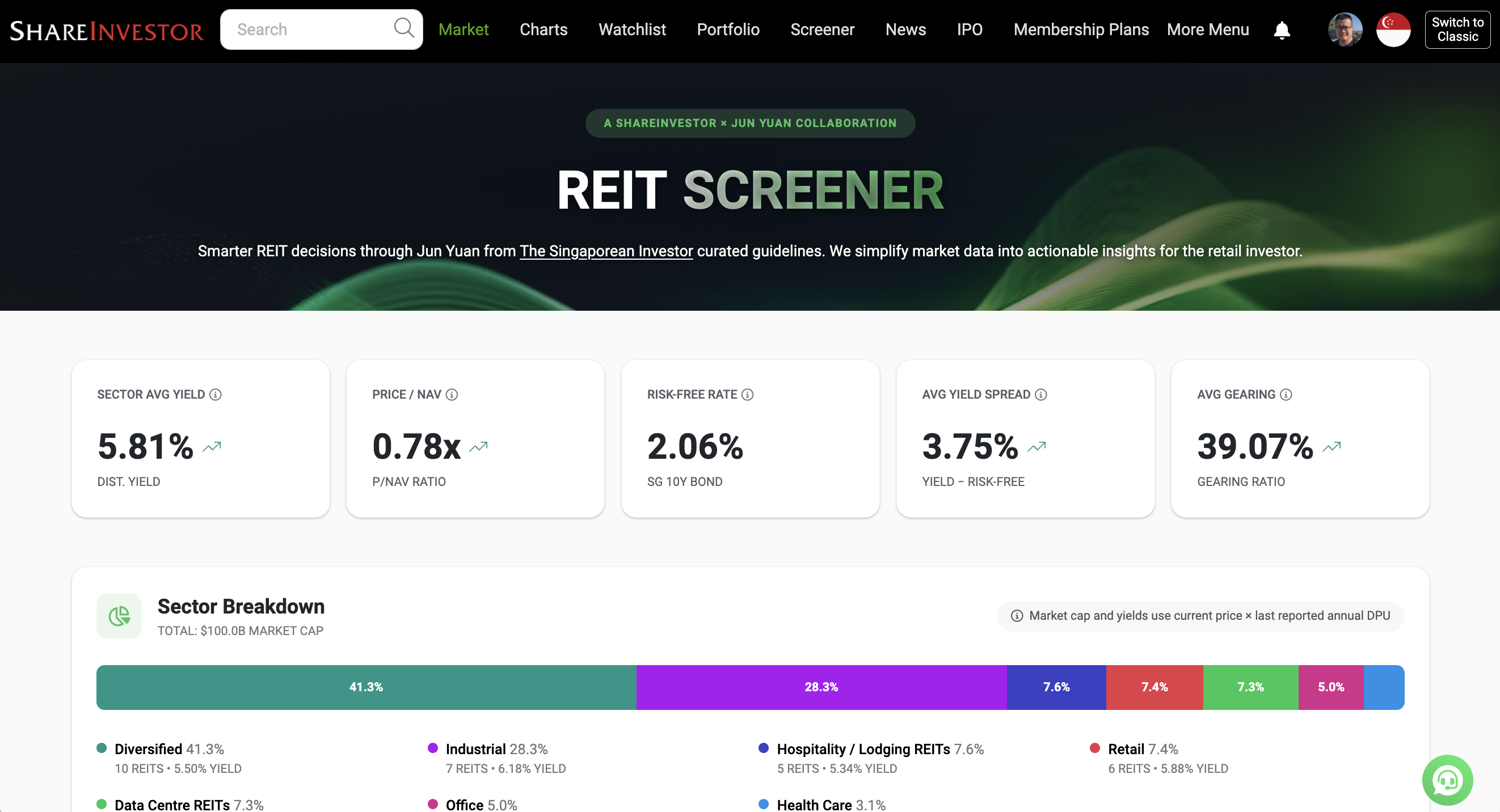
Take a closer look at the REIT Screener here...



Comments (0)