1. Deluge Corporation Limited – What Does the Company Do?
Deluge Corporation Limited is the largest player in Singapore’s fire detection and protection industry, with an estimated market share of approximately 8.3% in 2025, according to Frost & Sullivan.
The company provides an integrated, end-to-end range of fire detection and protection solutions covering the entire lifecycle of a fire protection system – from design, prefabrication and installation, to subsequent maintenance, servicing and training.
Its solutions can broadly be divided into active and passive fire protection systems.
Active fire protection systems include fire alarms and detectors, water-based sprinkler systems, water mist systems, foam systems and gas-based suppression systems. Passive fire protection systems, meanwhile, include fire-resistant structural elements and fire-stopping solutions.
Beyond installation, Deluge also provides preventive and corrective maintenance services, as well as additions and alterations to existing fire detection and protection systems.
The company also operates the BCA-accredited Deluge Training Test Centre, which provides fire safety training, professional upskilling programmes and competency assessments for industry professionals.
Its customer base spans a wide range of industries, including industrial, commercial, residential, healthcare, government and public sector, aviation, oil and gas, offshore and marine, technology, semiconductor, logistics, data centres and critical infrastructure.
Over the years, Deluge’s fire detection and protection systems have been installed across hospitals, airports, educational institutions, public transportation infrastructure, shopping malls and other critical infrastructure projects in Singapore and the region.
2. What are Some of Deluge’s Notable Projects?
Some of the notable projects undertaken by Deluge include:
- Fire protection systems for Land Transport Authority rail works involving Circle Line Stage 6 and the North East Line Extension.
- Fire protection works across airport terminal infrastructure at Changi Airport Terminals 1 and 2.
- Installation of fire protection, fire alarm, hydrant and clean gas systems at Sengkang General Hospital.
- Installation of fire protection systems at Marina Bay Sands Integrated Resort.
3. How Does Deluge Make Money?
Deluge reports its revenue across 3 business segments:
1. Integrated Projects:
This segment provides comprehensive fire detection and protection engineering and mechanical & electrical (M&E) services for both land-based and offshore projects.
Its involvement spans the entire project cycle, from design and procurement of materials to prefabrication, installation, testing and commissioning of fire detection and protection systems.
2. Lifecycle Services:
This segment provides ongoing maintenance and servicing solutions for installed fire detection and protection systems.
Its services include scheduled inspections and testing, preventive and corrective maintenance, 24/7 emergency response, system upgrades and regulatory compliance services. It also provides consultancy services relating to fire detection and protection systems and products.
These services are provided through long-term maintenance contracts, annual service agreements and ad-hoc engagements.
3. Products Distribution:
This segment is involved in the sourcing, distribution, sale and supply of fire detection and protection products, equipment, components and proprietary brands to contractors, facility owners, maintenance providers and industrial customers.
For the latest financial year ended 31 March 2026 (FY2026), Integrated Projects was Deluge’s largest revenue contributor at 66.6%, followed by Lifecycle Services at 30.0%, while Products Distribution contributed the remaining 3.4%.
Geographically, Deluge remains heavily exposed to Singapore. The country accounted for 90.3% of its FY2026 revenue, followed by Malaysia at 9.6%, while other countries collectively contributed the remaining 0.1%.
4. How Has Deluge Performed Financially?
Deluge has a financial year ending on 31 March. Its top- and bottom-line performance over the last 3 financial years, from FY2024 to FY2026, is as follows:
| FY2024 | FY2025 | FY2026 | |
| Revenue (S$’mil) | $113.2m | $139.8m (+23.5%) | $116.7m (-16.5%) |
| Gross Profit (S$’mil) | $33.6m | $42.5m (+26.5%) | $38.8m (-8.7%) |
| Net Profit (S$’mil) | $7.9m | $15.1m (+91.1%) | $11.2m (-25.8%) |
| Gross Profit Margin (%) | 29.7% | 30.4% | 33.2% |
| Net Profit Margin (%) | 7.0% | 10.8% | 9.6% |
Both revenue and net profit recorded double-digit year-on-year declines in FY2026.
The decline in revenue was mainly due to a lower contribution from the Integrated Projects segment. Several major ongoing projects, including major infrastructure projects, had reached their peak execution stages in FY2025 before returning to more normalised activity levels in FY2026.
As for the decline in net profit, this was due to a combination of factors, including lower gross profit and other income (with the latter affected by lower rental and fixed deposit interest income), as well as higher administrative expenses (mainly attributable to higher staff costs, professional fees, staff welfare and training expenses, along with office upkeep and maintenance costs).
One positive, however, was the continued improvement in Deluge’s gross profit margin despite the decline in revenue.
Gross profit margin improved from 30.4% in FY2025 to 33.2% in FY2026, supported by a 19.9% year-on-year decline in cost of sales. This was mainly due to lower material costs following the completion of peak execution activities for several major ongoing projects, including major infrastructure projects.
5. How Strong is Deluge’s Balance Sheet?
Deluge’s cash and borrowings over the last 3 financial years were as follows:
| FY2024 | FY2025 | FY2026 | |
| Cash & Cash Equivalents (S$’mil) | $$6.4m | $8.1m | $14.0m |
| Total Borrowing (S$’mil) | $21.7m | $26.4m | $11.2m |
| Net Cash/Debt (S$’mil) | -$15.3m | -$18.3m | +$2.8m |
One notable development in FY2026 was therefore the significant improvement in Deluge’s balance sheet, with the company moving from a net debt position of S$18.3m in FY2025 to a net cash position of S$2.8m.
6. Where Could Deluge’s Future Growth Come From?
In Singapore, Deluge could potentially benefit from a strong pipeline of transportation, healthcare, aviation, industrial, logistics and urban redevelopment projects.
Major developments include Changi Airport Terminal 5, Tuas Mega Port, the Cross Island Line, Downtown Line Extension, North-South Corridor and new healthcare developments.
This is on top of continued investments in data centres and other critical infrastructure, including new capacity and expansion projects by major technology and data centre operators.
Malaysia represents another potential avenue for growth, particularly through the Johor-Singapore Special Economic Zone (JS-SEZ).
Further industrial and data centre development within the JS-SEZ could generate additional demand for fire detection and protection systems, providing Deluge with opportunities to expand its presence across the border.
7. What is Deluge’s Dividend Policy?
Management has guided that the company intends to distribute at least 25% of its net profit attributable to shareholders as dividends.
8. What are the IPO Price and Key Dates?
Deluge’s IPO price has been set at S$0.60 per share.
The public offer opens on 6 October 2026 and closes on 14 October 2026 at 12 noon.
Trading of the company’s shares is expected to commence on 16 October 2026 at 9.00am.
The minimum initial application is 1,000 offering shares, with additional shares applied for in multiples of 100.
9. How Will Deluge Use the IPO Proceeds?
From my understanding, the net proceeds from the Offering and Cornerstone Tranche will primarily be used for the following purposes:
- Investing in infrastructure, facilities and operational capabilities.
- Pursuing strategic partnerships, acquisitions, joint ventures and regional expansion opportunities.
- Supporting further business expansion by allowing Deluge to participate in more tenders, secure additional contracts and undertake larger-scale projects.
For the last point, additional working capital will be required to support areas such as manpower, tender deposits, project mobilisation costs, material procurement, performance bonds and other expenses associated with taking on a larger number of projects and projects of greater scale.
Closing Thoughts:
Fire protection is an essential requirement for buildings and infrastructure, whether residential, commercial, industrial or public. As such, I regard the products and services provided by Deluge Corporation Limited as essential in nature.
Investors who prefer companies with significant exposure to Singapore may also find Deluge interesting, given that slightly more than 90% of its FY2026 revenue was generated from the city-state.
Looking ahead, I am also positive about the company’s growth prospects.
There is a sizeable pipeline of infrastructure and development projects in Singapore over the coming years, including Changi Airport Terminal 5, Tuas Mega Port and the Cross Island Line, just to name a few. These are massive projects, and could potentially provide Deluge with opportunities to further grow its order book.
This is on top of further developments announced by Prime Minister Lawrence Wong during the National Day Rally in August 2026.
Going through Deluge’s prospectus actually reminded me of another Singapore-listed company, Pan-United Corporation Limited (SGX: P52), in the sense that both companies could potentially benefit from Singapore’s development plans over the coming years.
Of course, that does not mean Deluge is without its share of risks.
One potential headwind is a slowdown in Singapore’s economic growth, which could result in delays or a slower rollout of major government and infrastructure projects. This could, in turn, affect the pace at which Deluge secures new contracts and recognises revenue.
Another risk is a sharp increase in raw material costs, particularly if supply chain disruptions return. Depending on Deluge’s ability to pass these higher costs on to customers, this could put pressure on its profit margins.
As far as dividends are concerned, management has guided for a payout ratio of at least 25% of net profit attributable to shareholders. While no guidance has been provided on the frequency of dividend payments, my take is that dividends could be paid on an annual basis.
Personally, however, I would not regard dividends as the main reason for investing in Deluge, particularly at this stage.
Instead, I feel the investment case should be centred more on its potential for capital appreciation over the longer term, particularly if the company is able to capitalise on Singapore’s infrastructure pipeline, grow its order book and gradually improve its financial performance in the years ahead.
Related Documents:
Stop Spending Hours Reading REIT Reports Every Quarter!
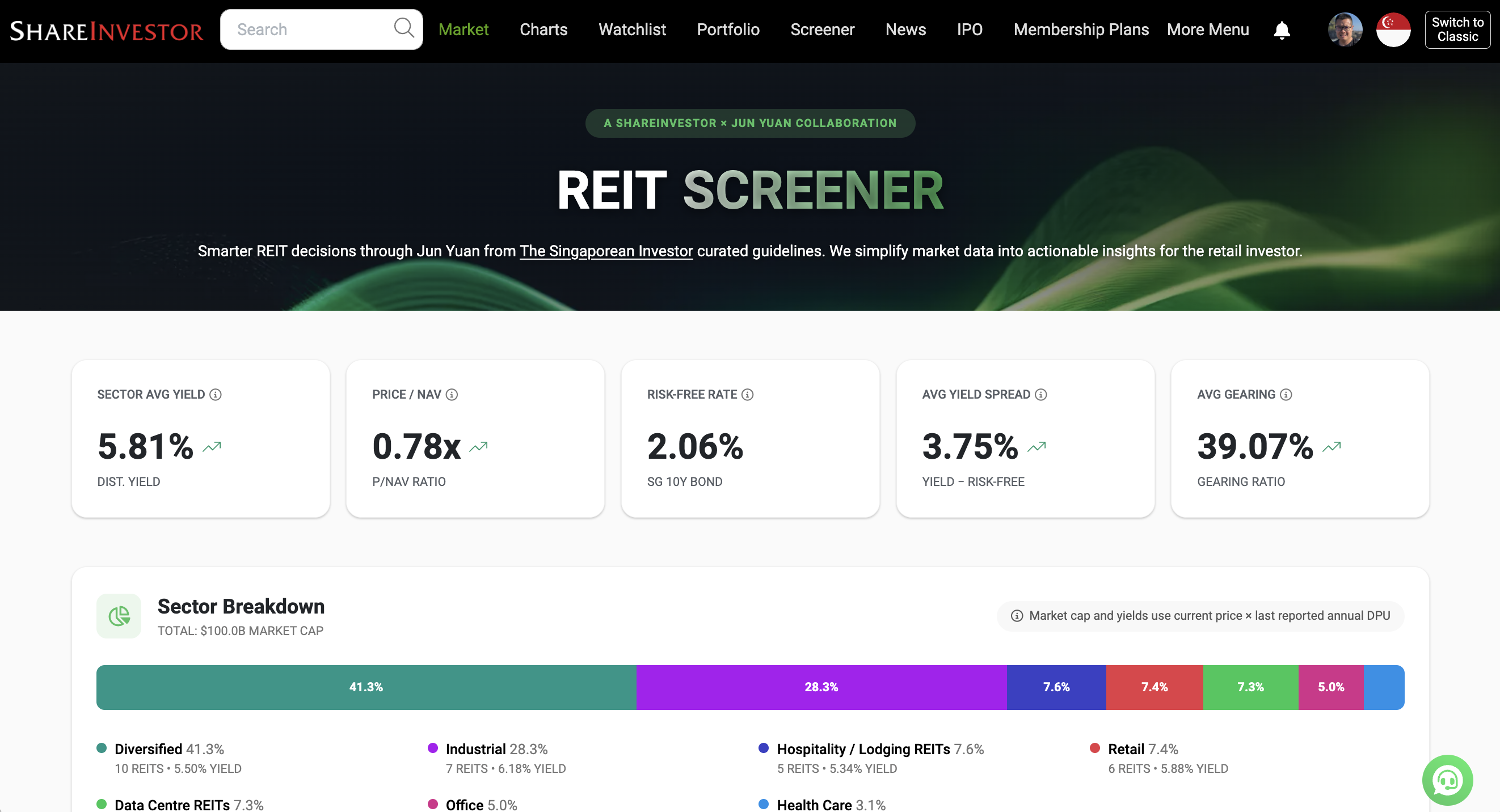
What if you could assess a REIT's portfolio occupancy, debt profile, valuation, and overall health in less than 30 seconds - without having to comb through a single quarterly report?
That's the problem the REIT Screener was built to solve.
Developed through a collaboration between ShareInvestor and The Singaporean Investor, the REIT Screener consolidates many of the key metrics and indicators I personally use when analysing REITs into one easy-to-use platform. Instead of spending hours extracting data manually every earnings season, you can now monitor the REITs you own and research new opportunities in just a few clicks.
If you're serious about REIT investing but don't have the time to manually track quarterly developments, the REIT Screener could be the shortcut you've been looking for:
Take a closer look at the REIT Screener here...



Comments (0)