2 of the 3 Mapletree REITs listed on the Singapore Exchange have already reported their financial results for 1Q FY2025/26 ended 30 June:
- Mapletree Logistics Trust (Results Released on 23 July) – Quarter in Review: Mapletree Logistics Trust’s 1Q FY2025/26 Results
- Mapletree Industrial Trust (Results Released on 28 July) – Mapletree Industrial Trust’s 1Q FY2025/26 Earnings: A Detailed Breakdown
Yesterday evening (30 July), it was Mapletree Pan Asia Commercial Trust’s turn to do so.
For starters, the REIT was initially listed as Mapletree Commercial Trust in April 2011, where it invests in commercial properties in Singapore. It was merged with Mapletree North Asia Commercial Trust (which invests in commercial properties in key gateway cities in Asia) in August 2022, and renamed as Mapletree Pan Asia Commercial Trust (SGX: N2IU), or MPACT for short. The REIT is also a constituent of the country’s benchmark Straits Times Index (STI), where it has been included since September 2019.
Currently, its portfolio comprises 17 commercial properties across 5 key gateway cities in Asia (4 in Singapore, 1 in Hong Kong, 2 in China, 9 in Japan, and 1 in South Korea) valued at S$16 billion.
The REIT’s financial performance and distribution payout is faced with 2 headwinds, which resulted in the continued weakness in terms of occupancy and rental reversion of its properties in Hong Kong, China, and Japan, as well as unfavourable foreign currency rates.
So, are there any signs of these headwinds improving? Let us find out in this post, where you will find my review of MPACT’s latest financial figures, portfolio occupancy and debt profile, as well as its distribution payout to unitholders:
Financial Figures (1Q FY2024/25 vs. 1Q FY2025/26)
| 1Q FY2024/25 | 1Q FY2025/26 | % Variance | |
| Gross Revenue (S$’mil) | $236.7m | $218.6m | -7.6% |
| Property Operating Expenses (S$’mil) | $57.3m | $52.6m | -8.2% |
| Net Property Income (S$’mil) | $179.4m | $166.0m | -3.6% |
| Distributable Income to Unitholders (S$’mil) | $110.8m | $106.8m | -3.6% |
MPACT’s financial performance continued to weaken, with its gross revenue, net property income, as well as its distributable income to unitholders recording a single-digit percentage decline compared to the same period a year ago.
The 7.6% year-on-year decline in the REIT’s gross revenue to S$218.6 million can be attributed to the absence of income from Mapletree Anson following the completion of its divestment on 31 July 2024, along with lower contribution from its overseas properties stemming from lower occupancy, negative rental reversion, and unfavourable forex impact arising from the depreciating Hong Kong Dollar and the Chinese Renminbi against the Singapore Dollar.
However, as property operating expenses fell by a higher percentage compared to its gross revenue (from the absence of expenses from Mapletree Anson following its divestment, lower utility expenses, and refund of prior year’s property tax received in 1Q FY2025/26), the REIT’s net property income was down by 3.6% year on year to S$166 million.
Portfolio Occupancy Profile (4Q FY2024/25 vs. 1Q FY2025/26)
As mentioned in the introductory paragraph, MPACT is faced with headwinds in its properties in Hong Kong, China, and Japan as far as their occupancy rates and rental reversions are concerned. While the occupancy rates of its Singapore properties continue to remain strong, this has not stopped the gradual decline of its overall portfolio occupancy from 94.0% in 1Q FY2024/25 to 89.6% in 4Q FY2024/25.
In the table below, you will find a comparison of the REIT’s portfolio occupancy recorded for 1Q FY2025/26 ended 30 June 2025, against that recorded for the previous quarter 3 months ago (i.e., 4Q FY2024/25 ended 31 March 2025), to find out if the weakness has been stemmed:
| 4Q FY2024/25 | 1Q FY2025/26 | |
| Portfolio Occupancy (%) | 89.6% | 89.3% |
| Portfolio WALE (by Gross Revenue – years) | 2.2 years | 2.3 years |
| Rental Reversion (%) | +3.6% | +1.4% |
MPACT’s portfolio occupancy saw a 0.6 percentage point (pp) decline to 89.3% – in fact, just like its financial performance, the REIT’s portfolio occupancy have saw a gradual decline in successive quarters, as follows – 94.0% (1Q FY2024/25) -> 90.3% (2Q FY2024/25) -> 90.0% (3Q FY2024/25) -> 89.6% (4Q FY2024/25) -> 89.3% (1Q FY2025/26) – definitely its one I’m continuing to monitor closely in the coming quarters to see if the trend continues.
The dip in MPACT’s portfolio occupancy in 1Q FY2025/26 compared to the previous quarter (i.e., 4Q FY2025/26) can be attributed to lower occupancy in all of its properties except for Mapletree Business City (up from 91.2% to 92.6%), VivoCity (up from 99.3% to 99.7%), and Festival Walk (up from 96.8% to 97.9%). The occupancy rate of The Pinnacle Gangnam remains at 99.9%.
Weakness continue to persist in its China and Japan properties – with the former down from 86.1% to 85.9%, and the latter down from 79.8% to 76.8%.
On rental reversions, for the China properties, it has continued to decline (from -9.3% in 4Q FY2024/25 to -19.4% in 1Q FY2025/26). For Festival Walk, rental reversions also weakened from -6.9% in 4Q FY2024/25 to -7.9% in 1Q FY2025/26. However, the rental reversion for its Japan properties have reversed into a positive percentage in the current quarter – from -7.2% in 4Q FY2024/25 to +0.4% in 1Q FY2025/26.
Finally, on lease expiry, it is very well-staggered – for the remaining 3 quarters in the current financial year 2025/26, it has 5.0% of retail leases and 7.6% of office/business park leases due for renewal. In the next 2 financial years (between FY2026/27 and FY2027/28), it has an average of 14.4% and 12.1% of retail and office/business park leases due for renewal each year respectively, with the remaining 14.8% of retail leases and 19.6% of office/business park leases due for renewal only in FY2028/29 or later.
Debt Profile (4Q FY2024/25 vs. 1Q FY2025/26)
Unlike its portfolio occupancy, where it has faced headwinds, MPACT’s debt profile is a different story – its aggregate leverage is maintained at a healthy level of under 40% (this was contributed by the REIT paring down its debt with proceeds from the divestment of Mapletree Anson), its debt expiry well-spread out over the years, and it also has a relatively high percentages (around 80%) of its borrowings hedged at fixed rates.
Let us take a look if MPACT’s debt profile have continued to remain healthy in the table below, where you will find a comparison of the statistics reported in the current quarter under review (i.e., 1Q FY2025/26 ended 30 June 2025) against that reported in the previous quarter 3 months ago (i.e., 4Q FY2024/25 ended 31 March 2025):
| 4Q FY2024/25 | 1Q FY2025/26 | |
| Aggregate Leverage (%) | 37.7% | 37.9% |
| Interest Coverage Ratio (times) | 2.8x | 2.9x |
| Average Cost of Debt (%) | 3.5% | 3.3% |
| Average Term to Debt Maturity (years) | 3.3 years | 3.4 years |
| % of Borrowings Hedged at Fixed Rates (%) | 79.9% | 77.7% |
Overall, the debt profile of MPACT for the current quarter under review compared against that in the previous quarter was a mixed one – with its aggregate leverage inching up slightly (by 0.2pp to 37.9%), but its average cost of debt saw a dip (by 0.2pp to 3.3%).
For the former, even though it has inched up, but at 37.9%, it is still at a very healthy level to the regulatory limit of 50%.
Debt expiry was also well-spread out – with 6% and 9% of borrowings due for refinancing in the remaining 3 quarters of FY2025/26, as well as in the next financial year 2026/27 respectively. In the 3 financial years thereafter (between FY2027/28 and FY2029/30), it has an average of 22% of borrowings due for refinancing each year, with the remaining 18% of borrowings due for refinancing only in FY2030/31 or later.
Distribution Payout to Unitholders (1Q FY2024/25 vs. 1Q FY2025/26)
Unitholders of MPACT will receive a distribution payout once every quarter – making it an option for investors looking to invest in REITs with such a distribution payout frequency.
The following is MPACT’s distribution payout declared for the current quarter under review (i.e., 1Q FY2025/26) compared against that declared a year ago:
| 1Q FY2024/25 | 1Q FY2025/26 | % Variance | |
| Distribution Per Unit (S$’cents) | 2.09 cents | 2.01 cents | -3.8% |
MPACT’s distribution payout fell by 3.8% year on year to 2.01 cents/unit largely due to weaker contributions from its overseas properties. However, this was partially mitigated by stable contribution from its Singapore properties, lower property operating expenses, along with lower finance expenses.
If you are a unitholder of the REIT, do take note of the following dates on its upcoming distribution payout:
Ex-Date: 06 August 2025
Record Date: 07 August 2025
Payout Date: 11 September 2025
CEO Ms Sharon Lim’s Comments & Outlook (Extracted from the REIT’s Press Release)
“MPACT’s performance this quarter reflects the strength of our Singapore portfolio and the strategic benefits of the Mapletree Anson divestment where the allocation of divestment proceeds towards debt reduction delivered interest cost savings and balance sheet improvements. Notably, VivoCity maintained outstanding all-rounded performance despite Basement 2 enhancement works, while a key tenant at MBC renewed its lease ahead of expiry, underscoring tenant confidence and reinforcing overall stability.
The proposed divestment of the two Japan office buildings reflects our proactive approach to portfolio optimisation. While modest in scale, this move allows us to mitigate single-tenant risk and optimise management efficiency. With divestment proceeds directed towards debt repayment, MPACT will also benefit from further improvement in financial resilience. Post-divestment, Singapore continues to be our core market, accounting for over 50% of MPACT’s AUM. We remain committed to maintaining occupancy and cash flow generation across our assets.”
Closing Thoughts
MPACT’s performance continued to be dragged down by its overseas properties – particularly the 2 office properties in China, where the occupancy rate continued to decline (from -9.3% in 4Q FY2024/25 to -19.4% in 1Q FY2025/26), and rental reversions recorded for new and/or renewed leases worsened (from -9.3% in 4Q FY2024/25 to -19.4% in 1Q FY2025/26) – with the China properties contributing 8.8% towards the REIT’s gross revenue in 1Q FY2025/26, weakness in terms of the properties’ occupancy and rental reversion will continue to impact the REIT’s financial performance to some extent.
For its properties in Hong Kong and Japan, it was a mixed bag – for Hong Kong, the occupancy rate improved, while rental reversion weakened, and for Japan, it was the reverse.
Another area of concern I have was the continued decline in the REIT’s overall portfolio occupancy in successive quarters – from 94.0% in 1Q FY2024/25 to 89.3% in 1Q FY2025/26 – the increase in vacancy of its properties will also have an impact in its financial performances in the quarters ahead.
However, it was not all negative for the REIT. One positive I noted was its healthy debt profile – even though its aggregate leverage have inched up to 37.9% in 1Q FY2025/26, but at this level, it is still a distance to the regulatory limit of 50%.
With that, I have come to the end of my review of MPACT’s 1Q FY2025/26 results released yesterday (30 July) evening. As much as I hope you’ve found the contents presented in this post useful, but do take note that all the opinions are purely mine which I’m sharing for educational purposes only. They do not represent any buy or sell calls for the REIT’s units. Please do your own due diligence before you make any investment decisions.
Related Documents
Disclaimer: At the time of writing, I am a unitholder of Mapletree Pan Asia Commercial Trust.
Stop Spending Hours Reading REIT Reports Every Quarter!
What if you could assess a REIT's portfolio occupancy, debt profile, valuation, and overall health in less than 30 seconds - without having to comb through a single quarterly report?
That's the problem the REIT Screener was built to solve.
Developed through a collaboration between ShareInvestor and The Singaporean Investor, the REIT Screener consolidates many of the key metrics and indicators I personally use when analysing REITs into one easy-to-use platform. Instead of spending hours extracting data manually every earnings season, you can now monitor the REITs you own and research new opportunities in just a few clicks.
If you're serious about REIT investing but don't have the time to manually track quarterly developments, the REIT Screener could be the shortcut you've been looking for:
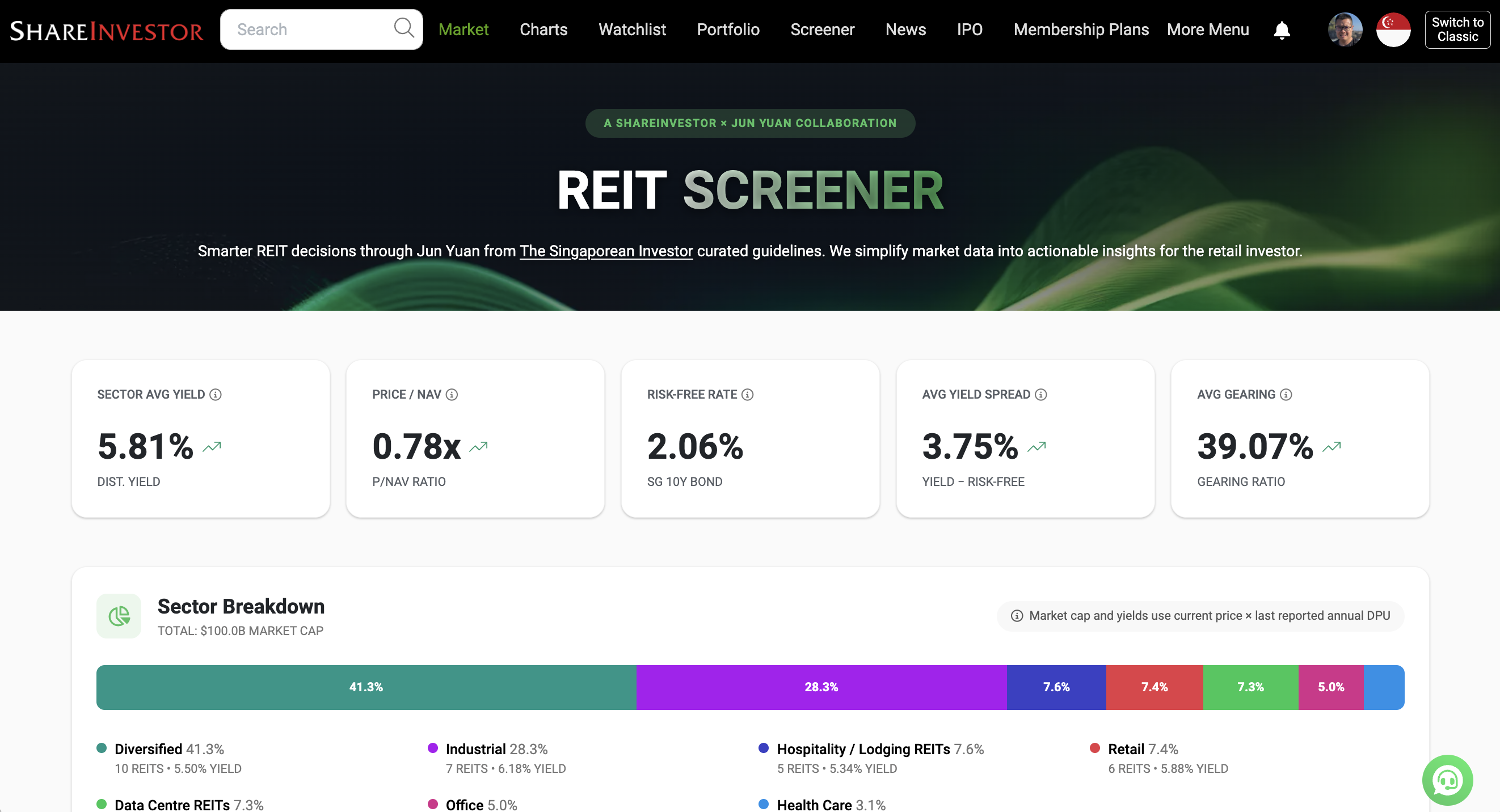
Take a closer look at the REIT Screener here...



Comments (0)