For the uninitiated, there are a total of 5 REITs and Business Trusts Sponsored by CapitaLand Investment Limited (SGX: 9CI) listed on the Singapore Exchange: CapitaLand Ascendas REIT (SGX: A17U), CapitaLand Ascott Trust (SGX: HMN), CapitaLand China Trust (SGX: AU8U), CapitaLand India Trust (SGX: CY6U), and CapitaLand Integrated Commercial Trust (SGX: C38U).
Out of which, CapitaLand Ascendas REIT and CapitaLand Integrated Commercial Trust are constituents of Singapore’s benchmark Straits Times Index (STI).
Personally, I am a unitholder of 3 of them – CapitaLand Ascendas REIT (which invests in industrial and data centre properties in developed markets), CapitaLand India Trust (which invests in business parks, industrial and logistics properties, as well as data centre developments in India), and CapitaLand Integrated Commercial Trust (which invests in retail and office properties in Singapore, Germany, and Australia).
My focus in today’s post is CapitaLand India Trust (SGX: CY6U), or CLINT for short. The business trust offers retail investors here in Singapore an exposure to the growing Indian market. Currently, CLINT’s portfolio comprises 10 IT parks, 4 industrial and logistics facilities, and 4 data centre developments located in key Indian cities of Bangalore, Chennai, Hyderabad, Mumbai, and Pune with a total assets under management of S$3.7 billion.
Earlier this evening (30 July), CLINT released its financial results for the 2nd quarter, as well as for the 1st half of the financial year ended 30 June 2025 (i.e., 1H FY2025), and in this post, you’ll find my review of its latest financial figures, portfolio occupancy and debt profile, as well as its distribution payout to unitholders:
Financial Figures (2Q FY2024 vs. 2Q FY2025, and 1H FY2024 vs. 1H FY2025)
2Q FY2024 vs. 2Q FY2025:
| 2Q FY2024 | 2Q FY2025 | % Variance | |
| Total Property Income (S$’mil) | $69.2m | $74.7m | +7.9% |
| Property Operating Expenses (S$’mil) | $15.1m | $16.2m | +7.3% |
| Net Property Income (S$’mil) | $54.1m | $58.5m | +8.1% |
The business trust did not provide any financial figures for the 2nd quarter – I have computed them based on the figures provided in its business update for the 1st quarter, as well as for the 1st half of the respective financial years.
As you can see from the table above, it was a stable performance by CLINT for the 2nd quarter, with its total property income and net property income both up by a high single-digit percentage compared to a year ago.
1H FY2024 vs. 1H FY2025:
| 1H FY2024 | 1H FY2025 | % Variance | |
| Total Property Income (S$’mil) | $136.1m | $149.3m | +9.7% |
| Property Operating Expenses (S$’mil) | $32.6m | $35.7m | +9.5% |
| Net Property Income (S$’mil) | $103.5m | $113.6m | +9.8% |
| Distributable Income to Unitholders (S$’mil) | $48.7m | $53.6m | +10.1% |
Similar to its financial results for the 2nd quarter, CLINT’s total property income and net property income also saw a high single-digit percentage improvement compared to last year.
The 9.7% and 9.8% year-on-year improvements in CLINT’s total property income and net property income to S$149.3 million and S$113.6 million respectively can be attributed to: (i) higher rental income from existing properties compared to the same period last year; (ii) income contributions from newly completed properties which are fully leased (MTB 6 in ITPB, and CyberVale Free Trade Warehousing Zone), along with (iii) income contributions from aVance II, Pune, as well as Building Q2, where acquisitions were completed in March 2024 and July 2024 respectively.
In Indian Rupee-terms, the business trust’s total property income and net property income both rose by 14% year on year to INR9,624.9 million and INR7,321.7 million.
On the other hand, CLINT’s total property expenses increased by 9.5% year on year to S$35.7 million mainly due to higher property-related expenses.
Portfolio Occupancy Profile (1Q FY2025 vs. 2Q FY2025)
Apart from its stable financial performances, another thing I like about CLINT is its strong portfolio occupancy – where it has been consistently maintained at above 90%.
Let us find out if the business trust has managed to maintain this feat in the table below, where I will be comparing the statistics reported for the current quarter under review (i.e., 2Q FY2025 ended 30 June 2025) against that reported in the previous quarter 3 months ago (i.e., 1Q FY2025 ended 31 March 2025):
| 1Q FY2025 | 2Q FY2025 | |
| Portfolio Occupancy (%) | 92.0% | 92.0% |
| Portfolio WALE (years) | 3.4 years | 3.7 years |
Compared to the previous quarter, CLINT’s portfolio occupancy remained unchanged at 92%.
Looking at the occupancy rates of the 12 properties, most have an occupancy rate of at least 90% except for ITPC (at 82%), aVance Hyderabad (at 84%), and aVance II, Pune (at 73%).
The business trust also managed to record a positive rental reversion of +9% for new and/or renewed leases – which is another positive, as higher rentals will contribute positively to its financial performances in the quarters ahead.
Finally, as far as lease expiries goes, it only has 4% of leases due for renewal in the 2nd half of FY2025 (with more than 70% either renewed, or highly likely to be renewed). Over the next 3 years (between FY2026 and FY2028), lease expiries are well-spread out, with an average of about 18% of leases due for renewal each year, with the remaining 43% of leases due for renewal only in FY2029 or later.
Debt Profile (1Q FY2025 vs. 2Q FY2025)
One of the things I like to share before I review CLINT’s debt profile is its ‘average cost of debt’, where many retail investors expressed concerns that at an average of around 6.0%, its on the high side.
3 things I like to share on this – first, if we were to look at India’s benchmark borrowing rates in recent years, it has been around 6+% (you can find out more on Trading Economics here); second, CLINT benefits from a ‘natural hedge’ as it borrows in Indian Rupees and generates its income in the same currency; and third, the management is cognisant of investors’ concerns on this and is looking to grow its financial results at a faster rate than the climb in interest rates.
I hope the above have given a better understanding of the interest rate environment in India.
Moving on, the table below is a comparison of CLINT’s debt profile recorded for 2Q FY2025 against that recorded in 1Q FY2025:
| 1Q FY2025 | 2Q FY2025 | |
| Aggregate Leverage (%) | 41.5% | 42.3% |
| Interest Coverage Ratio (times) | 2.5x | 2.5x |
| Average Cost of Debt (%) | 6.0% | 5.9% |
| Average Term to Debt Maturity (years) | 2.8 years | 2.5 years |
| % of Borrowings Hedged at Fixed Rates (%) | 84.5% | 77.2% |
Looking at CLINT’s debt profile, its aggregate leverage of 42.3% was excluding the issuance of S$100 million of subordinated perpetual securities at 4.40% per annum on 02 July 2025 – if its included, the business trust’s aggregate leverage would be down to 40.1%, which is a decent level in my opinion.
On its debt expiry ahead, it has 17.3% of borrowings due for refinancing in the 2nd half of FY2025 – however, I note that refinancing has largely been completed. Over the next 3 years (between FY2026 and FY2028), its debt expiry is well-spread out, with an average of 15.6% of borrowings due for refinancing each year, with the remaining 35.7% of borrowings due for refinancing only in FY2029 or later.
Distribution Payout to Unitholders (1H FY2024 vs. 1H FY2025)
The management of CLINT declares a distribution to the unitholders on a half-yearly basis.
In the table below, you’ll find CLINT’s distribution payout for the current period under review (i.e., 1H FY2025) compared against the amount declared a year ago (i.e., 1H FY2024):
| 1H FY2024 | 1H FY2025 | % Variance | |
| Distribution Per Unit (S$’cents) | 3.64 cents | 3.97 cents | +9.1% |
If you are a unitholder of CLINT, do take note of the following dates on its distribution payout:
Ex-Date: 08 September 2025
Record Date: 09 September 2025
Payout Date: 18 September 2025
CEO Mr Nagabhushanam Gauri Shankar’s Comments & Outlook (Extracted from the Business Trust’s Press Release)
“CLINT’s strong first half results were underpinned by income contributions from newly completed developments, and supported by positive rental reversions and high occupancy rates. This reflects the strength and resilience of our portfolio across key cities in India.
Revenue contribution from one of our data centres is set to commence in the second half of 2025 and development of the data centres is progressing well. We are actively engaging potential buyers to divest some of our assets, including partial stakes in our data centres to unlock value and reduce debt. These potential divestments are part of our active portfolio management strategy, which will increase our financial flexibility to pursue higher-yielding assets and deliver sustainable returns for unitholders.”
Closing Thoughts
On the whole, it was a positive set of results reported by CLINT.
Starting off with its financial performance (both for the 2nd quarter, as well as for the first half of the year), it recorded a stable high single-digit percentage growth. The same can also be said for its distribution payout to unitholders.
Overall portfolio occupancy remained at a high level of 92%, with 9 out of 12 properties having an occupancy of 90%. To top it off, rental reversions for new and/or renewed leases was also at a positive +9%, which will contribute positively towards the improvement of its financial performances in the quarters ahead.
Finally, CLINT’s debt profile continues to remain in a healthy position in my opinion, with its aggregate leverage at 40.1% (if the perpetual securities issued in July 2025 was taken into consideration). Otherwise its aggregate leverage would be at 42.3%. Also, CLINT’s debt expiries are well-spread out over the years.
With that, I have come to the end of my review of CLINT’s latest financial results for 2Q and 1H FY2025. Do note that everything you have just read in this post are purely for educational purposes only, and do not constitute as any buy or sell calls for the business trust’s units. Please do your own due diligence before you make any investment decisions.
Related Documents
Disclaimer: At the time of writing, I am a unitholder of CapitaLand India Trust.
Stop Spending Hours Reading REIT Reports Every Quarter!
What if you could assess a REIT's portfolio occupancy, debt profile, valuation, and overall health in less than 30 seconds - without having to comb through a single quarterly report?
That's the problem the REIT Screener was built to solve.
Developed through a collaboration between ShareInvestor and The Singaporean Investor, the REIT Screener consolidates many of the key metrics and indicators I personally use when analysing REITs into one easy-to-use platform. Instead of spending hours extracting data manually every earnings season, you can now monitor the REITs you own and research new opportunities in just a few clicks.
If you're serious about REIT investing but don't have the time to manually track quarterly developments, the REIT Screener could be the shortcut you've been looking for:
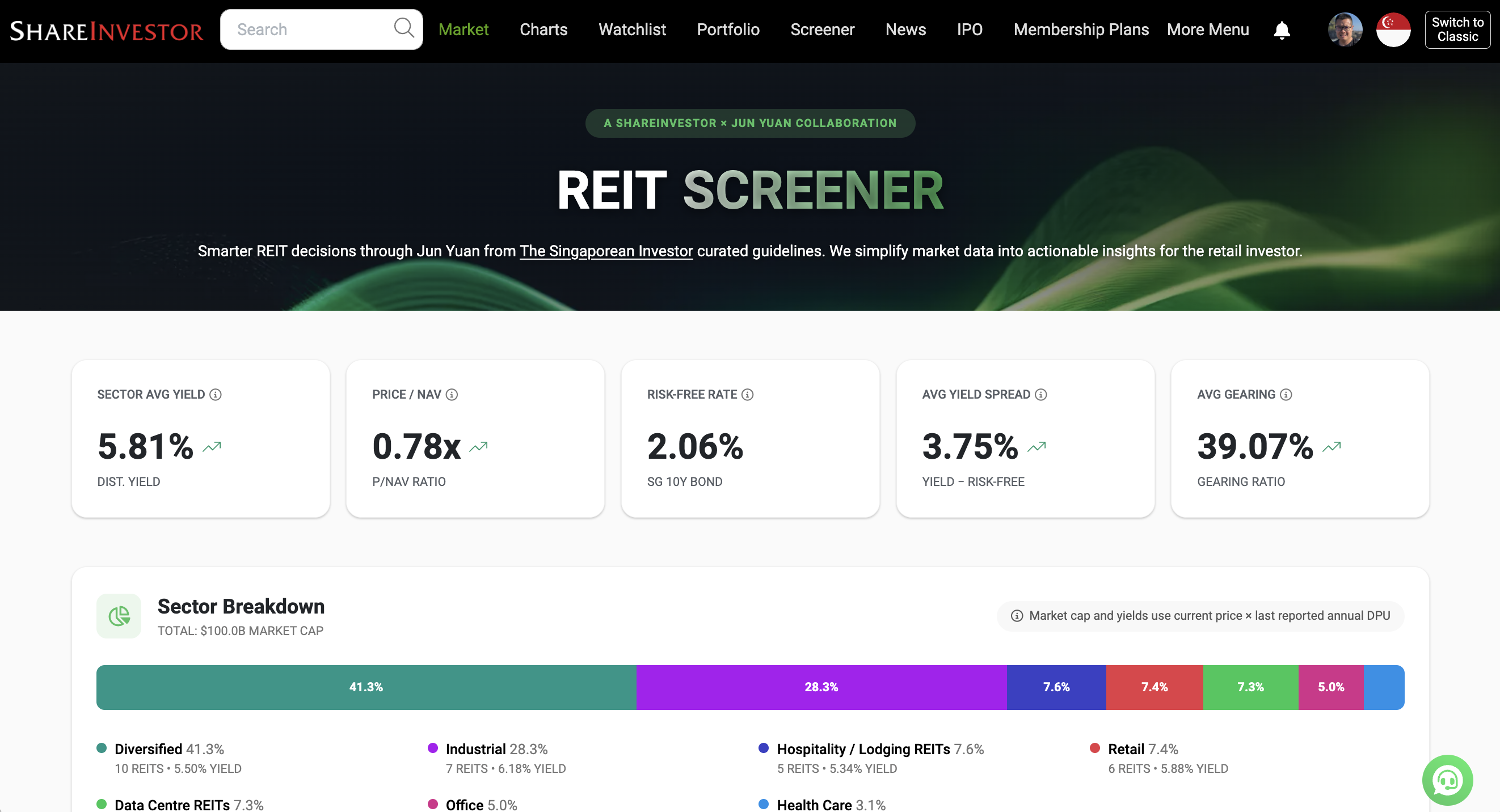
Take a closer look at the REIT Screener here...



Comments (0)