1. What is the Hang Seng High Dividend 30 Index ETF?
Launched in April 2025 and listed on the Stock Exchange of Hong Kong, the Hang Seng High Dividend 30 Index ETF (SEHK: 3466) is managed by Hang Seng Investment Management and seeks to track the performance of the Hang Seng High Dividend 30 Index.
The underlying Index consists of 30 high dividend-yield equities listed on the Hong Kong Stock Exchange, selected from a universe of large- and mid-cap companies.
In other words, instead of investing into individual Hong Kong-listed dividend stocks, investors can gain exposure to a diversified basket of companies through a single ETF.
2. How are Companies Selected for Inclusion in the Index?
One thing worth highlighting is that despite the Index being named the ‘Hang Seng High Dividend 30 Index’, it does not simply select the companies with the highest dividend yields.
This is because an extremely high dividend yield is not always a positive sign.
Sometimes, a company’s dividend yield appears attractive simply because its share price has fallen significantly, which could indicate concerns about the company’s future earnings or dividend sustainability.
Therefore, the Index applies several screening criteria before selecting its final constituents.
Firstly, companies must belong to the large- and mid-cap segment of Hong Kong-listed equities.
Next, they must meet liquidity requirements, with each stock required to maintain a 6-month average daily turnover of at least HKD20 million. This helps to exclude companies with limited trading activity.
Since the Index focuses on dividend-paying companies, eligible stocks must also have paid dividends consistently over the previous 3 years.
Additionally, companies with the highest historical volatility (the top decile based on trailing 12-month volatility) or the weakest price performance are removed from consideration.
This helps to filter out companies where the high dividend yield may simply be a result of a declining share price.
After applying these filters, the remaining companies are ranked according to their net dividend yield, which is calculated based on the latest fiscal year dividend per share after deducting applicable withholding taxes, and this figure is divided by the share price of the company as of the data cut off date.
The 30 companies with the highest net dividend yields are then selected as Index constituents.
To prevent excessive concentration in any single company, each constituent’s weightage is capped at 10%.
The Index is reviewed annually in May using data as of end-March (with dividend information updated as of end-April), followed by a rebalance in June.
3. What is the Sector Breakdown of the ETF?
The Hang Seng High Dividend 30 Index ETF provides exposure across 8 different sectors.
While Consumer Discretionary represents the largest sector allocation at close to 25%, the remaining sectors each account for less than 20% of the portfolio.
As at 31 August 2026, the sector breakdown of the ETF is as follows:
- Consumer Discretionary (24.94%)
- Properties & Construction (17.06%)
- Industrials (16.49%)
- Consumer Staples (15.76%)
- Utilities (10.23%)
- Financials (6.77%)
- Information Technology (4.34%)
- Telecommunications (3.16%)
- Cash & Others (1.25%)
One observation is that the ETF has relatively higher exposure towards more traditional sectors such as industrials, consumer companies, utilities and property-related businesses.
This is not surprising, as mature companies in these industries often generate more stable cash flows and are therefore more likely to return profits to shareholders through dividends.
4. What is the Share Class Breakdown of the ETF?
Looking at the ETF’s share class exposure, the majority of the portfolio consists of Hong Kong-listed companies.
As at 31 August 2026, the breakdown is as follows:
- Hong Kong Stocks (42.91%)
- Other Hong Kong-Listed Mainland Companies (29.98%)
- H-Shares (13.81%)
- Red Chip Shares (12.05%)
- Cash & Others (1.25%)
Combined, Hong Kong stocks and other Hong Kong-listed Mainland companies make up close to 73% of the ETF.
For investors unfamiliar with the different share classes:
- H-shares refer to shares of mainland Chinese companies that are incorporated in China but listed and traded on the Hong Kong Stock Exchange.
- Red chip shares refer to companies incorporated outside mainland China but controlled by Chinese government or state-owned entities and listed in Hong Kong.
5. What are the Top 10 Holdings in the ETF?
The ETF currently holds 30 companies, with the top 10 holdings accounting for approximately 41.3% of the portfolio.
Interestingly, the weightage is relatively evenly distributed, with none of the individual companies having a weightage above 5%.
The following are the ETF’s top 10 holdings, together with a brief description of their businesses:
1. SITC International Holdings Company Ltd (SEHK: 1308) (Industrials) (4.94% Weightage)
SITC International operates container ships that transport goods between ports across Asia. The company also provides related logistics services such as freight forwarding, warehousing, customs clearance and container depot services, helping businesses move products efficiently across the supply chain.
2. Onewo Inc (SEHK: 2602) (Properties & Construction) (4.57% Weightage)
Onewo provides property management and related services, helping maintain residential communities, offices and commercial buildings. Its services include cleaning, security, repairs, maintenance, community management, home renovation, property brokerage and smart city solutions.
3. COSCO Shipping Holdings Co Ltd (SEHK: 1919) (Industrials) (4.40% Weightage)
COSCO Shipping Holdings operates a global fleet of container ships that transport goods such as electronics, machinery and consumer products between countries. Besides shipping, the company also operates port terminals and provides logistics services supporting global supply chains.
4. Vtech Holdings Ltd (SEHK: 303) (Information Technology) (4.31% Weightage)
VTech designs and manufactures electronic products including educational toys, baby monitors, cordless phones and smart communication devices. It also provides electronic manufacturing services for other companies.
5. Yue Yuen Industrial (Holdings) Ltd (SEHK: 551) (Consumer Discretionary) (4.11% Weightage)
Yue Yuen is one of the world’s largest footwear manufacturers, producing athletic and casual footwear for major global brands such as Nike, adidas, Asics and New Balance. It also operates sportswear retail and distribution businesses through its subsidiary Pou Sheng International.
6. Cathay Pacific Airways Ltd (SEHK: 293) (Consumer Discretionary) (3.86% Weightage)
Cathay Pacific operates passenger flights, air cargo services and related aviation businesses, connecting travellers and businesses across Asia and major international markets.
7. Shenzhen International Holdings Ltd (SEHK: 152) (Industrials) (3.86% Weightage)
Shenzhen International operates infrastructure supporting China’s supply chain, including logistics parks, warehouses, ports and transportation networks. It also operates toll roads and environmental protection businesses.
8. Far East Horizon Ltd (SEHK: 3360) (Financials) (3.82% Weightage) (3.82% Weightage)
Far East Horizon provides financing solutions, including equipment leasing, to businesses across industries such as healthcare, construction, manufacturing and transportation. It also provides related operational services.
9. China State Construction International Holdings Ltd (SEHK: 3311) (Properties & Construction) (3.75% Weightage)
China State Construction International undertakes large-scale construction and infrastructure projects, including buildings, hospitals, roads and public facilities. It also invests in and operates selected infrastructure assets.
10. Orient Overseas (International) Ltd (SEHK: 316) (Industrials) (3.67% Weightage)
Orient Overseas operates container ships that transport goods globally. Through its subsidiary OOCL, the company provides international shipping and logistics services including freight forwarding, warehousing and supply chain solutions.
6. What is the Dividend Payout of the ETF?
The ETF was launched in April 2025 and began distributing dividends to unitholders one month later in May 2025.
The ETF currently pays dividends monthly.
Its distribution history from May to December 2025 is as follows:
| Month | Dividend Per Unit (HKD’cents) |
| May 2025 | 6.59 HK cents |
| June 2025 | 7.22 HK cents |
| July 2025 | 7.64 HK cents |
| August 2025 | 8.24 HK cents |
| September 2025 | 8.71 HK cents |
| October 2025 | 8.84 HK cents |
| November 2025 | 8.92 HK cents |
| December 2025 | 9.53 HK cents |
The ETF’s monthly distribution increased steadily after its launch, reaching 10.01 HK cents in March 2026.
However, since April 2026, the distribution has gradually declined, falling to HKD0.0811 in September 2026.
This highlights an important point for income investors — while an ETF may have a high dividend yield, distributions are not guaranteed and can fluctuate depending on the dividends received from its underlying holdings.
7. What are Some of the Key Risks to Consider?
1. Relatively New ETF
The Hang Seng High Dividend 30 Index ETF was only listed in April 2025, while the underlying Index was launched a month earlier in March 2025.
Therefore, the ETF does not yet have a long operating history or experience across different market cycles.
Investors have limited data on how the Index methodology performs during prolonged downturns, periods of dividend cuts, or stressed market conditions.
2. China Regulatory and Policy Risks
Many companies within the ETF have significant exposure to mainland China.
Changes in government policies, regulations or industry rules could affect company earnings, valuations and ultimately the ETF’s performance.
3. Interest Rate Risk
Dividend-paying stocks often compete with bonds and other income-generating assets.
When interest rates rise, investors may demand higher yields from equities, which can place pressure on the valuations of dividend-paying companies.
4. Concentration Risk
Although the ETF consists of 30 companies across 8 sectors, the portfolio remains concentrated in several key industries.
The 5 largest sectors (Consumer Discretionary, Properties & Construction, Industrials, Consumer Staples and Utilities) collectively account for approximately 84.5% of the ETF.
Therefore, weakness in these sectors could have a significant impact on the ETF’s overall performance.
8. What is the Lot Size of the ETF?
The Hang Seng High Dividend 30 Index ETF has a lot size of 400 units.
This means investors need to purchase units in multiples of 400.
The ETF’s minimum price movement (spread) is HKD0.02 per tick.
9. What are the Management Fees of the ETF?
The ETF charges a management fee of up to 0.55% per annum, while its total expense ratio (TER) is 0.85%.
This means that for every HKD10,000 invested, investors can expect approximately HKD85 per year in operating expenses, assuming the TER remains unchanged.
10. How has the Unit Price of the ETF Moved since its Inception in April 2025?
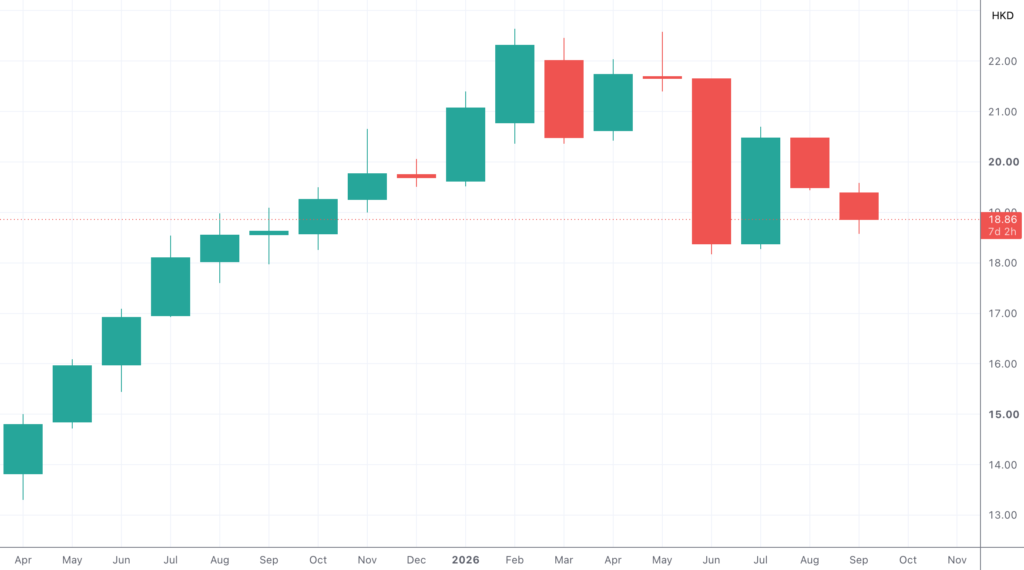
Since its listing in April 2025, the ETF’s unit price has generally trended upwards, reaching a high of HKD22.65 in February 2026 before declining slightly in subsequent months.
An investor who bought the ETF when trading commenced in April 2025 at HKD13.82 and held until the end of December 2025, when the unit price closed at HKD19.51, would have enjoyed capital appreciation of slightly more than 40%.
However, given that the ETF has only been listed for slightly more than a year, there is insufficient historical data to determine whether such performance can be sustained over the longer term.
Closing Thoughts
For income investors looking to gain exposure to Hong Kong-listed companies, the Hang Seng High Dividend 30 Index ETF could be an interesting ETF to consider given its focus on dividend-paying companies and monthly distribution frequency.
The ETF also provides investors with diversification across 30 companies, with no individual company accounting for more than 5% of the portfolio. The top 10 holdings collectively represent around 40% of the ETF, with the remaining 20 companies making up the majority of the portfolio.
However, investors should also be aware of several important considerations.
Firstly, both the ETF and its underlying Index are relatively new, meaning there is limited evidence on how the strategy performs through a complete market cycle.
Secondly, many companies within the ETF have exposure to mainland China, which introduces additional regulatory, policy and economic risks.
Finally, while dividend income can be attractive, investors should remember that distributions can fluctuate and should not be viewed as guaranteed.
Ultimately, the Hang Seng High Dividend 30 Index ETF offers investors a convenient way to access Hong Kong dividend stocks through a single investment vehicle.
However, as with any investment, investors should look beyond the dividend yield alone and consider the quality of the underlying businesses, sustainability of dividends and risks involved before making an investment decision.
Disclaimer: At the time of writing, I do not have any units of the Hang Seng High Dividend 30 Index ETF.
Are You Worried about Not Having Enough Money for Retirement?
You're not alone. According to the OCBC Financial Wellness Index, only 62% of people in their 20s and 56% of people in their 30s are confident that they will have enough money to retire.
But there is still time to take action. One way to ensure that you have a comfortable retirement is to invest in real estate investment trusts (REITs).
In 'Building Your REIT-irement Portfolio' which I've authored, you will learn everything you need to know to build a successful REIT investment portfolio, including a list of 9 things to look at to determine whether a REIT is worthy of your investment, 1 simple method to help you maximise your returns from your REIT investment, 4 signs of 'red flags' to look out for and what you can do as a shareholder, and more!

You can find out more about the book, and grab your copy (ebook or physical book) here...

Comments (0)