1. What is the iShares MSCI Malaysia Index ETF About?
Launched in March 1996 and managed by BlackRock Fund Advisors, the iShares MSCI Malaysia Index ETF (NYSE ARCA: EWM) provides investors with exposure to 21 large- and mid-cap companies listed in Malaysia.
In other words, instead of having to invest in individual Malaysian companies separately, the ETF allows investors to gain exposure to some of the country’s largest listed companies through a single investment.
2. Which Index does the ETF Track?
The iShares MSCI Malaysia Index ETF tracks the MSCI Malaysia Index, which is designed to measure the performance of large- and mid-cap companies in the Malaysian equity market.
As of 31 August 2026, the MSCI Malaysia Index comprised 21 constituents, with a combined index market capitalisation of close to US$120.0 billion.
3. How are Companies Selected for Inclusion in the MSCI Malaysia Index?
First and foremost, companies must be listed on Bursa Malaysia to be considered for inclusion in the MSCI Malaysia Index.
However, not every listed company will qualify. The Index focuses specifically on large- and mid-cap companies, while also taking into consideration factors such as the number of shares available for public investors to buy and sell, as well as how actively the shares are traded.
MSCI reviews the Index every quarter. Companies that have grown sufficiently large and meet the necessary requirements may be added, while those that no longer meet the criteria may be removed.
4. What is the Sector Breakdown of the ETF?
One thing that immediately stands out about the ETF is its heavy concentration in the Financials sector, which had a 51.02% weightage as of 04 September 2026.
This means that the performance of financial companies will have a significant influence on the ETF’s overall performance. In this respect, it is somewhat similar to the State Street SPDR Straits Times Index ETF (SGX: ES3), where Singapore’s 3 listed banks (DBS, UOB and OCBC) collectively had a 57.86% weightage.
Apart from Financials, the other 2 sectors with weightages exceeding 10% are Utilities at 13.31% and Industrials at 10.31%.
The remaining 4 sectors represented in the ETF each have weightages of less than 10%: Materials at 8.70%, Consumer Staples at 7.99%, Communication at 5.36%, and Health Care at 2.98%.
Cash and/or Derivatives make up the remaining 0.33% of the ETF.
5. What are the Top 10 Holdings in the ETF?
Among the ETF’s 10 largest holdings, 6 are from the Financials sector, which explains why the sector has such a dominant weightage in the ETF. Another 2 are from Utilities, while Materials and Industrials have 1 company each.
In terms of individual company weightages, the 3 largest holdings (Public Bank, CIMB Group Holdings and Malayan Banking) each have double-digit percentage allocations of 15.78%, 13.65% and 11.13%, respectively.
The remaining 7 companies each have weightages of no more than 6.48%.
The following are the 10 companies with the heaviest weightages in the ETF:
1. Public Bank Bhd (KLSE: 1295) (Financials) (15.78% Weightage)
Public Bank Bhd is one of Malaysia’s largest banks, providing everyday banking services such as savings accounts, loans, credit cards and wealth management solutions to individuals. It also serves businesses, with a particular focus on small and medium-sized enterprises (SMEs), supported by an extensive branch network in Malaysia and selected Asian markets.
2. CIMB Group Holdings Bhd (KLSE: 1023) (Financials) (13.65% Weightage)
Similar to Public Bank, CIMB Group Holdings Bhd is one of Malaysia’s largest banking groups and has a strong regional presence across Southeast Asia. Its businesses span consumer banking, commercial banking, Islamic banking and capital markets.
3. Malayan Banking Bhd (KLSE: 1155) (Financials) (11.13% Weightage)
Malayan Banking Bhd, better known as Maybank, is Malaysia’s largest banking group, providing a wide range of financial services including personal banking, loans, credit cards, wealth management, corporate banking, investment banking and insurance.
Maybank also has a strong presence across Southeast Asia, serving individuals, businesses and governments, with Malaysia, Singapore and Indonesia among its key markets.
4. Tenaga Nasional Bhd (KLSE: 5347) (Utilities) (6.48% Weightage)
Tenaga Nasional Bhd is Malaysia’s largest electricity utility company. It operates power plants and manages Malaysia’s electricity grid, while also expanding into renewable energy projects such as solar and hydro power as part of the transition towards cleaner energy.
5. Press Metal Aluminium Holdings Bhd (KLSE: 8869) (Materials) (6.47% Weightage)
Press Metal Aluminium Holdings Bhd is Southeast Asia’s largest integrated aluminium producer, manufacturing products such as aluminium ingots, billets and extruded aluminium that are used across industries including construction, automotive, electronics and renewable energy.
6. Gamuda Bhd (KLSE: 5398) (Industrials) (5.10% Weightage)
Gamuda Bhd is a Malaysian engineering, construction and property group best known for developing major infrastructure projects such as railways, roads, bridges, tunnels and water infrastructure.
It also develops residential townships and commercial properties, while expanding into areas such as renewable energy and digital infrastructure.
7. YTL Power International Bhd (KLSE: 6742) (Utilities) (3.85% Weightage)
YTL Power International Bhd is a Malaysian utilities and infrastructure group whose businesses include generating and selling electricity, providing water and sewerage services, and operating telecommunications networks.
It is also expanding into digital infrastructure, including data centres and AI cloud computing, with operations spanning Malaysia, Singapore, the United Kingdom and other markets.
8. AMMB Holdings Bhd (KLSE: 1015) (Financials) (3.76% Weightage)
AMMB Holdings Bhd is the holding company of AmBank Group, one of Malaysia’s major banking groups. It provides services such as savings and deposits, loans, credit cards, wealth management and Islamic banking to individuals and businesses.
The group also offers corporate and investment banking, stockbroking, asset management, insurance and Takaful services.
9. RHB Bank Bhd (KLSE: 1066) (Financials) (3.35% Weightage)
RHB Bank Bhd is one of Malaysia’s major banking groups, providing everyday banking services such as deposits, home and car loans, credit cards and wealth management to individuals, along with financing and banking solutions for businesses.
It also provides investment banking, stockbroking, asset management, Islamic banking and insurance services, with a presence across several Southeast Asian markets.
10. Hong Leong Bank Bhd (KLSE: 5819) (Financials) (3.35% Weightage)
Hong Leong Bank Bhd is one of Malaysia’s major banking groups, providing services such as savings and deposits, home and car loans, credit cards, wealth management and insurance to individuals, along with financing and banking solutions for businesses.
It also offers Islamic banking and global markets services, with operations spanning Malaysia and several other Asian markets.
Collectively, these 10 companies account for 72.92% of the ETF. This means that despite the ETF holding 21 companies, its overall performance remains heavily influenced by the performance of these 10 largest holdings.
6. What is the Dividend Payout Frequency and History of the ETF?
Unitholders of the iShares MSCI Malaysia Index ETF receive dividend distributions on a semi-annual basis, typically in June and December each year.
The following are the ETF’s annual dividend payouts over the 5-year period between 2021 and 2025, together with their respective dividend yields based on the ETF’s closing price on the final trading day of each year:
| Year | Dividend Per Share (US$) | Dividend Yield (%) |
| 2021 | US$1.623 | 6.5% |
| 2022 | US$0.684 | 3.0% |
| 2023 | US$0.737 | 3.5% |
| 2024 | US$0.813 | 3.3% |
| 2025 | US$0.933 | 3.4% |
Apart from the sharp year-on-year decline in 2022, the ETF’s dividend payout subsequently recorded a steady recovery over the next 3 years. However, despite recovering to US$0.933 per unit in 2025, this was still 42.5% lower than the US$1.623 paid out in 2021.
Another important consideration for Singaporean investors is that the iShares MSCI Malaysia Index ETF is a US-listed ETF. As such, dividends received by Singaporean investors are generally subject to a 30% US dividend withholding tax, meaning investors will effectively receive 70% of the declared distributions.
7. What are Some of the Key Risks to Note before Investing in the ETF?
1. Heavy Concentration in the Financial Sector
As we saw earlier, companies in the Financials sector account for slightly more than 50% of the ETF.
The profitability of banks can be affected by a wide range of factors, including interest rates, economic growth, loan demand, net interest margins, credit costs and loan defaults.
Financial institutions are also heavily regulated, which means changes in capital requirements and other banking regulations can affect their profitability.
As such, investors buying into the ETF are not only gaining exposure to the Malaysian stock market, but are also taking on significant exposure to the country’s banking sector.
2. Concentration Among its Largest Holdings
Apart from sector concentration, there is also a significant degree of concentration among the ETF’s individual holdings.
Its top 10 holdings collectively account for 72.92% of the ETF, while Public Bank, CIMB Group Holdings and Maybank alone make up approximately 40.6%.
As a result, should one or more of these major companies experience significant problems, the ETF’s performance could be disproportionately affected.
3. Emerging Market Risks
Malaysia is classified by MSCI as an emerging market, rather than a developed market.
While emerging markets can offer attractive growth opportunities, investing in them may also involve additional risks, including greater market volatility, political and economic uncertainty, regulatory changes, capital controls, and differences in market infrastructure, accounting and disclosure standards compared with developed markets.
Although Malaysia has a relatively established capital market compared with many other emerging economies, these broader emerging-market risks are still something investors should be mindful of.
4. Currency Risks
The ETF’s underlying holdings are denominated in Malaysian Ringgit, while the ETF itself is traded in US dollars.
For Singaporean investors, this creates an additional layer of currency risk.
Movements between the Malaysian Ringgit and US dollar can affect the ETF’s US dollar returns. On top of that, movements between the US dollar and Singapore dollar can affect how much the investment is ultimately worth in Singapore dollar terms when investors sell their units and convert the proceeds back to Singapore dollars.
8. How has the ETF’s Unit Price Moved in Recent Years?
The following is the ETF’s monthly unit price movement since January 2021:
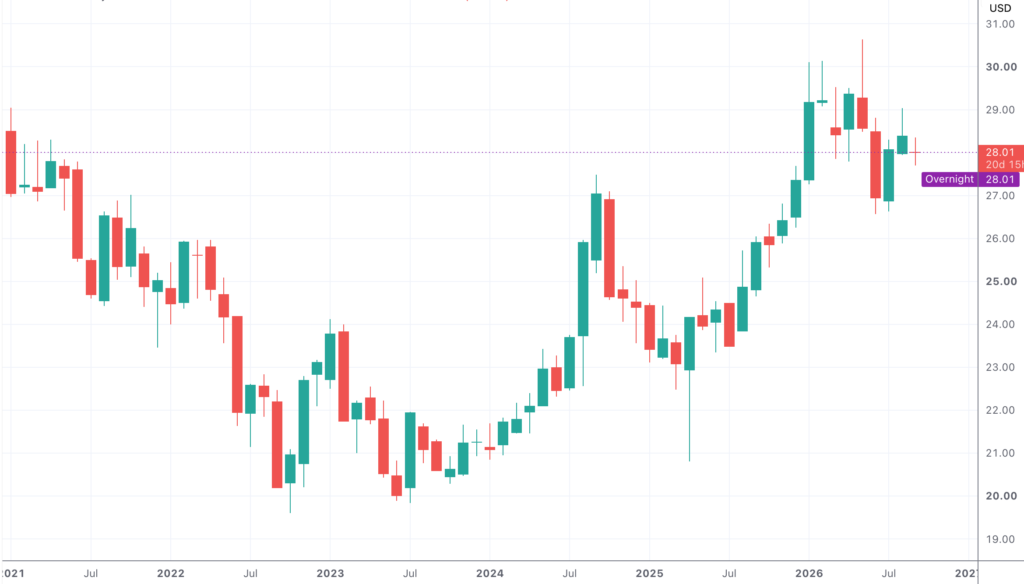
Looking at the chart above, the iShares MSCI Malaysia Index ETF experienced its fair share of volatility over the 5-year period.
Its unit price fell from a high of US$29.05 in January 2021 to US$21.09 in October 2022, before recovering to US$24.12 in January 2023.
It subsequently declined again to US$19.84 in July 2023, before staging a steady recovery to US$27.49 in September 2024. Another decline followed, bringing the ETF down to US$20.80 in April 2025, before it began another steady recovery thereafter.
Despite these fluctuations, an investor who bought into the ETF at the start of 2021 (when it opened at US$28.51 on 04 January 2021), and remained invested until the end of 2025, when it closed at US$27.36, would have been sitting on a slight 4.0% unrealised capital loss.
However, this does not take into account the dividends received along the way.
After factoring in the approximately US$4.79 per unit in dividends declared between 2021 and 2025, the investment would instead have generated an overall gain of approximately 12.8%, before taking into account withholding taxes, transaction costs and the reinvestment of dividends.
9. What are the Fees Associated with the ETF?
The iShares MSCI Malaysia Index ETF has an expense ratio of 0.50% per annum.
This means that for every US$10,000 invested in the ETF, approximately US$50 a year goes towards the fund’s operating expenses, although this is reflected in the ETF’s net asset value rather than separately charged to investors.
Closing Thoughts
One thing I personally like about investing in the Malaysian market is the element of familiarity, particularly for Singaporeans who visit the country frequently.
Looking through the ETF’s largest holdings, I am pretty sure many Singaporean investors will immediately recognise at least half of the companies, including familiar names such as Public Bank, CIMB, Maybank and Tenaga Nasional.
For investors who would like some exposure to the Malaysian stock market without having to select individual companies themselves, the iShares MSCI Malaysia Index ETF (NYSE ARCA: EWM) is certainly one option worth considering. Through a single investment, investors can gain exposure to 21 of Malaysia’s large- and mid-cap companies.
That said, one important characteristic investors need to be aware of is the ETF’s heavy concentration in the Financials sector, which accounts for slightly more than half of its portfolio. As a result, the performance of Malaysia’s major banks will have a significant influence on how the ETF performs.
There is also considerable concentration among its largest holdings, with the top 10 companies accounting for close to three-quarters of the ETF. This means that while investors are technically gaining exposure to 21 companies, the ETF’s performance is still largely driven by a relatively small group of companies.
From an income perspective, the ETF may also be less appealing to dividend-focused Singaporean investors. Apart from the unusually high yield recorded in 2021, its dividend yield has generally been in the 3+% range in recent years, and this is before taking into consideration the 30% US dividend withholding tax applicable to Singaporean investors.
Finally, investors should also be mindful of currency risks. With the underlying Malaysian investments denominated in Ringgit, the ETF traded in US dollars, and Singaporean investors ultimately measuring their returns in Singapore dollars, movements in exchange rates can have a meaningful impact on the eventual returns received.
Overall, the iShares MSCI Malaysia Index ETF provides a convenient way for investors who specifically want exposure to Malaysia to invest in a basket of some of the country’s largest listed companies. However, its heavy exposure to banks, concentration among its largest holdings, relatively modest dividend yield and currency risks are some of the key considerations investors should weigh before investing.
Disclaimer: At the time of writing, I do not have units of the iShares MSCI Malaysia ETF.
Stop Spending Hours Reading REIT Reports Every Quarter!
What if you could assess a REIT's portfolio occupancy, debt profile, valuation, and overall health in less than 30 seconds - without having to comb through a single quarterly report?
That's the problem the REIT Screener was built to solve.
Developed through a collaboration between ShareInvestor and The Singaporean Investor, the REIT Screener consolidates many of the key metrics and indicators I personally use when analysing REITs into one easy-to-use platform. Instead of spending hours extracting data manually every earnings season, you can now monitor the REITs you own and research new opportunities in just a few clicks.
If you're serious about REIT investing but don't have the time to manually track quarterly developments, the REIT Screener could be the shortcut you've been looking for:
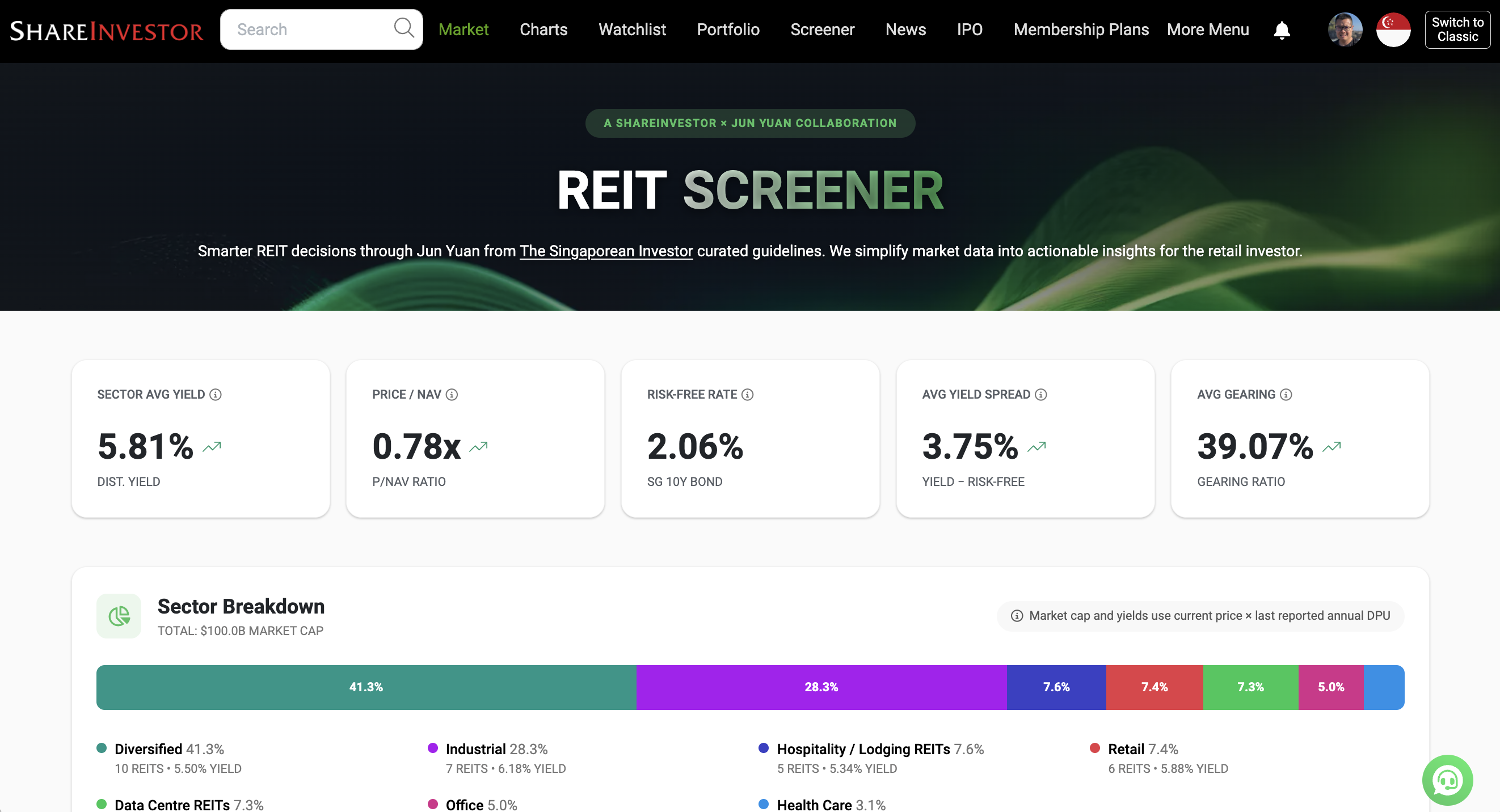
Take a closer look at the REIT Screener here...



Comments (0)