1. What is the Amova-StraitsTrading Asia ex Japan REIT Index ETF?
The Amova-StraitsTrading Asia ex Japan REIT Index ETF is an exchange-traded fund that allows investors to gain exposure to a basket of Asian real estate investment trusts, or REITs, through a single investment.
It is listed on the Singapore Exchange under 2 trading counters:
- SGX: CFA, which trades in Singapore dollars; and
- SGX: COI, which trades in US dollars.
Both counters represent units in the same underlying fund. Trading the ETF through the US-dollar counter does not remove the foreign-currency exposure arising from the fund’s underlying investments.
The ETF is managed by Amova Asset Management Asia Limited, formerly known as Nikko Asset Management Asia. Older articles and documents may therefore refer to it as the NikkoAM-StraitsTrading Asia ex Japan REIT ETF.
2. Which Index does the ETF Track?
The ETF aims to replicate, as closely as possible before expenses, the performance of the FTSE EPRA Nareit Asia ex Japan REITS 10% Capped Index.
The index comprises qualifying REITs from developed and emerging Asian markets, excluding Japan, Australia and New Zealand. Eligible REITs must satisfy the index provider’s requirements, including certain size and trading-liquidity criteria.
The phrase ’10% Capped’ means that the index applies a limit intended to prevent any single REIT from becoming overly dominant. However, a constituent’s weight can temporarily move above 10% between index reviews as market prices fluctuate.
The index is reviewed every quarter – in March, June, September and December. REITs may be added, removed or assigned new weights during these reviews.
As this is a passively managed ETF, the manager generally follows the index rather than trying to select only the most attractive REITs or reduce exposure ahead of an expected market downturn.
3. What are the ETF’s Largest Holdings?
As of 31 May 2026, the ETF’s 10 largest holdings accounted for approximately 60.3% of its portfolio.
Among the 10 largest holdings as of 31 May 2026, 8 were listed on the Singapore Exchange, 1 on the Hong Kong Stock Exchange and 1 in India.
1. Link REIT (SEHK: 0823) (Portfolio Weight: 10.7%): Link REIT is a Hong Kong-listed REIT owning a diversified portfolio of mainly retail properties, car parks, offices and logistics assets across Asia-Pacific.
2. CapitaLand Ascendas REIT (SGX: A17U) (Portfolio Weight: 10.5%): CapitaLand Ascendas REIT, or CLAR, owns a diversified portfolio of business parks, industrial facilities, logistics properties and data centres across several developed markets.
3. CapitaLand Integrated Commercial Trust (SGX: C38U) (Portfolio Weight: 9.6%): CapitaLand Integrated Commercial Trust, or CICT, is Singapore’s largest listed REIT and owns a portfolio of major retail malls and office properties, primarily in Singapore.
4. Embassy Office Parks REIT (NSE: EMBASSY) (Portfolio Weight: 5.5%): Embassy Office Parks REIT is an Indian REIT that owns large business parks and office campuses serving major multinational and technology companies.
5. Keppel DC REIT (SGX: AJBU) (Portfolio Weight: 5.0%): Keppel DC REIT invests primarily in data centres and other digital-infrastructure properties across Asia-Pacific and Europe.
6. Mapletree Logistics Trust (SGX: M44U) (Portfolio Weight: 4.5%): Mapletree Logistics Trust, or MLT, owns a diversified portfolio of logistics facilities and warehouses across major Asian markets.
7. Mapletree Industrial Trust (SGX: ME8U) (Portfolio Weight: 4.5%): Mapletree Industrial Trust, or MIT, owns data centres and industrial properties across Singapore, the United States and Japan.
8. Keppel REIT (SGX: K71U) (Portfolio Weight: 3.4%): Keppel REIT owns a portfolio of office and commercial properties across Singapore, Australia, South Korea and Japan.
9.Suntec REIT (SGX: T82U) (Portfolio Weight: 3.4%): Suntec REIT owns office, retail and convention properties in Singapore, Australia and the United Kingdom.
10. Frasers Centrepoint Trust (SGX: J69U) (Portfolio Weight: 3.2%): Frasers Centrepoint Trust, or FCT, focuses mainly on suburban shopping malls serving the everyday needs of residents in Singapore.
6 of these Singapore-listed holdings were also constituents of the Straits Times Index as of mid-2026 – CapitaLand Ascendas REIT, CapitaLand Integrated Commercial Trust, Keppel DC REIT, Mapletree Logistics Trust, Mapletree Industrial Trust, and Frasers Centrepoint Trust.
4. What is the Geographical Concentration of the ETF?
Despite its regional name, the ETF is heavily weighted towards Singapore.
Singapore and Hong Kong together accounted for 78.6% of the portfolio.
India, Malaysia, South Korea and the Philippines collectively represented another 19.2%, while other Asian markets accounted for 1.4%.
The ETF therefore provides some regional diversification, but it should not be mistaken for an evenly spread Asian REIT portfolio. Its performance remains strongly influenced by Singapore’s REIT and property markets.
5. In What Sectors are the REITs in the ETF in?
The portfolio’s 3 largest property sector allocations were:
- Industrial REITs: 25.7%
- Retail REITs: 25.2%
- Diversified REITs: 20.9%
Together, these 3 categories represented 71.8% of the ETF.
The remaining portfolio comprised:
- Office REITs: 15.7%
- Data-centre REITs: 5.6%
- Hotel and resort REITs: 3.9%
- Other sectors: 2.3%
- Cash and derivatives: 0.8%
6. What is the Distribution Payout of the ETF?
As a unitholder of the ETF, you’ll receive a distribution payout once every quarter – typically in the first few days of February, May, August, and November.
The following table is the distribution payout of the Amova-StraitsTrading Asia ex Japan REIT Index ETF over the past 5 years, along with its distribution yield:
| Year | Distribution Per Unit (S$) | Distribution Yield (%) |
| 2021 | S$0.046801 | 4.3% |
| 2022 | S$0.050101 | 5.5% |
| 2023 | S$0.051102 | 5.9% |
| 2024 | S$0.045502 | 5.9% |
| 2025 | S$0.042605 | 5.1% |
The ETF’s historical yield was generally around 5% between 2022 and 2025. However, the distribution per unit declined in both 2024 and 2025. Also, its 2025 distribution was approximately 9% below its 2021 payout.
7. What are the Fees Associated with the ETF?
The ETF has a stated management fee of 0.50% per year and a trustee fee of up to 0.04% per year.
Its total expense ratio is capped at 0.55% per year. According to the manager, expenses above this limit will be borne by the manager rather than the fund.
8. What are Some of the Risks Associated with Investing in the ETF?
1. Interest Rate & Refinancing Risk: REITs commonly use debt to finance their properties. Higher interest rates can increase borrowing and refinancing costs, reducing the income available for distribution. Higher rates can also make bonds and fixed deposits more attractive relative to REITs, placing downward pressure on REIT prices.
2. Property Market Risk: Falling rents, lower occupancy, tenant failures and declining property valuations can hurt the REITs held by the ETF. Different property sectors face different risks. For example, office properties may be affected by remote working trends, while shopping malls depend partly on consumer spending and foot traffic.
3. Geographic Concentration: Approximately 65% of the fund was invested in Singapore as of 31 May 2026. A downturn in Singapore’s economy, property market or REIT sector could therefore have a significant effect on the ETF.
4. Holding Concentration: The 10 largest holdings accounted for approximately 60.3% of the portfolio. Poor performance by a few major REITs could materially affect the performance of the entire fund.
5. Currency Risk: Although the ticker symbol ‘SGX: CFA’ trades in Singapore dollars, the ETF invests in REITs and properties exposed to several foreign currencies. A weakening of regional currencies against the Singapore dollar can reduce the SGD value of overseas income and assets. Conversely, stronger foreign currencies may support SGD-denominated returns. Trading through the US-dollar ‘SGX: COI’ counter does not eliminate the portfolio’s underlying currency exposure.
9. How has the ETF Performed in the Last 5 Years?
The following is how the Amova-StraitsTrading Asia ex Japan REIT Index ETF’s (SGX: CFA) unit price has moved since January 2021 (on a monthly basis):
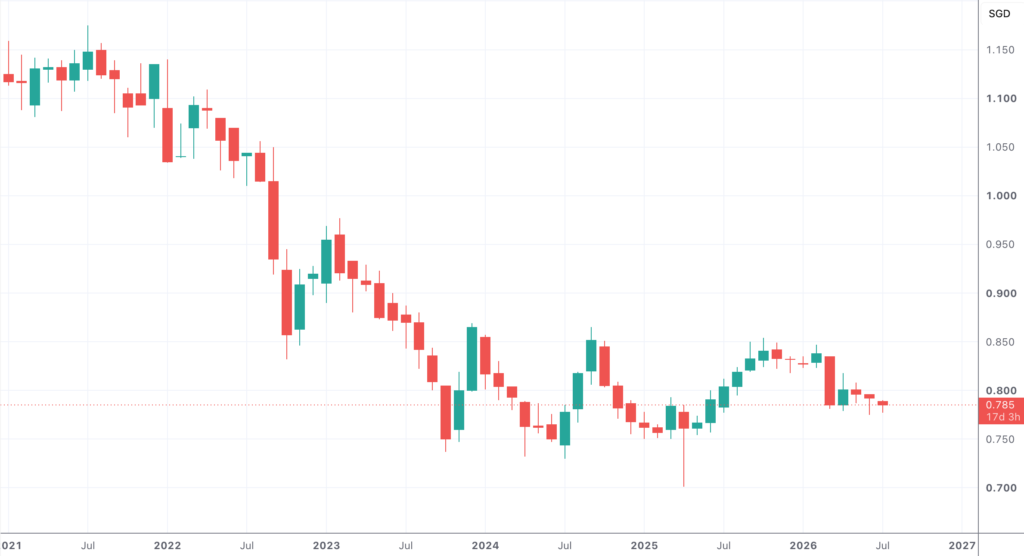
The ETF faced a difficult environment between 2021 and 2025.
REITs were initially affected by the lingering effects of the Covid-19 pandemic. They subsequently came under pressure from aggressive interest-rate increases, which raised financing costs and made lower-risk income investments more competitive.
The ETF’s unit price fell approximately 40% from a high of S$1.175 in July 2021 to a low of S$0.701 in April 2025. It subsequently stabilised, trading mainly between approximately S$0.785 and S$0.835 from July to December 2025.
Now, consider an investor who bought CFA at its opening price of S$1.125 on the first trading day of 2021 and continued holding it until the end of 2025, when it closed at S$0.832.
Based only on the unit-price movement, the investor would have had an unrealised capital loss of approximately 26%. Even if distributions received during this period was considered, the investor would have had an unrealised capital loss of approximately 5.1%.
Closing Thoughts
The Amova-StraitsTrading Asia ex Japan REIT Index ETF offers a convenient way to invest in a basket of REITs through a single SGX-listed security.
However, its regional diversification should be viewed in context. As of 31 May 2026, approximately 65% of the portfolio was invested in Singapore, while Hong Kong represented another 13.6%. All other markets combined accounted for only around one-fifth of the portfolio, excluding cash and derivatives.
The 10 largest holdings also made up approximately 60.3% of the ETF. 8 of them were Singapore-listed REITs, collectively representing about 44.1% of the portfolio. Developments affecting these large Singapore REITs can therefore have a meaningful influence on the ETF’s performance.
The ETF has historically offered a distribution yield of around 5%, but the cash payout declined in both 2024 and 2025. Its 2025 distribution was approximately 9% lower than in 2021.
To sum up, this ETF may suit investors who want convenient exposure to Asian REITs and are comfortable with its heavy Singapore weighting.
Disclaimer: At the time of writing, I do not own any units of the Amova-StraitsTrading Asia ex Japan REIT Index ETF.
Join Me for a FREE Live Online Chit-Chat on Thursday, 12 November, from 8–9pm (SGT)!

It's been quite some time since I last had a live chit-chat with the investing community, and I’m excited to be back for another session! A big thank you to my friend, Dinah Poehlmann from Your Finance Mind, for inviting me once again!
This time, we’re taking a little break from REITs and exploring some interesting topics surrounding investing, including my go-to investing resources, when is a stock considered 'investable', my thoughts about using AI for stock analysis and trading, and much more.
Whether you're just starting your investing journey or have been investing for years, I hope this session will offer some useful perspectives and practical takeaways that you can apply to your own investing journey.
Best of all, the session is completely FREE to attend! All you need to do is register in advance to receive the Zoom link:
👉 Click here to reserve your spot!
Are You Worried about Not Having Enough Money for Retirement?
You're not alone. According to the OCBC Financial Wellness Index, only 62% of people in their 20s and 56% of people in their 30s are confident that they will have enough money to retire.
But there is still time to take action. One way to ensure that you have a comfortable retirement is to invest in real estate investment trusts (REITs).
In 'Building Your REIT-irement Portfolio' which I've authored, you will learn everything you need to know to build a successful REIT investment portfolio, including a list of 9 things to look at to determine whether a REIT is worthy of your investment, 1 simple method to help you maximise your returns from your REIT investment, 4 signs of 'red flags' to look out for and what you can do as a shareholder, and more!

You can find out more about the book, and grab your copy (ebook or physical book) here...


Comments (0)