When we think about what moves the stock market, some of the first things that probably come to mind are a company’s latest earnings (particularly whether its quarterly results and outlook beat or miss analysts’ expectations), changes in benchmark interest rates (and news surrounding them), economic growth indicators such as GDP, key inflation data including CPI, PPI, and PCE, or even changes in government policies.
While all these factors certainly play an important role in influencing market movements, there is another powerful force at work every single day – human emotions.
And among the many emotions investors experience, 2 stand out in particular: fear and greed.
When markets are rising strongly, greed can lead investors to chase stocks even as their valuations become increasingly expensive. On the other hand, when markets are falling sharply, fear can cause investors to sell even fundamentally sound companies simply because everyone else seems to be doing the same – and going against the crowd somehow does not seem to ‘make sense’ at that point in time.
Understanding these 2 emotions, and more importantly, learning how to manage them, can make a significant difference to the investment decisions we make.
Let us take a closer look in this post.
How Greed Drives Markets Higher
Greed tends to become most obvious during strong bull markets.
When share prices keep rising, investors naturally become more optimistic. Seeing others make money can also create a fear of missing out, or what we commonly know as ‘FOMO’.
Instead of asking whether a company remains fundamentally sound or reasonably valued, the focus gradually shifts towards one question: ‘How much higher can its share price go?’
And the longer the rally continues, the stronger this confidence can become.
Investors who were initially cautious may eventually decide to jump in simply because they do not want to be left behind. As more money flows into the market, share prices rise even further, reinforcing the belief that buying was the right decision.
However, the problem is that a company’s fundamentals do not always improve as quickly as its share price.
Eventually, valuations can become stretched to a point where even a relatively small disappointment – such as management providing a slightly weaker-than-expected earnings outlook for the coming quarter or year – may be enough to trigger a sharp correction.
How Fear Drives Markets Lower
Fear works in almost exactly the opposite way.
When markets fall sharply, investors become increasingly concerned about how much more they could potentially lose.
Negative headlines suddenly receive much more attention. Investors may begin imagining the worst possible outcomes, while the urge to protect whatever capital they have left becomes increasingly powerful.
This can lead to indiscriminate selling.
Even fundamentally sound companies with healthy balance sheets, strong cash flows, and sustainable dividends may see their share prices fall sharply simply because investors are rushing for the exits.
Ironically, such periods can sometimes present attractive opportunities for long-term investors to accumulate quality companies at more reasonable valuations.
However, buying when almost everyone else is fearful is much easier said than done.
Once again, emotions come into play. Even if we believe a company is attractively valued, we may hesitate to invest because we are worried that its share price could fall even further immediately after we buy.
The Market Can Amplify Both Emotions
One interesting thing about fear and greed is that movements in the market itself can reinforce these emotions.
When share prices rise, investors become more confident. That confidence encourages more buying, which pushes prices even higher and attracts even more investors into the market.
Similarly, when share prices fall, investors become increasingly fearful. More investors sell, prices fall further, and the decline creates even greater fear.
This is why markets can sometimes move far beyond what the underlying fundamentals appear to justify.
In the short term, share prices are not determined purely by numbers. They are also influenced by how investors interpret those numbers – and, importantly, how they react emotionally to what everyone else is doing.
Why Investors Need a Process
We cannot completely eliminate emotions from investing, and that is perfectly understandable. After all, it is our hard-earned money that is on the line.
What we can do, however, is put a sensible investment process in place so that fear and greed have less influence over the decisions we make.
For example, before investing in a company, we can determine what we believe its fair valuation should be, understand the potential risks involved, and establish what developments would cause our original investment thesis to change – and potentially warrant a divestment.
When markets subsequently become volatile, we can revisit these considerations rather than reacting purely to movements in share prices.
The same applies when markets are booming.
Instead of buying simply because everyone around us seems optimistic, we should continue asking ourselves the same questions:
Is the business fundamentally sound?
Are its earnings sustainable?
And most importantly, are we paying a reasonable price for it?
Having a consistent investment process does not guarantee that every investment will turn out well. But it can help prevent our emotions from making important investment decisions on our behalf.
Closing Thoughts
Fear and greed have always been part of financial markets, and they will probably remain so for as long as humans continue to make investment decisions.
Greed can cause investors to chase rising share prices while overlooking increasingly expensive valuations. Fear, on the other hand, can cause them to sell quality investments simply because markets are falling.
Both emotions become particularly dangerous when they cause us to abandon our investment process and make decisions based purely on what share prices are doing.
As retail investors, we do not need to predict exactly when the market will become fearful or greedy. Neither do we need to perfectly time every market top and bottom.
Instead, what matters is being able to recognise when our own emotions are beginning to influence our investment decisions.
So, the next time markets are soaring and you feel an overwhelming urge to buy, or when markets are plunging and you desperately feel like selling, take a moment to revisit your original investment thesis and the company’s underlying fundamentals.
Ask yourself whether something has genuinely changed with the business, or whether it is simply the market’s perception towards it that has changed.
If the fundamentals and your original investment thesis remain intact, perhaps the biggest change is not in the investment itself – but in how the market, and possibly ourselves, are feeling about it.
Stop Spending Hours Reading REIT Reports Every Quarter!
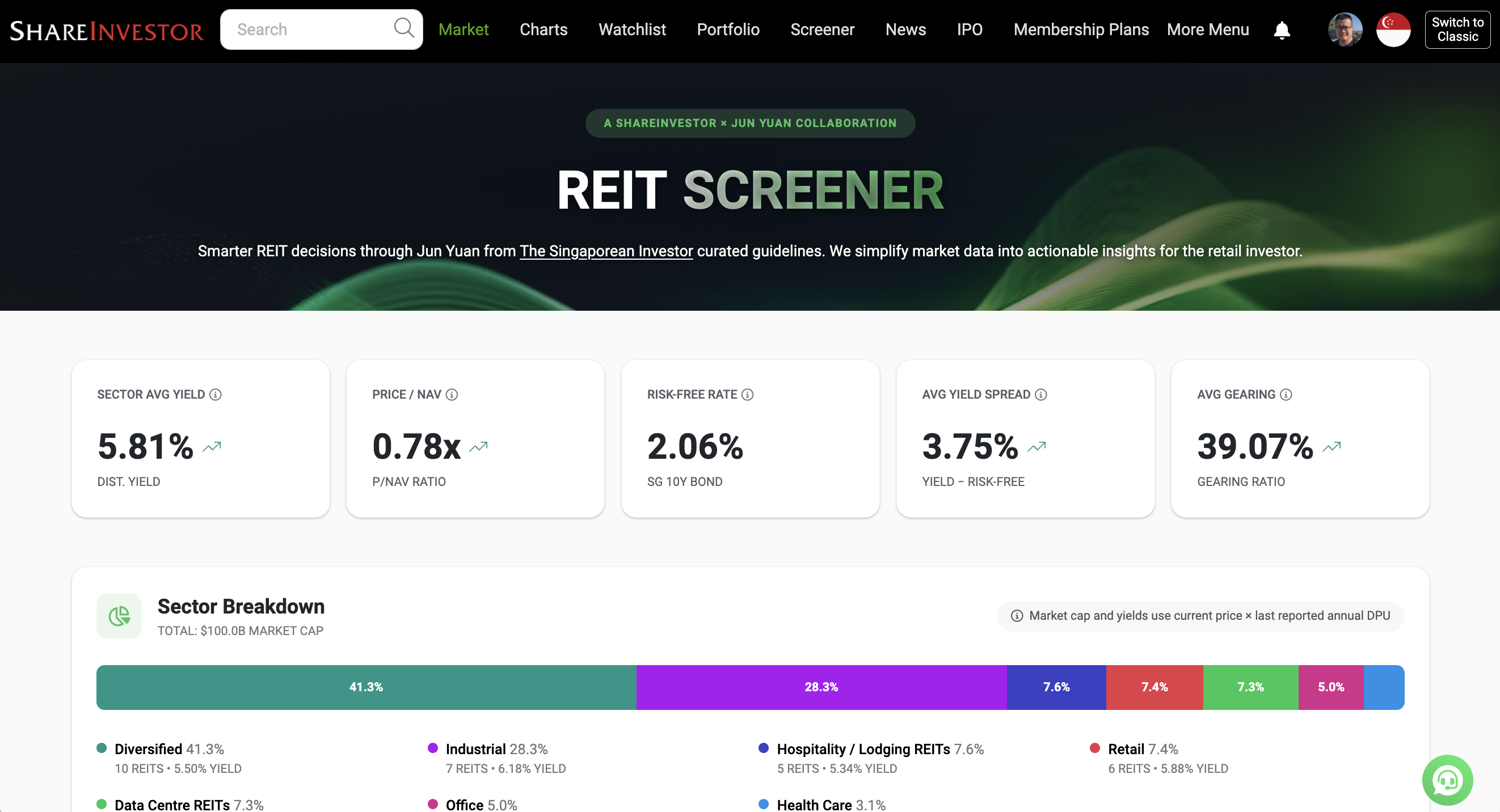
What if you could assess a REIT's portfolio occupancy, debt profile, valuation, and overall health in less than 30 seconds - without having to comb through a single quarterly report?
That's the problem the REIT Screener was built to solve.
Developed through a collaboration between ShareInvestor and The Singaporean Investor, the REIT Screener consolidates many of the key metrics and indicators I personally use when analysing REITs into one easy-to-use platform. Instead of spending hours extracting data manually every earnings season, you can now monitor the REITs you own and research new opportunities in just a few clicks.
If you're serious about REIT investing but don't have the time to manually track quarterly developments, the REIT Screener could be the shortcut you've been looking for:
Take a closer look at the REIT Screener here...



Comments (0)