Brief Overview:
Mapletree Industrial Trust (SGX: ME8U), or MIT, invests in industrial assets, including hi-tech buildings, business spaces, and general industrial properties, as well as data centres.
As of 31 March 2026, MIT’s portfolio includes 79 properties in Singapore, 55 properties in North America (13 of which are held through a joint venture with its Sponsor, Mapletree Investments Pte Ltd), and 2 properties in Japan. The total value of these assets is S$8.3 billion.
Financial Performance (4Q FY2024/25 vs. 4Q FY2025/26):
| 4Q FY2024/25 | 4Q FY2025/26 | % Gain/Loss | |
| Gross Revenue (S$’mil) | $177.8m | $163.8m | -7.9% |
| Property Operating Expenses (S$’mil) | $46.6m | $43.9m | -5.8% |
| Net Property Income (S$’mil) | $131.2m | $119.9m | -8.6% |
| Distributable Income to Unitholders (S$’mil) | $95.8m | $88.2m | -7.9% |
This marks the 3rd consecutive quarter in which MIT’s gross revenue, net property income, and distributable income to unitholders all recorded a year-on-year decline of high single-digit percentages (around 7% to 8%).
The decline in the REIT’s gross revenue and net property income was primarily due to several factors, including the loss of income from the divestment of 3 properties in Singapore (The Strategy, The Synergy, and Woodlands Central Cluster) in August 2025, the non-renewal of leases in its North American portfolio, and the depreciation of the United States Dollar and Japanese Yen against the Singapore Dollar. However, this was partly offset by increased revenue from new leases and renewals in its Singapore portfolio, as well as the completion of the final phase of fit-out works at the Osaka Data Centre in May 2025.
Property operating expenses fell by 4.3% year on year to S$172.6 million, mainly due to lower property costs following the divestment of the 3 Singapore properties.
Lastly, the decline in distributable income to unitholders was a result of the absence of net divestment gains from the Tanglin Halt cluster, no distributable income from the 3 divested Singapore industrial properties, and a reduction in distribution from joint ventures due to higher borrowing costs following the repricing of maturing interest rate swaps.
Financial Performance (FY2024/25 vs. FY2025/26):
| FY2024/25 | FY2025/26 | % Gain/Loss | |
| Gross Revenue (S$’mil) | $711.8m | $673.0m | -5.5% |
| Property Operating Expenses (S$’mil) | $180.4m | $172.6m | -4.3% |
| Net Property Income (S$’mil) | $531.5m | $500.4m | -5.9% |
| Distributable Income to Unitholders (S$’mil) | $386.0m | $362.6m | -6.1% |
This marks the first time in 5 years (from FY2020/21 to FY2025/26) that MIT’s top- and bottom-line saw year-on-year declines.
The decrease in gross revenue and net property income was mainly due to the loss of income from the 3 divested Singapore properties (The Strategy, The Synergy, and Woodlands Central Cluster), the non-renewal of leases in its North American portfolio, and the depreciation of the United States Dollar against the Singapore Dollar. However, this was partly offset by higher revenue from the Tokyo property acquired in October 2024, the completion of the final phase of fit-out works at the Osaka Data Centre in May 2025, and increased revenue from new leases and renewals in the Singapore Portfolio.
Property operating expenses fell by 4.3% year on year to S$172.6 million, mainly due to lower property costs following the divestment of the 3 Singapore industrial properties.
Finally, the decline in distributable income to unitholders was primarily due to the absence of net divestment gains from the Tanglin Halt cluster, no distributable income from the divestment of the 3 Singapore properties, and reduced distribution from joint ventures due to higher borrowing costs resulting from the repricing of matured interest rate swaps.
Portfolio Occupancy Profile (3Q FY2025/26 vs. 4Q FY2025/26):
| 3Q FY2025/26 | 4Q FY2025/26 | |
| Portfolio Occupancy (%) | 91.4% | 91.2% |
| Portfolio WALE (by Gross Revenue – years) | 4.5 years | 4.4 years |
MIT’s portfolio occupancy decreased slightly by 0.2 percentage points to 91.2%, primarily due to a further drop in occupancy rates for its North American properties, which declined by 1.4 percentage points to 86.1%. This marks the 6th consecutive quarter of declining occupancy rates for the REIT’s North American properties, as shown below:
90.9% (2Q FY2024/25) → 90.3% (3Q) → 88.2% (4Q) → 88.0% (1Q FY2025/26) → 87.8% (2Q) → 87.5% (3Q) → 86.1% (4Q)
As I highlighted in my November 2025 post, where I sought insights from the REIT’s investor relations about the challenges faced by its North American properties, this decline was anticipated (you can read the full post here). From my understanding, improvements are expected starting from the next financial year, as revenue growth from new leases is factored in. This will be something I continue to monitor closely.
Lease expiries are well-spread out, with 17.9% of leases due for renewal each year over the next three financial years (FY2026/27 to FY2028/29). The remaining 46.2% of leases are not due for renewal until FY2029/30 or later.
On rental reversions, for 4Q FY2025/26, the reversion rate for Singapore properties was +6.2%.
Debt Profile (3Q FY2025/26 vs. 4Q FY2025/26):
| 3Q FY2025/26 | 4Q FY2025/26 | |
| Aggregate Leverage (%) | 37.2% | 34.0% |
| Interest Coverage Ratio (times) | 3.9x | 4.0x |
| Average Cost of Debt (%) | 3.1% | 3.2% |
| Average Term to Debt Maturity (years) | 2.9 years | 3.4 years |
| % of Borrowings Hedged at Fixed Rates (%) | 88.6% | 88.6% |
Regarding MIT’s debt profile, a notable change was the 3.2 percentage point reduction in its aggregate leverage, bringing it to a healthy 34.0%. This was primarily due to the repayment of borrowings in the interim, pending the deployment of proceeds from the new perpetual securities (S$300 million at 3.25% in March 2026). Aggregate leverage is anticipated to increase to approximately 37.5% after the drawdown of debt and the redeployment of the new perpetual securities to redeem existing perpetual securities.
The REIT’s debt maturity profile is well-distributed, with between 8% and 28% of borrowings due for refinancing each year over the next five financial years (FY2026/27 to FY2030/31). The remaining 17% of borrowings will be due for refinancing in FY2031/32 or later.
Distribution Payout to Unitholders (4Q FY2024/25 vs 4Q FY2025/26):
| 4Q FY2024/25 | 4Q FY2025/26 | % Gain/Loss | |
| Distribution Per Unit (S$’cents) | 3.36 cents | 3.09 cents | -8.0% |
The lower distribution per unit for the 4th quarter was attributed to the absence of distribution from the divestment proceeds of the Tanglin Halt sector. If this is excluded, MIT’s distribution per unit for 4Q FY2024/25 would be 3.25 cents, reflecting a year-on-year decline of just 4.9% compared to the distribution payout of 3.09 cents for the current quarter under review.
If you are a unitholder of MIT, do take note of the following dates on its latest distribution payout:
Ex-Date: 06 May 2026
Record Date: 07 May 2026
Payout Date: 12 June 2026
Distribution Payout to Unitholders (FY2024/25 vs FY2025/26):
| FY2024/25 | FY2025/26 | % Gain/Loss | |
| Distribution Per Unit (S$’cents) | 13.57 cents | 12.71 cents | -6.3% |
Excluding gains from the divestment of the Tanglin Halt sector, MIT’s distribution per unit for FY2024/25 would be 13.13 cents. Compared to its payout of 12.71 cents for the current financial year under review, this represents a decline of 3.2%.
CEO Ms Lily Ler’s Comments & Outlook (from the REIT’s Press Release):
“FY25/26 was a year of active portfolio management and repositioning, with a clear focus on resilience. We completed divestments totalled S$550.6 million, while placing strong emphasis on operational execution through proactive leasing, including backfilling vacant space as well as renewing or extending leases ahead of expiries. The successful issuance of S$300 million 3.25% perpetual securities, ahead of redemption of existing perpetual securities due in May 2026, is also a testament to investors’ confidence in MIT and our accessibility to various funding sources. Together, these actions strengthen portfolio quality and position MIT for sustainable long-term returns.”
Closing Thoughts:
Overall, FY2025/26 was a challenging year for MIT, as both its top- and bottom-lines experienced a year-on-year decline for the first time in 5 years. This was due to the absence of income from divested properties, difficulties in its North American portfolio, and a weaker United States Dollar against the Singapore Dollar.
Regarding the occupancy rates of its North American properties, there has been a gradual decline since 2Q FY2024/25, when the occupancy rate stood at 90.9%, falling to 86.1% by 4Q FY2025/26. However, there is a glimmer of hope, as based on discussions I had with the REIT’s investor relations team late last year, I understand that improvements are expected starting next financial year. This is something I will continue to monitor closely.
Lastly, on its debt profile, MIT remains in a very healthy position, with aggregate leverage at over 30%, a well-distributed debt expiry profile, and nearly 90% of borrowings hedged at fixed rates. This effectively mitigates the risks of interest rate fluctuations impacting its borrowing costs and distribution payout growth.
Financial Results of the Other Mapletree REITs:
Mapletree Logistics Trust (SGX: M44U): 4Q & FY2025/26 Results Review
Related Documents:
Press Release
Financial Statement
Presentation Slides
Disclaimer: At the time of writing, I am a unitholder of Mapletree Industrial Trust.
Stop Spending Hours Reading REIT Reports Every Quarter!
What if you could assess a REIT's portfolio occupancy, debt profile, valuation, and overall health in less than 30 seconds - without having to comb through a single quarterly report?
That's the problem the REIT Screener was built to solve.
Developed through a collaboration between ShareInvestor and The Singaporean Investor, the REIT Screener consolidates many of the key metrics and indicators I personally use when analysing REITs into one easy-to-use platform. Instead of spending hours extracting data manually every earnings season, you can now monitor the REITs you own and research new opportunities in just a few clicks.
If you're serious about REIT investing but don't have the time to manually track quarterly developments, the REIT Screener could be the shortcut you've been looking for:
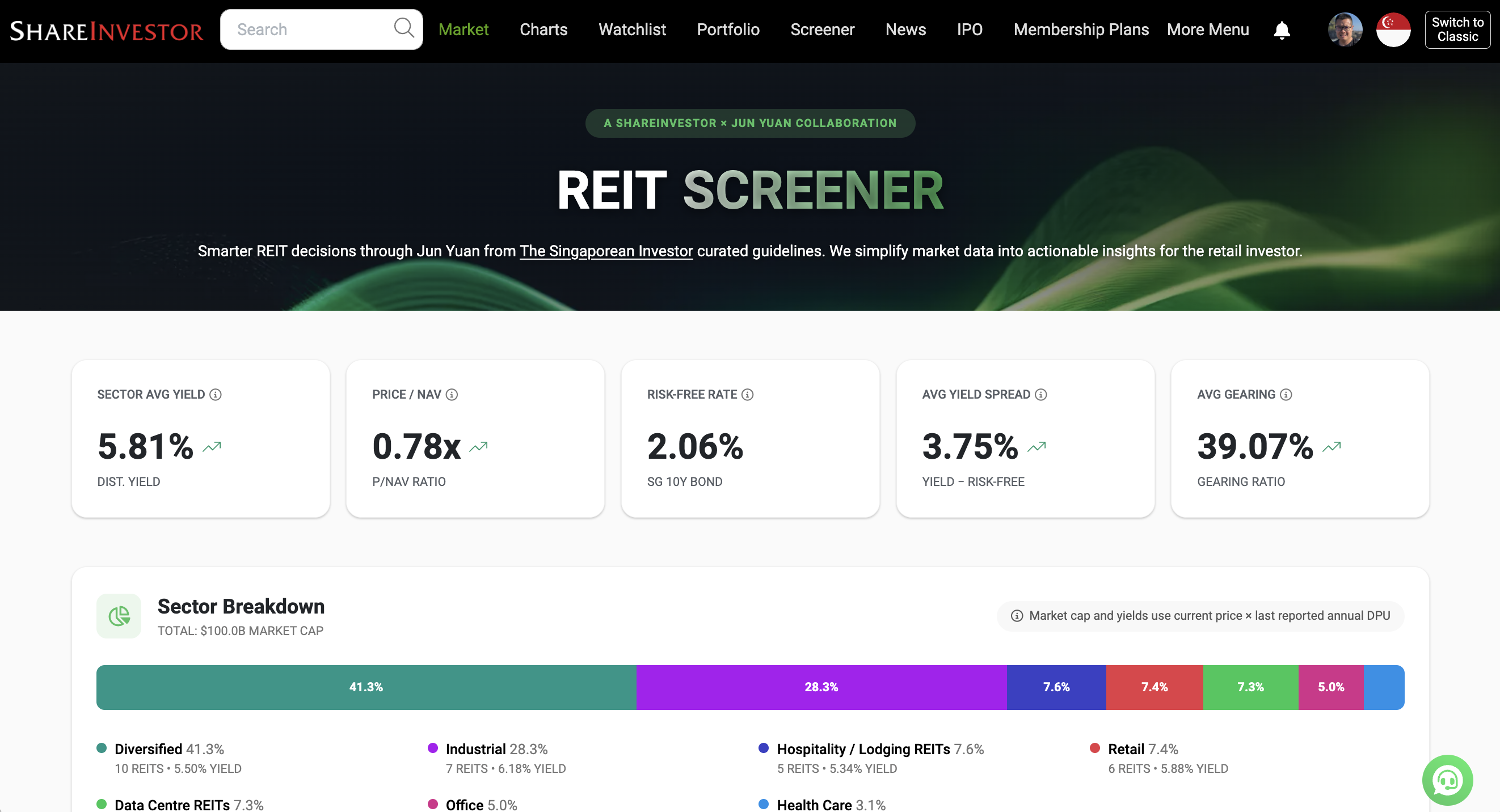
Take a closer look at the REIT Screener here...



Comments (0)