Brief Overview:
Originally known as CapitaLand Mall Trust, the first REIT listed on the Singapore Exchange, it focused on investing in retail malls in Singapore. In July 2002, the REIT merged with CapitaLand Commercial Trust, which held office properties in Singapore and Germany, and was subsequently rebranded as CapitaLand Integrated Commercial Trust (SGX: C38U), or CICT.
As of 31 December 2025, CICT’s portfolio consists of 25 real estate assets primarily used for retail and/or office purposes, located across 3 countries: 20 in Singapore, 2 in Frankfurt, Germany, and 3 in Sydney, Australia. The combined value of these properties is S$27.0 billion.
CICT is also the largest REIT listed on the Singapore Exchange by market capitalisation.
Financial Figures (1Q FY2025 vs. 1Q FY2026):
| 1Q FY2025 | 1Q FY2026 | % Gain/Loss | |
| Gross Revenue (S$’mil) | $395.3m | $426.7m | +8.0% |
| Property Operating Expenses (S$’mil) | $103.8m | $112.3m | +8.2% |
| Net Property Income (S$’mil) | $291.5m | $314.4m | +7.9% |
CICT’s gross revenue and net property income increased by 8.0% and 7.9% year on year, to S$426.7 million and S$314.4 million respectively. This growth was primarily driven by the full acquisition of a 100% stake in CapitaSpring and the contribution from Gallileo in Germany.
Portfolio Occupancy Profile (4Q FY2025 vs. 1Q FY2026):
| 4Q FY2025 | 1Q FY2026 | |
| Occupancy (Retail) (%) | 98.7% | 97.8% |
| WALE (Retail) (years) | 1.9 years | 1.9 years |
| Rental Reversion (Retail) (%) | +6.6% | +4.4% |
| Occupancy (Office) (%) | 95.7% | 93.7% |
| WALE (Office) (years) | 3.2 years | 3.1 years |
| Rental Reversion (Office) (%) | +6.6% | +6.1% |
| Occupancy (Integrated Development) (%) | 97.7% | 96.0% |
| WALE (Integrated Development) (years) | 4.3 years | 4.3 years |
CICT’s properties experienced slight declines in occupancy rates, with retail properties decreasing by 0.9 percentage points (pp) to 97.8%, office properties dropping by 2.0pp to 93.7%, and integrated developments falling by 1.7pp to 96.0%. This slight negative impact was primarily attributed to lower occupancies at CQ@Clarke Quay, Funan (office), and Main Airport Center (Germany).
Nevertheless, the overall occupancy rates across the various property types remain strong, above 90%.
Regarding lease expiries, they are well-distributed, with 11.4% of retail leases and 5.1% of office leases due for renewal over the next 3 quarters of FY2026. Between FY2027 and FY2029 (a 3-year period), an average of 12.5% of retail leases and 8.8% of office leases will be due for renewal annually. The remaining 5.1% of retail leases, 10% of office leases, and 4.5% of hospitality leases are due for renewal only in FY2030 or later.
Lastly, the REIT achieved positive rental reversions for both retail and office properties, with increases of +4.4% and +6.1% respectively. This trend is expected to support stable growth in CICT’s financial performance in the upcoming quarters.
Debt Profile (4Q FY2025 vs. 1Q FY2026):
| 4Q FY2025 | 1Q FY2026 | |
| Aggregate Leverage (%) | 38.6% | 38.5% |
| Interest Coverage Ratio (times) | 3.7x | 3.8x |
| Average Cost of Debt (%) | 3.2% | 2.9% |
| Average Term to Debt Maturity (years) | 4.0 years | 4.0 years |
| % of Borrowings at Fixed Rates (%) | 74.0% | 76.0% |
CICT’s debt profile showed slight improvements across the metrics I monitor, with all indicators remaining at healthy levels compared to the previous quarter.
The debt maturity profile is also well-staggered, with only 4% and 10% of borrowings due for refinancing in the remaining 3 quarters of FY2026 and the whole of FY2027, respectively. Between FY2028 and FY2031 (a four-year period), an average of 17.5% of borrowings will be up for refinancing, with the remaining 16% due for refinancing in FY2032 or later.
Closing Thoughts:
Overall, it was a strong quarter for CICT in terms of financial performance, with gross revenue and net property income experiencing high single-digit percentage growth.
The REIT’s debt profile also showed improvements, as key metrics such as aggregate leverage, interest coverage ratio, average cost of debt, and the percentage of borrowings at fixed rates all improved compared to the previous quarter.
The only downside was a slight dip in the occupancy rates of its retail, office, and integrated development assets, which fell by between 0.9 and 2.0 percentage points. However, with occupancy rates still above 90%, this is not a major concern.
Finally, since CICT follows a semi-annual distribution policy, no payouts were declared for the current quarter.
Related Documents:
Business Updates of the Other CapitaLand REITs and Business Trusts:
CapitaLand Ascendas REIT (SGX: A17U): 1Q FY2026 Business Update Review
CapitaLand India Trust (SGX: CY6U): 1Q FY2026 Business Update Review
Disclaimer: At the time of writing, I am a unitholder of CapitaLand Integrated Commercial Trust.
Stop Spending Hours Reading REIT Reports Every Quarter!
What if you could assess a REIT's portfolio occupancy, debt profile, valuation, and overall health in less than 30 seconds - without having to comb through a single quarterly report?
That's the problem the REIT Screener was built to solve.
Developed through a collaboration between ShareInvestor and The Singaporean Investor, the REIT Screener consolidates many of the key metrics and indicators I personally use when analysing REITs into one easy-to-use platform. Instead of spending hours extracting data manually every earnings season, you can now monitor the REITs you own and research new opportunities in just a few clicks.
If you're serious about REIT investing but don't have the time to manually track quarterly developments, the REIT Screener could be the shortcut you've been looking for:
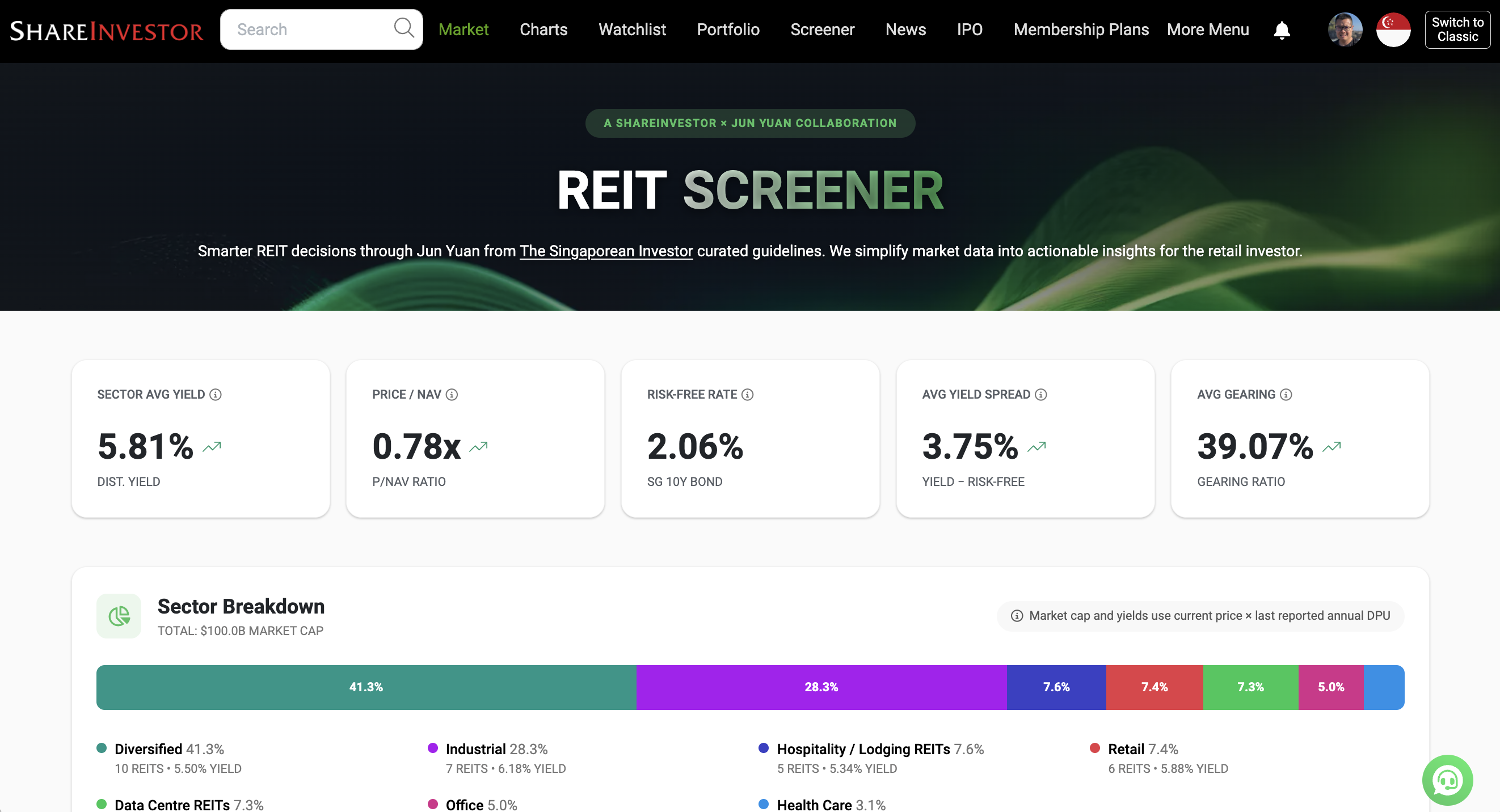
Take a closer look at the REIT Screener here...



Comments (0)