South Korea is one of the most popular holiday destinations among Singaporeans.
Apart from the country’s trendy cafes and wonderful local cuisines, as well as gorgeous sceneries at some of the popular attractions (among tourists and locals), in terms of its economy, the country is the 4th largest in Asia (behind China, Japan, and India) – making the country good investment option.
That said, I understand that language is one of the obstacles when it comes to studying about the individual companies. However, you can invest in the country by investing in the iShares MSCI South Korea ETF (NYSE ARCA:EWY). How I came about the ETF was from a sharing by a friend of mine. I thought the ETF was an interesting one, and I embarked on some research to learn more about it.
In this post, I will be sharing with you the essentials you need to know about the ETF:
What Index does the iShares MSCI South Korea ETF Track?
The iShares MSCI South Korea ETF tracks the MSCI Korea 25/50 Index – a free float-adjusted market capitalisation-weighted index designed to measure the performance of 104 large- and mid-cap companies listed on the Korea Exchange.
For those who are wondering why 25/50 in the underlying index name – it basically means the weight of any single company cannot have a weightage of more than 25%, and all the companies with a weightage of above 5% cannot have a total weightage of more than 50%.
In Which Sectors are the Companies in the ETF in?
The following table is the list of sectors, along with their weightage, in the iShares MSCI South Korea ETF:
| Sector | % Weightage |
| Information Technology | 34.64% |
| Industrials | 14.96% |
| Financials | 11.26% |
| Materials | 10.25% |
| Consumer Discretionary | 10.07% |
| Communication | 7.42% |
| Healthcare | 5.97% |
| Consumer Staples | 2.65% |
| Energy | 1.68% |
| Utilities | 0.57% |
As you can see, Information Technology holds a heavy weightage in the ETF, because the ETF’s top 2 holdings with the heaviest weightage are Samsung Electronics Ltd (which has a weightage of 21.77%), and SK Hynix Inc (which has a weightage of 7.02%) – more information about the companies coming up in the next section.
What are the Top 10 Holdings of the ETF?
The 10 companies with the heaviest weightage in the ETF are in the following sectors (with their weightage in percentage terms in brackets): Information Technology (31.15%), Materials (5.56%), Communication (2.80%), Consumer Discretionary (2.55%), and Industrials (1.78%).
Here are more information about the 10 companies:
1. Samsung Electronics (KRX:005930) (21.77% Weightage, Information Technology)
Samsung Electronics is a company which all Singaporeans should be familiar with, as many are users of its electronics products, including its Galaxy smartphone, Smart TV, refrigerators and washing machines, etc.
It is one of the world’s largest producers of a wide variety of consumer and industry electronics, including appliances, digital media services, semiconductors, memory chips, and integrated systems.
The company not only has the heaviest weightage in the iShares MSCI South Korea ETF, but it is also the only one with a weightage of more than 10%.
With its fiscal year ending every December, here’s an overview of Samsung Electronics’ total revenue and net income (also known as net profit) recorded over the last 5 years – between 2018 and 2022:

Apart from in 2019 (where its total revenue fell by 5.5% and its net income tumbled by 51%), the remaining years saw its total revenue and net income recording year-on-year (y-o-y) growths.
The compound annual growth rate (or CAGR) of its total revenue and net income over a 5-year period was at a stable 4.4% and 4.5% respectively.
2. SK Hynix Inc (KRX:000660) (7.02% Weightage, Information Technology)
Coming in 2nd place in terms of weightage in the index is SK Hynix Inc – at 7.02%.
The company is the world’s second-largest market of memory chips, and a leading supplier of semiconductors.
Some of the products produced by the company include dynamic random access memory (DRAM) chips, flash memory chips (NAND), and CMOS image sensors (CIS).
It has a fiscal year ending every December, and the following is its total revenue and net income recorded over the last 5 years (between 2018 and 2022):
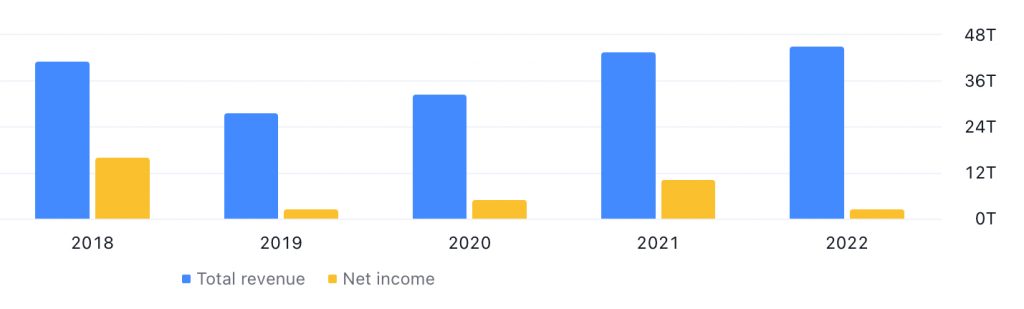
Out of the 5 years I have looked at, SK Hynix’s total revenue only recorded a y-o-y decline in 2019 (by 33%), and recording a CAGR of about 2%, while its net income fell in 2 out of 5 years (by 87% in 2019 and 77% in 2022 – due to a prolonged memory chip market slump).
3. Posco Holdings (KRX:005490) (3.23% Weightage, Materials)
Headquartered in Pohang, Posco Holdings, together with its subsidiaries, manufactures and sells iron and steel rolled products (such as hot rolled and cold rolled products, wire rods, plates, silicon steel sheets, and stainless steel products for the automotive, shipbuilding, home appliance, engineering, and machinery industries) in its home country, as well as internationally.
At the time of writing, the South Korean-listed company has the 3rd largest weightage in the ETF, at 3.23%.
The following is its total revenue and net income recorded over the last 5 years, between 2018 and 2022 (the company has a fiscal year end every December):
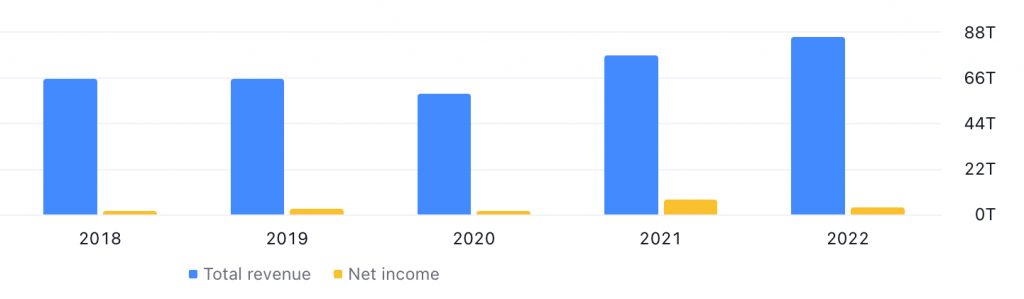
Its total revenue fell in 2 out of 5 years (by about 1% in 2019 and by about 10% in 2020), and recording a CAGR of 5.5%.
Similar to its total income, the company’s net income also recorded a y-o-y decline in 2 out of 5 years (by about 13% in 2020, and by 52% in 2022 – due to the company’s halt in operation of its Pohang steel mill, as well as the negative impact of a strike by cargo truckers) – despite of that, its net income still managed to grow at a CAGR of 13.5% over a 5-year period.
4. Naver Corp (KRX:035420) (2.80% Weightage, Communication)
Naver Corp is another company where Singaporeans are probably familiar with – where many make use of the company’s NAVER Maps to navigate around South Korea. Some of you may also be users of the popular LINE messaging app – yes, this app is produced by Naver Corp.
Apart from these 2 apps, the South Korean company also owns the SNOW camera app, digital comics platform NAVER WEBTOON, group social media platform, NAVER BAND, and metaverse platform ZEPTEO.
The company also is popularly dubbed as the ‘Google of Korea’, as it is the country’s number one search engine.
With a fiscal year ending every December, the following is Naver Corp’s total revenue and net income recorded over the last 5 years – between 2018 and 2022:
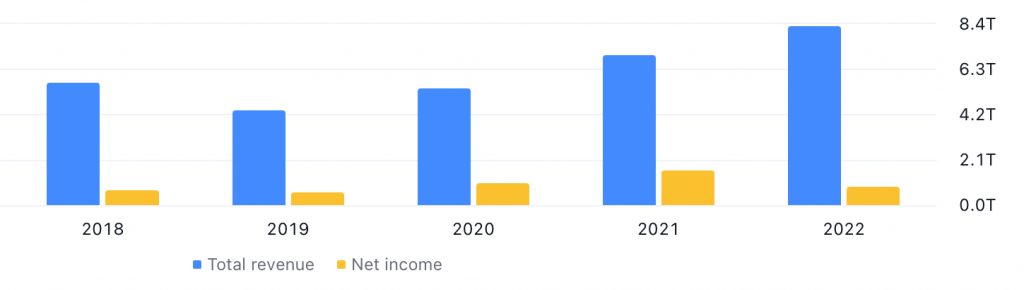
Its total revenue fell in just 1 out of 5 years (the only year which its total revenue saw a y-o-y decline was in 2019, by 22%), while its net income declined in 2 out of 5 years (by 10% in 2019, and by 51% in 2022 – due to a lack of a one-time income from a merger between its messaging firm Line in Japan and Z Holdings in the first quarter of 2021).
In terms of their CAGR, its total revenue was at 8.0%, and its net income was at 3.2%.
5. Hyundai Motor (KRX:005380) (2.55% Weightage, Consumer Discretionary)
Hyundai Motor is the producer of the namesake brand of vehicles – which are used by ComfortDelGro (SGX:C52) for its taxi fleet. So the company should be one that is familiar with Singaporeans as well.
From my understanding, the company vehicles are sold in 193 countries through over 5,000 dealerships and showrooms, and it is the world’s third-largest car maker in terms of production in 2022 – only falling behind Toyota and Volkswagen.
The company has a fiscal year ending every December, and the following is its total revenue and net profit recorded over the last 5 years – between 2018 and 2022:
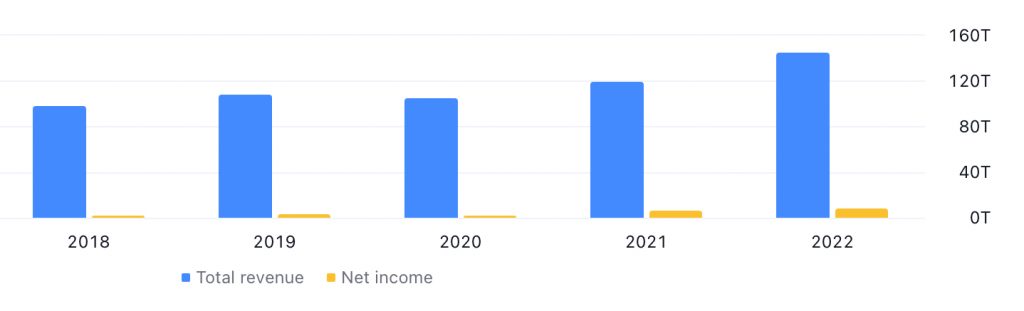
Over a 5-year period, its total revenue and net profit fell in 1 out of 5 years (in 2020, where its total revenue dipped by 1.7%, and its net income fell by 52% due to the Covid pandemic), and recording a CAGR of 8.0% and 37.3% respectively – the latter a very impressive one in my personal opinion.
6. Samsung SDI Ltd (KRX:006400) (2.36% Weightage, Information Technology)
Owned by Samsung Electronics (KRX:005930), Samsung SDI Ltd is in the business of manufacturing battery (through its Energy Solutions business segment, where it manufactures rechargeable batteries for use in IT devices, automotive, and energy storage systems applications) and electronic materials (through its Electronic Materials business, where it produces materials for semiconductors and displays).
The company has a fiscal year end every December, and here’s its total revenue and net income recorded over the last 5 years (between 2018 and 2022):
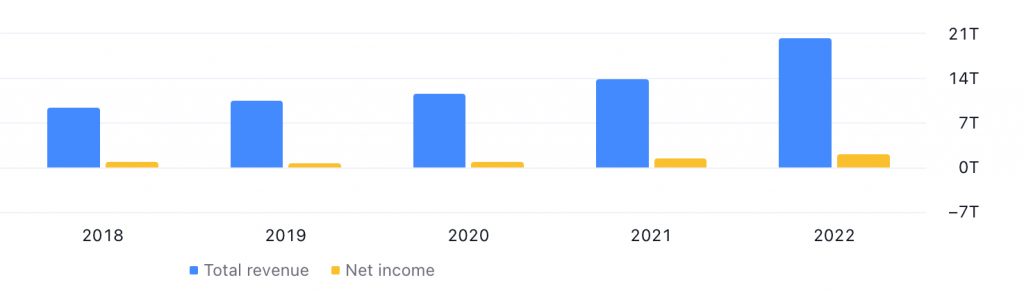
Its total revenue saw y-o-y improvement every single year, and growing at a CAGR at 17.0% (pretty impressive in my opinion).
Meanwhile, its net income saw growth in 4 out of 5 years I have looked at (the only year which its net income saw a y-o-y decline was in 2019, by 49%) – that said, over a 5-year period, Samsung SDI’s net income still manage to record a CAGR of 22.7% – again this is a pretty impressive growth rate.
7. LG Chem Ltd (KRX:051910) (2.33% Weightage, Materials)
Commonly referred to as LG Chemical, it is the largest Korean chemical company.
The company manufactures a wide range of products from high-value added petrochemicals to renewable plastics, specialising in cutting-edge electronic and battery materials such as cathodes, as well as drugs and vaccines to deliver differentiated solutions for its customers.
It has a fiscal year end every December, and the following is its total revenue and net income recorded over the last 5 years (between 2018 and 2022):
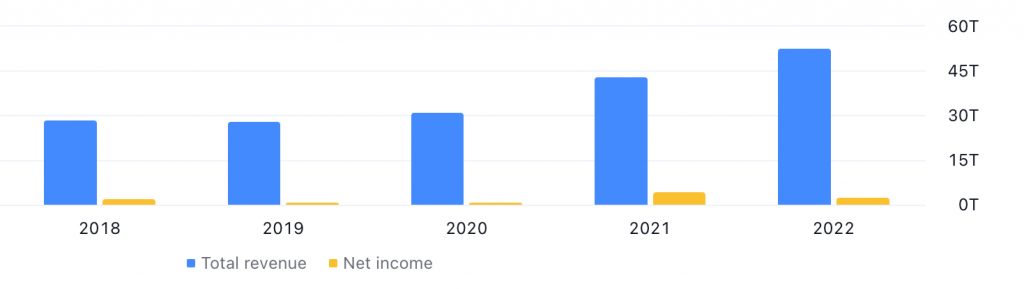
Total revenue saw y-o-y growth in all but 1 year (in 2019, where it dipped by about 3%). In terms of its CAGR over a 5-year period, it is at 13.0% (pretty decent growth in my opinion).
Net income fell in 2 out of 5 years (by 78% in 2019, and by 50% in 2022 – due to the shrinking demand of petrochemicals). Despite of that, its net income still manage to grow at a CAGR of 4.7%.
8. Kia Corporation (KRX:000270) (2.29% Weightage, Consumer Discretionary)
Mention about Kia Corporation, what does it remind you of? That’s right, its namesake brand of automobile. In fact, the company is South Korea’s second largest automobile manufacturer after its parent company, Hyundai Motor (where it holds a 33.9% stake).
Currently, Kia Corporation produces more than 1.4 million vehicles a year at 14 manufacturing and assembly operations in 8 countries. Its vehicles are sold and serviced through a network of more than 3,000 distributors and dealers covering 172 countries.
The company has a fiscal year end every December, and here’s its total revenue and net income recorded over the last 5 years – between 2018 and 2022:
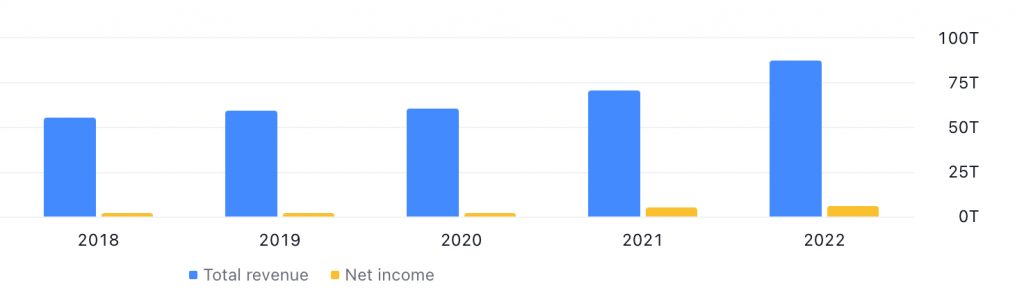
In terms of its total revenue performance, it has been on a steady upward climb over the last 5 years, and recording a CAGR of 9.8%.
Looking at its net income, it saw a y-o-y improvement in 4 out of 5 years (the only year which its net income declined was in 2020, by about 18.6%). In terms of its CAGR, it was at a very impressive 36.1%.
9. KB Financial Group Inc (KRX:105560) (2.01% Weightage, Financials)
Founded in 2008, KB Financial Group Inc is South Korea’s leading financial services provider offering a broad range of financial products and services through its 11 subsidiaries.
The financial services provider operates through the following segments: Corporate Banking, Retail Banking, Other Banking Services, Credit Card, Life Insurance, Investment and Securities Business.
Here’s the company’s total revenue and net income recorded over the last 5 years (between 2018 and 2022 – it has a fiscal year end every December):

Its total revenue saw a steady growth over the last 5 years, and recording a CAGR of 7.7%, while its net income saw y-o-y improvements in 4 out of 5 years (the only year which saw its net income fell was in 2022), and growing at a CAGR of 6.9% – I would consider its financial performances over the years as stable.
10. LG Energy Solution Ltd (KRX:373220) (1.78% Weightage, Industrials)
Last but not least, we have LG Energy Solution Ltd – Established since 2020, the South Korean company is one of the largest battery makers in the world alongside CATL, Panasonic, SK Innovation, and Samsung SDI (the company has the 6th highest weightage in the iShares MSCI South Korea ETF).
From my understanding, the company is currently a battery supplier to global car markers, including Ford, Chrysler, Audi, Renault, Volvo, and SAIC Motor (a Chinese state-owed automobile manufacturer).
As the company was only established in 2020, here is its total revenue and net income recorded over the last 3 years (between 2020 and 2022 – the company has a fiscal year end every December):
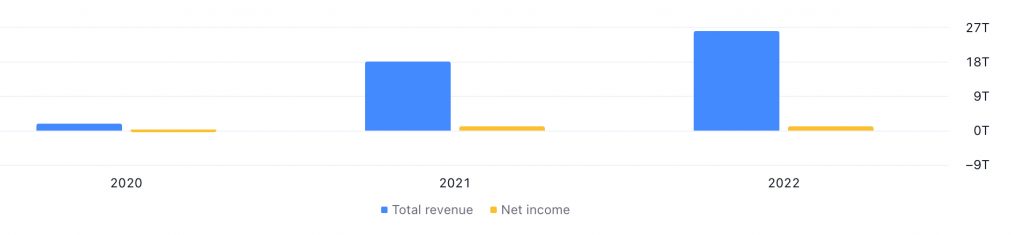
Total revenue grew every single year throughout the entire 3 year period, and recording a CAGR of close to 160%.
As for its net income, it turned into a net profit position since 2021. However, in 2022, its net income fell by 3.2% in 2022.
What is the ETF’s Expense Ratio?
Expense ratio of the ETF comprises of just management fee of 0.58%.
What is the Dividend Policy of the ETF?
As a investor of the ETF, you will receive dividend payouts once every year, in December.
The following table is the dividend payout of iShare MSCI South Korea ETF over the last 5 years – between 2018 and 2022, extracted from NASDAQ.com:
| 2018 | 2019 | 2020 | 2021 | 2022 | |
| Dividend Per Share (US$) | $0.79 | $1.31 | $0.63 | $1.68 | $0.70 |
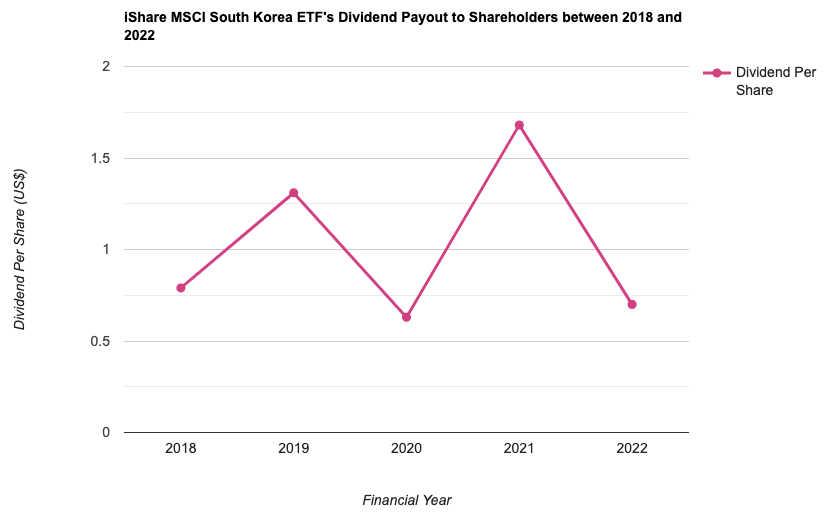
One thing to note is that the ETF’s dividend payout have fluctuated over the years.
The second thing to note, if you are a Singaporean investing in this ETF is that, because it is listed on the New York Stock Exchange in the United States, as a Singaporean investing in the ETF, all dividend payouts will be subjected to a 30% withholding tax – meaning the dividends you receive will be 30% lesser than the amount declared.
How has the ETF’s Unit Price Moved over the Years
The following is the ETF’s price movements (on a weekly timeframe) since its inception in 2020:

Unit Price Movement of the iShares MSCI South Korea ETF (NYSE ARCA:EWY) Since its Inception in 2020
As you can see from the chart below, since November 2005, its price have been moving in a consolidation at between US$43.48 and US$66.17 (highlighted in a green rectangular box above). Currently, its price of US$63.23 is somewhere near the top of the range.
Personally, if I were to invest in the ETF, I will wait till the price comes down to the bottom of the range at around US$43.48.
How Can You Invest in the ETF?
Just like how you buy and sell shares of companies listed on the New York Stock Exchange, you can buy and sell units of the ETF the same way on your brokerage platform.
The minimum number of units you need to purchase is just 1 (just like for the US companies).
Closing Thoughts
To recap, the iShares MSCI South Korea ETF (NYSE ARCA:EWY), as the name implies, offers you a way to get invested in the South Korea economy, which is currently the 4th largest in Asia. The ETF tracks the MSCI Korea 25/50 Index, which measures the performance of the large- and mid-cap companies listed on the Korea Exchange.
In terms of companies that have the heaviest weightage, quite a number of them are familiar to us, including Samsung Electronics (for its Galaxy Smartphone and for its Smart TV), Naver Corp (for its Naver Maps and LINE messaging apps), Hyundai Motor and Kia Corporation (for their namesake brand of automobiles). As far as the financial performances of these companies are concerned, I’m sure you will agree with me that they all have a decent set of results over the years.
However, one thing about the ETF to take note for income investors (in layman terms, they are investors who focus on dividend payouts when investing), its dividend payouts have fluctuated over the years.
With that, I have come to the end of my sharing on the iShares MSCI South Korea ETF. I hope the contents above have given you a good understanding about the ETF. Do take note that the information presented is purely for educational purposes only, and they do not represent any buy or sell calls for it. You are strongly encouraged to do your own due diligence before you make any investment decisions.
Disclaimer: At the time of writing, I am not an investor of the iShare MSCI South Korea ETF.
REITs vs Banks: Which Investment Delivers More for Income Seekers?
If you thought 2025 was a wild ride for the stock market, wait until you see 2026! With not only the uncertainty of interest rate changes and geopolitical tensions but also a military operation by Israel and the United States against Iran, it's set to be even more turbulent.
So, with all this in mind, which is the better choice for income investors: REITs or banks?
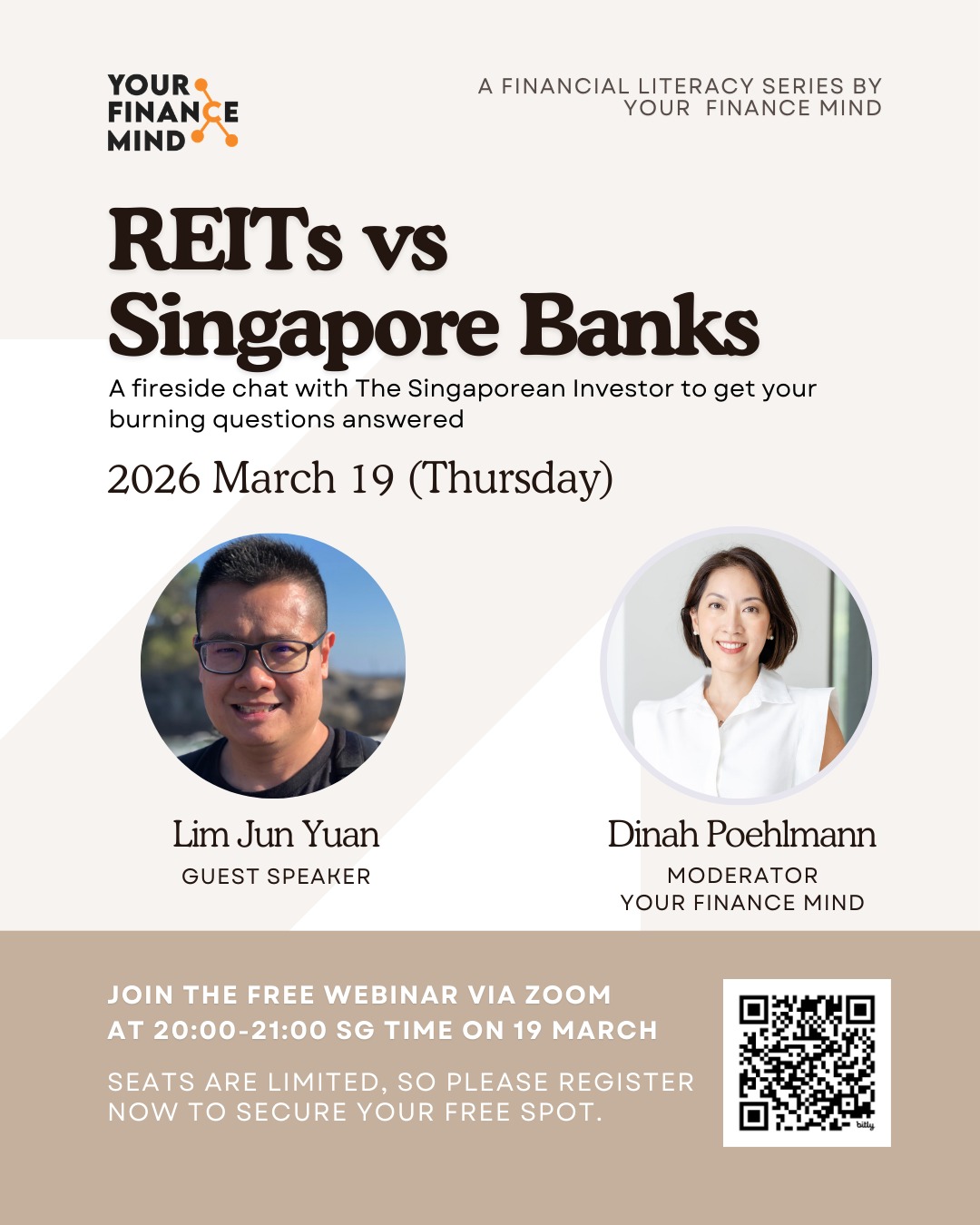
I'm honoured to be re-invited by Dinah Poehlmann from Your Finance Mind for a fireside chat on Zoom this year, where I'll be sharing my insights on this topic.
Join me on Thursday, 19 March 2026, from 8pm to 9pm, as I offer my thoughts and answer any questions you may have.
Best part? Registration is completely free! Secure your spot now through the link below:
👉 Sign Up Now and Mark Your Calendars
Are You Worried about Not Having Enough Money for Retirement?
You're not alone. According to the OCBC Financial Wellness Index, only 62% of people in their 20s and 56% of people in their 30s are confident that they will have enough money to retire.
But there is still time to take action. One way to ensure that you have a comfortable retirement is to invest in real estate investment trusts (REITs).
In 'Building Your REIT-irement Portfolio' which I've authored, you will learn everything you need to know to build a successful REIT investment portfolio, including a list of 9 things to look at to determine whether a REIT is worthy of your investment, 1 simple method to help you maximise your returns from your REIT investment, 4 signs of 'red flags' to look out for and what you can do as a shareholder, and more!

You can find out more about the book, and grab your copy (ebook or physical book) here...

Comments (0)