In the previous post, I have shared all the researches I have done on the retail REIT in terms of its historical financial performance, portfolio occupancy and debt profile, along with distribution payouts to unitholders over a period of 10 years (between FY2010 and FY2019). You can check out the post here in case you’ve missed it.
My post today focuses on the unit price movements of the retail REIT to identify the best possible points to invest in it, based on technical analysis.
To start off, whenever I analyse any companies’ share price movements, I will first zoom all the way out to try and see if, over the years, a company’s share price movements is moving upwards, downwards, or in a range.
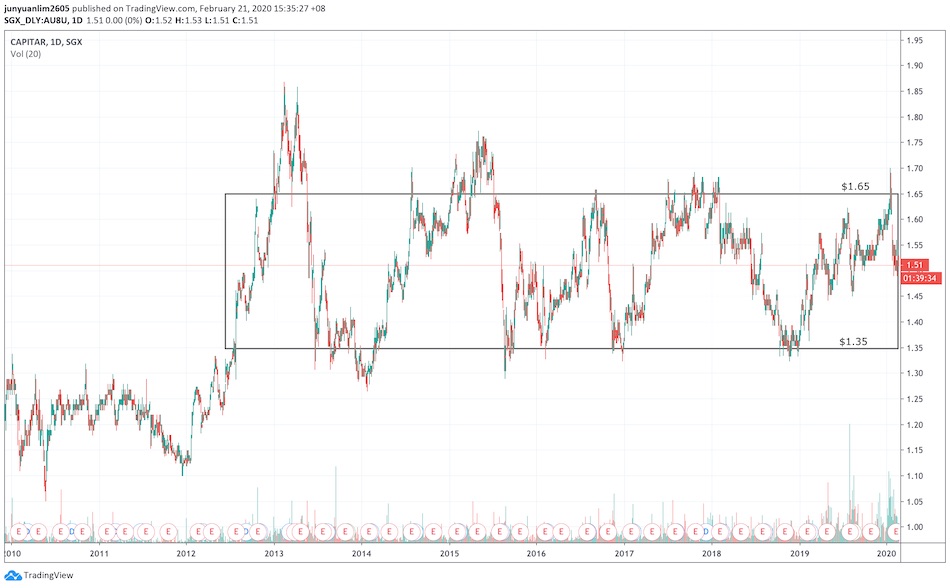
The following is CapitaLand Retail China Trust’s unit price movements since FY2010:

Did you notice anything about the REIT’s unit price movements over the years in the screenshot above?
Yes, it has largely been moving within a range since mid-2012, where the unit price have largely been moving between $1.35 and $1.65:
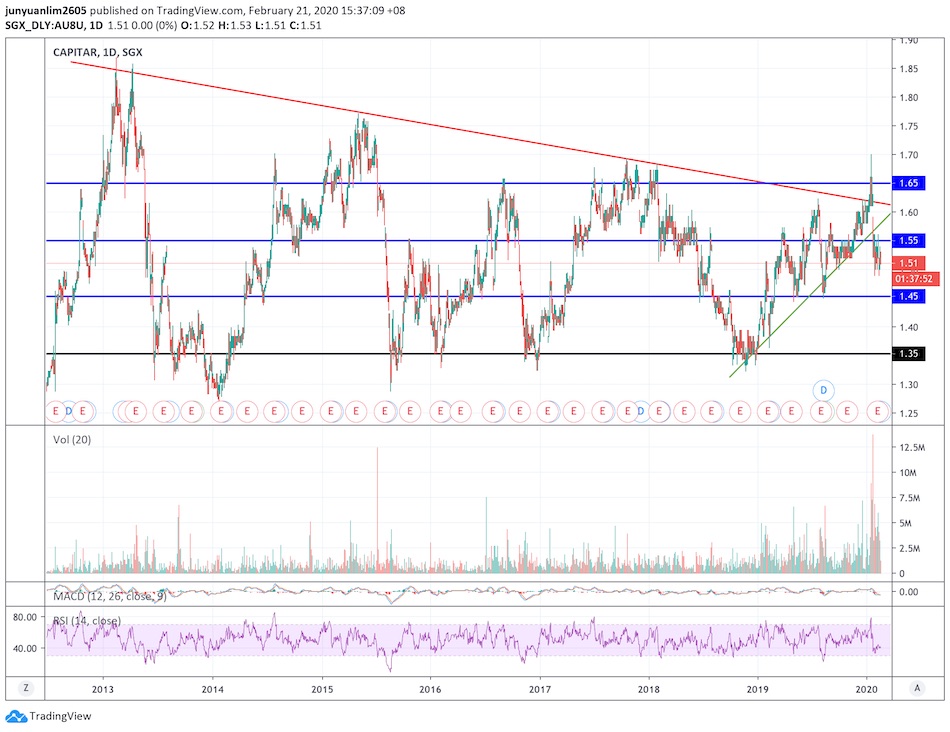
The next thing I did was zoom into the range and identify the various support/resistance lines, along with any uptrend/downtrend lines which I’ve spotted:
Finally, I’ll further zoom in to the REIT’s most recent unit price movements to find out how its unit price have been moving, and how it may possibly move in the near-term:
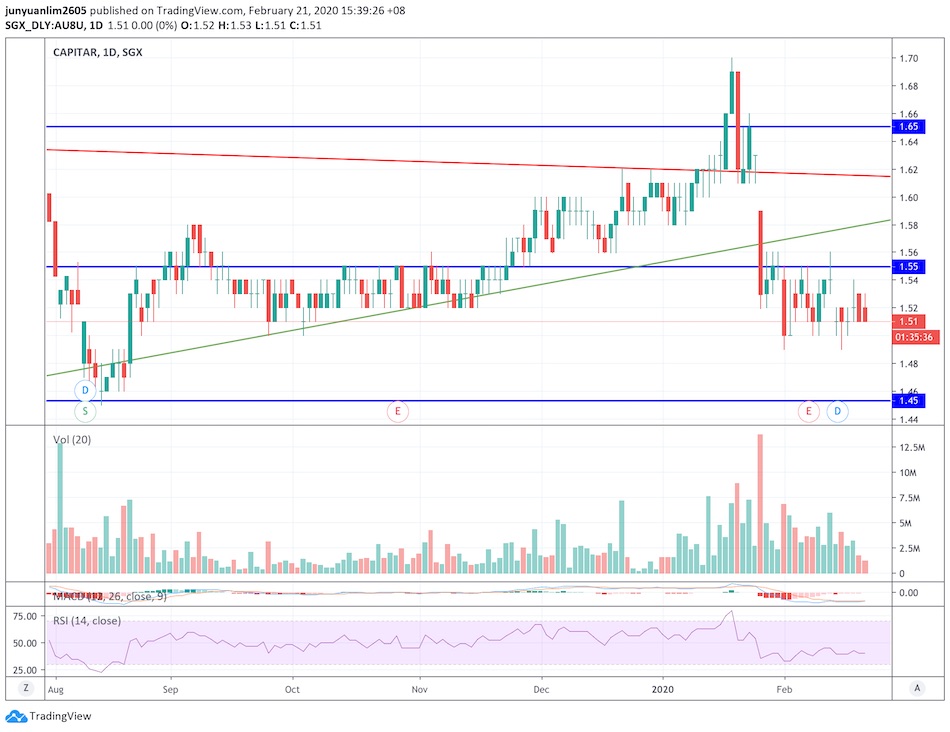
As you can see from the chart movements above, the retail REIT’s unit price went up to a high of $1.70 in mid January 2020 (which is its current 52-week high) before tumbling shortly after, on news that the REIT’s mall in Wuhan is closed and its other malls are operating at shorter hours due to the outbreak of Covid-19 in China.
Its share price went to a low of $1.49 before rebounding up and most recently, it has been moving in a tight range of between $1.51 and $1.54:
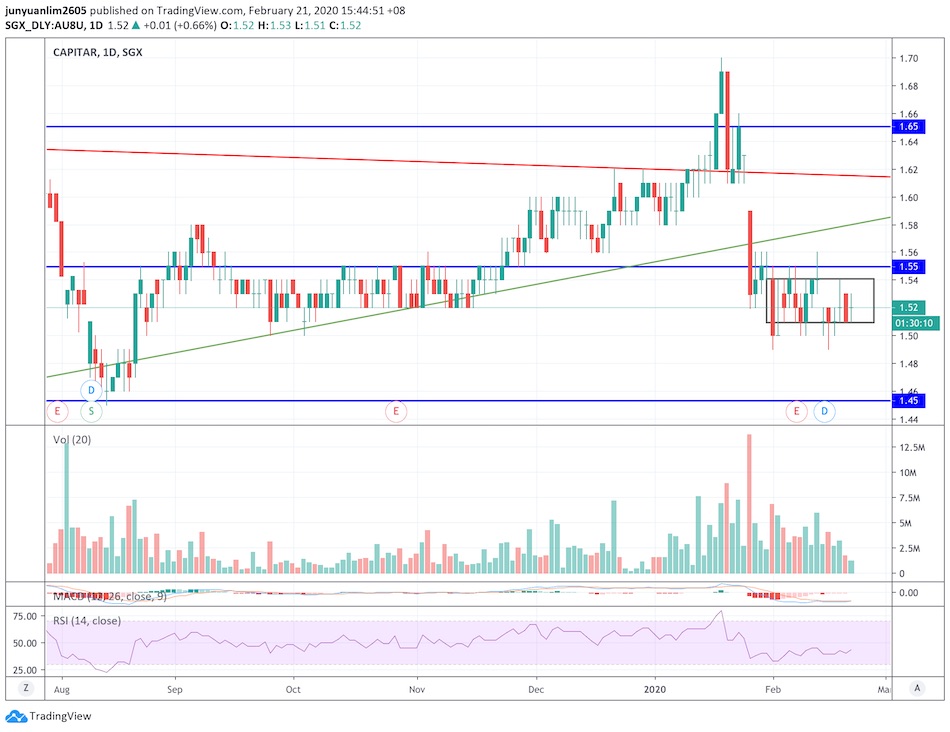
Personally, in the near-term, the unit price could very well continue to move in this tight range. Depending on the situation of the Covid-19 outbreak, it could move upwards and attempt to break above the $1.55 resistance should there be any positive news about it, or it could fall further towards the $1.45 support line.
If I were to invest in the REIT, I’ll consider when the price falls to $1.45 (before I invest, I will have a look at the various technical indicators, including moving averages, MACD, and RSI, as well as its candlestick movements to determine if its unit price is likely to bounce up from there or it may break below the $1.45 support line and fall even further before I make any decision), or wait till the price falls to the bottom of the range at $1.35 (identified earlier on in this post.)
Disclaimer: I am not a unitholder of CapitaLand Retail China Trust at the time of writing.
REITs vs Banks: Which Investment Delivers More for Income Seekers?

If you thought 2025 was a wild ride for the stock market, wait until you see 2026! With not only the uncertainty of interest rate changes and geopolitical tensions but also a military operation by Israel and the United States against Iran, it's set to be even more turbulent.
So, with all this in mind, which is the better choice for income investors: REITs or banks?
I'm honoured to be re-invited by Dinah Poehlmann from Your Finance Mind for a fireside chat on Zoom this year, where I'll be sharing my insights on this topic.
Join me on Thursday, 19 March 2026, from 8pm to 9pm, as I offer my thoughts and answer any questions you may have.
Best part? Registration is completely free! Secure your spot now through the link below:
👉 Sign Up Now and Mark Your Calendars
Are You Worried about Not Having Enough Money for Retirement?
You're not alone. According to the OCBC Financial Wellness Index, only 62% of people in their 20s and 56% of people in their 30s are confident that they will have enough money to retire.
But there is still time to take action. One way to ensure that you have a comfortable retirement is to invest in real estate investment trusts (REITs).
In 'Building Your REIT-irement Portfolio' which I've authored, you will learn everything you need to know to build a successful REIT investment portfolio, including a list of 9 things to look at to determine whether a REIT is worthy of your investment, 1 simple method to help you maximise your returns from your REIT investment, 4 signs of 'red flags' to look out for and what you can do as a shareholder, and more!

You can find out more about the book, and grab your copy (ebook or physical book) here...


Comments (0)