Brief Introduction:
Mapletree Logistics Trust (SGX: M44U), or MLT, is a logistics-focused REIT that owns a diversified portfolio of strategically located, income-generating logistics properties across the Asia-Pacific region.
Since its listing in 2005 with an initial portfolio of 15 logistics assets in Singapore valued at S$422 million, MLT has expanded significantly. As at 31 March 2026 (FY2025/26), its portfolio comprises 175 properties across eight countries, including 44 in Singapore, 42 in China, 22 in Japan, 20 in South Korea, 13 in Australia, 12 in Vietnam, 9 each in Malaysia and Hong Kong, and 4 in India. Collectively, these assets are valued at approximately S$13.1 billion.
Summary of MLT’s Annual Report for FY2025/26:
Key Performance Highlights:
- Gross revenue and net property income declined by 2.6% and 2.4% year on year to S$708.3 million and S$610.2 million respectively. The decrease was largely due to the absence of income from divested properties and the depreciation of regional currencies against the Singapore Dollar. Excluding these factors, gross revenue and NPI would have increased by S$6.1 million and S$5.4 million respectively, supported by resilient same-store performance across Singapore, Japan, Vietnam, Malaysia, and Hong Kong, as well as contributions from the newly completed Mapletree Joo Koon Logistics Hub.
- By geographical segment, Singapore remained the largest contributor to gross revenue at 29.9%, followed by Hong Kong (16.9%), China (15.1%), Japan (11.5%), South Korea (7.5%), Australia (7.0%), Malaysia (6.3%), Vietnam (4.7%), and India (1.1%).
- Distributable income to unitholders fell by 8.9% year on year to S$70.1 million, primarily due to the absence of divestment gains recorded previously. Consequently, Distribution Per Unit (DPU) declined by 9.8% year-on-year to 7.262 cents. Excluding the impact of divestment gains, distributable income and DPU would have registered more modest declines of 2.5% and 3.4% respectively.
- Portfolio occupancy improved from 96.2% to 96.9%, with MLT achieving occupancy levels above market averages across all 9 operating markets. Rental reversions remained positive at 2.3% when China was excluded and 0.8% on an overall basis.
- MLT’s tenant base remains well diversified, with its top 10 customers, including Equinix, CWT, Coles Group, HKTV, and SF Express, contributing approximately 19.7% of gross revenue. No single tenant accounted for more than 3.7% of total revenue.
- The valuation of MLT’s 175-property portfolio inched down by 1.6% year on year to S$13.1 billion. The decline was mainly attributable to the divestment of 6 properties and a S$325.0 million currency translation loss arising from the strengthening Singapore Dollar. These were partially offset by net fair value gains on existing assets in most markets, contributions from the completed redevelopment of Mapletree Joo Koon Logistics Hub, capital expenditure initiatives, and a new acquisition.
- Balance sheet strength remained intact, with aggregate leverage holding steady at 40.6%, compared to 40.7% a year earlier. The REIT also maintains a well-spread debt maturity profile, with only 2% of borrowings due within the next 12 months and no more than 22% maturing in any single year. Average debt tenor stood at 3.6 years. Notably, MLT’s average borrowing cost edged down from 2.7% to 2.6%, making it one of the lowest among S-REITs. This was achieved through proactive treasury management and ongoing optimisation of its funding and hedging strategies.
- Interest rate and currency risks continue to be actively managed. Approximately 83% of borrowings have been hedged into fixed rates, reducing exposure to interest rate volatility and providing greater DPU stability. In addition, around 75% of the REIT’s expected income over the next 12 months has been either hedged into or generated in Singapore Dollars, helping to cushion the impact of foreign exchange fluctuations on distributable income.
Situation of the REIT’s Logistics Properties in China:
- MLT’s China portfolio maintained a healthy occupancy rate of 94.2% in FY2025/26, slightly higher than the 94.0% recorded a year earlier and well above the industry average of approximately 80%.
- Although operating conditions in China’s logistics sector remained challenging due to a substantial pipeline of new supply and subdued domestic consumption, which continued to exert pressure on rental rates and vacancy levels, there are indications that market conditions may be stabilising. This is reflected in the improving rental reversion trend within MLT’s China portfolio, where negative rental reversions narrowed from 11.4% in FY2024/25 to 5.7% in FY2025/26.
Focus on Active Portfolio Rejuvenation:
- MLT continues to adopt an active asset management strategy by conducting regular reviews of its portfolio on a property-by-property basis. The objective is to identify assets for divestment, particularly older properties with ageing specifications, lower yields, or limited redevelopment potential. Capital released from these divestments is being redeployed into newer, higher-specification Grade A logistics facilities and other value-enhancing opportunities, rather than being distributed to unitholders. This approach reflects management’s prudent stance amid ongoing macroeconomic uncertainties, including global trade tensions, tariff-related disruptions to supply chains, and cautious leasing demand from tenants.
- In FY2024/25, management identified a potential divestment pipeline valued at approximately S$1 billion, with around half of the assets located in China and Hong Kong. During FY2024/25, MLT completed S$168 million of divestments, comprising 2 properties each in Singapore and Japan, 5 in Malaysia, and 1 in China. This was followed by a further S$99 million of divestments in FY2025/26, involving 6 properties across Singapore (3), Malaysia (1), South Korea (1), and Australia (1). Notably, these assets were sold at an average premium of about 20% above their respective valuations.
- Alongside its divestment programme, MLT completed the acquisition of a newly built Grade A logistics facility in Bhiwandi, Mumbai, in March 2026 for S$53.2 million. The property, which was completed in August 2025, is fully leased to 2 leading listed food and grocery e-commerce companies and has a remaining weighted average lease term of 3.9 years, with built-in rental escalation clauses that provide visibility for future income growth.
- MLT also successfully completed the S$205 million redevelopment of Mapletree Joo Koon Logistics Hub, transforming the asset into a modern Grade A ramp-up logistics facility. The redevelopment has been well received by the market, with the property achieving full occupancy within a year of obtaining its Temporary Occupation Permit (TOP) in May 2025.
Sustainability Progress:
- MLT continues to make steady progress towards its sustainability targets, including its goal of achieving 100 MWp of self-funded solar generation capacity by 2030. During FY2025/26, its self-funded solar capacity increased by 24% year on year to 58.9 MWp, while total installed solar generation capacity surged by 85% year on year to 131.8 MWp.
- The REIT also expanded its carbon reduction efforts by attaining Scope 2 market-based carbon neutrality in Malaysia, adding to the milestones already achieved in China and Hong Kong.
- In addition, MLT remains well on track to have green-certified buildings account for at least 80% of its portfolio’s gross floor area (GFA) by 2030. As at FY2025/26, green-certified space represented 67% of its portfolio GFA, comfortably surpassing its interim target of 60% for the year.
Impact of Sustained Higher Energy Prices on MLT:
- The direct impact of elevated energy prices on MLT’s operations has remained relatively limited. Net electricity expenses account for less than 2% of total property operating costs, as most of the REIT’s assets are ambient warehouses with relatively low landlord-controlled energy consumption. In addition, solar energy generation at selected properties helps to offset part of these costs. Utility expenses attributable to tenants are also generally recoverable under lease agreements.
- Nevertheless, the broader indirect effects of persistently high energy prices are less predictable. These may manifest through higher inflation, slower economic activity, increased operating costs for businesses, and the possibility of interest rates remaining elevated for a prolonged period.
- Despite these potential headwinds, MLT has not observed any material changes in tenant behaviour thus far. Leasing demand across the portfolio has remained resilient, with no significant impact noted in rental negotiations, leasing decision timelines, or rental collection performance. As such, portfolio leasing activity has continued to remain stable.
Near-Term Headwinds:
- The continued strength of the Singapore Dollar against regional currencies is expected to remain a key challenge in the near term, potentially weighing on MLT’s reported financial performance through adverse foreign exchange translation effects.
- At the same time, higher interest rates continue to exert pressure on distributions, as expiring borrowings and interest rate hedges are progressively refinanced at rates above their existing levels.
- In light of the evolving geopolitical situation in the Middle East, management is closely monitoring potential second-order impacts on the global economy, including any effects on business sentiment, trade activity, and demand for logistics space.
- Looking ahead, MLT’s priorities will centre on maintaining healthy occupancy levels across its portfolio while continuing to rejuvenate and optimise its asset base through selective divestments, targeted asset enhancement initiatives, and yield-accretive acquisitions. Concurrently, the REIT intends to uphold a disciplined capital management strategy to preserve financial flexibility, strengthen portfolio resilience, and support sustainable long-term distributions for unitholders.
Details of MLT’s 17th AGM:
Date: Monday, 20 July 2026
Time: 2.30pm
Venue: 20 Pasir Panjang Road, Mapletree Business City, Town Hall – Auditorium, Singapore 117439
The meeting will be conducted entirely in a physical format, and no virtual attendance option will be available for unitholders.
Unitholders who wish to engage with the management may do so by attending the meeting in person and raising their questions during the proceedings. Alternatively, questions may be submitted in advance via email to Ask-MapletreeLog@mapletree.com.sg no later than 2.30pm on 9 July 2026 (Thursday).
Closing Thoughts:
FY2025/26 marked the second consecutive year in which Mapletree Logistics Trust reported a slight decline in both gross revenue and net property income, as well as the third straight year of lower DPU. The primary factors behind the weaker performance were the challenging operating environment in China and the continued strength of the Singapore Dollar against regional currencies.
With regard to China, I am encouraged by the gradual signs of improvement despite the difficult market conditions. Occupancy within MLT’s China portfolio edged up to 94.2% in FY2025/26 from 94.0% a year earlier, and remains significantly above the industry average of approximately 80%. At the same time, rental reversions, while still negative, have shown meaningful improvement, narrowing from -11.4% in FY2024/25 to -5.7% in FY2025/26. While the recovery is likely to be gradual, these trends suggest that conditions may be stabilising.
On the currency front, management has taken proactive steps to mitigate the impact of foreign exchange fluctuations. With approximately 75% of the REIT’s income either derived in or hedged into Singapore Dollars, the adverse impact of a stronger Singapore Dollar on distributable income has been partially cushioned.
Beyond these near-term challenges, I continue to view MLT’s fundamentals favourably. The REIT owns a highly diversified portfolio spread across multiple markets, with no single country accounting for an outsized proportion of gross revenue. Portfolio occupancy has also remained consistently strong, staying above 96% over the past 5 financial years. In addition, MLT maintains a healthy balance sheet, with aggregate leverage of 40.6% and an average borrowing cost of just 2.6% – one of the lowest among Singapore-listed REITs.
Overall, I remain confident in management’s ability to navigate the current headwinds and position the REIT for long-term growth. Going forward, I will continue to monitor the performance of its China portfolio closely, particularly in terms of occupancy levels, rental reversions, and revenue contribution. Barring any significant deterioration in macroeconomic conditions, I expect operating metrics in China to continue improving in the quarters ahead, although it may still take several quarters before rental reversions return to positive territory.
Related Documents:
Annual Report
Independent Market Research Report
Sustainability Report
AGM Notice
AGM Proxy Form
Appendix – The Proposed Renewal of the Unit Buy-Back Mandate
Disclaimer: At the time of writing, I am a unitholder of Mapletree Logistics Trust.
Stop Spending Hours Reading REIT Reports Every Quarter!
What if you could assess a REIT's portfolio occupancy, debt profile, valuation, and overall health in less than 30 seconds - without having to comb through a single quarterly report?
That's the problem the REIT Screener was built to solve.
Developed through a collaboration between ShareInvestor and The Singaporean Investor, the REIT Screener consolidates many of the key metrics and indicators I personally use when analysing REITs into one easy-to-use platform. Instead of spending hours extracting data manually every earnings season, you can now monitor the REITs you own and research new opportunities in just a few clicks.
If you're serious about REIT investing but don't have the time to manually track quarterly developments, the REIT Screener could be the shortcut you've been looking for:
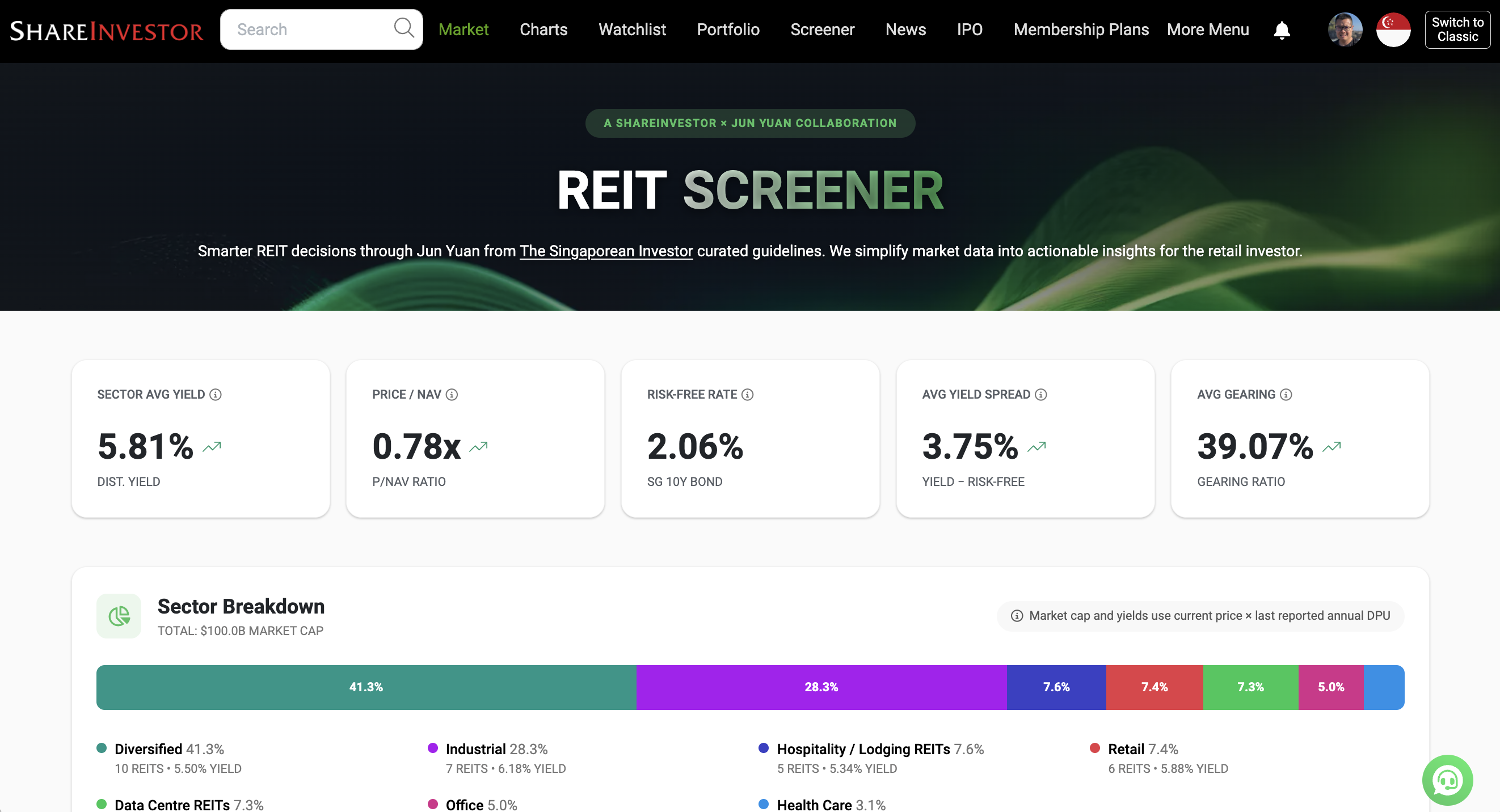
Take a closer look at the REIT Screener here...



Comments (0)