Brief Overview:
United Overseas Bank Limited (SGX: U11), or UOB, is one of the leading banks in Asia. It has its headquarters in Singapore, and banking subsidiaries in China, Indonesia, Malaysia, Thailand, and Vietnam.
To date, UOB has a global network of more than 470 offices in 19 markets in Asia Pacific, Europe, and North America.
It is also highly rated by many credit rating agencies: Aa1 by Moody’s Investor’s Service, and AA- by both S&P Global Ratings & Fitch Ratings.
Financial Figures (4Q FY2024 vs. 4Q FY2025):
| 4Q FY2024 | 4Q FY2025 | % Gain/Loss | |
| – Net Interest Income (S$’mil) | $2,451m | $2,346m | -4.3% |
| – Net Fee & Commission Income (S$’mil) | $567m | $625m | +10.2% |
| – Other Non-Interest Income (S$’mil) | $443m | $319m | -28.0% |
| Total Income (S$’mil) | $3,461m | $3,290m | -4.9% |
| Total Expenses (S$’mil) | $1,579m | $1,528m | -3.2% |
| Net Profit Attributable to Shareholders (S$’mil) | $1,523m | $1,410m | -7.4% |
This is the 2nd quarter in a row with which UOB’s quarterly results saw a weaker performance on a year-on-year basis (to recap, in the 3rd quarter, its net interest income, other non-interest income, total income, and net profit attributable to shareholders also fell, and you can read about it here).
For the 4th quarter, UOB’s net interest income recorded a 4.3% year-on-year decline to S$2,346 million from a 0.16 basis point drop in its net interest margin (from 2.00% in 4Q FY2024 to 1.84% in 4Q FY2025), which far outweighed a loan growth of 4%.
Other non-interest income plunged by 28.0% year on year to S$319 million as a result of a lower trading and investment income.
Finally, a lower total income (due to a lower net interest income and other non-interest income), along with an increase in tax and non-controlling interest (up by 62.2% year on year to S$266 million) led to UOB’s net profit attributable to shareholders falling by 7.4% year on year to S$1,410 million.
Financial Figures (FY2024 vs. FY2025):
| FY2024 | FY2025 | % Gain/Loss | |
| – Net Interest Income (S$’mil) | $9,674m | $9,355m | -3.3% |
| – Net Fee & Commission Income (S$’mil) | $2,395m | $2,569m | +7.3% |
| – Other Non-Interest Income (S$’mil) | $2,225m | $1,884m | -15.3% |
| Total Income (S$’mil) | $14,294m | $13,808m | -3.4% |
| Total Expenses (S$’mil) | $6,310m | $6,157m | -2.4% |
| Net Profit Attributable to Shareholders (S$’mil) | $6,045m | $4,682m | -22.5% |
Dragged by weaker performances in the 2nd half of the year, UOB’s full year results was a weaker one compared to a year ago (the last time the bank reported a year-on-year decline in its full year results was in FY2020, largely due to the Covid-19 pandemic).
The 3.3% year-on-year dip in the UOB’s net interest income can be attributed to a 14 basis point decline in its net interest margin (from 2.03% in FY2024 to 1.89% in FY2025) on the back of lower benchmark rates. This far outweighed the impact of a 4% loan growth.
Other non-interest income fell by 15.3% year on year to S$1,884 million, as trading income and liquidity management activities normalised following last year’s exceptional performance.
The only bright spot was in its net fee and commission income, which was up by 7.3% year on year to a new high of S$2,569 million, as wealth management and loan related fees reached new highs amid favourable market conditions and a rising consumer confidence.
Finally, a combination of a weaker total income, an increase in amortisation of intangible assets (by 9% year on year from S$28 million to S$31 million), and a surge in allowance for credit and other losses (by more than 100% year on year from S$926 million to S$2,042 million) resulted in a 22.5% year-on-year drop in its net profit attributable to shareholders to S$4,682 million.
Key Financial Ratios (3Q FY2025 vs. 4Q FY2025):
| 3Q FY2025 | 4Q FY2025 | Difference (in Percentage Points – pp) | |
| Net Interest Margin (%) | 1.82% | 1.84% | +0.02pp |
| ^^ Return on Equity (%) | 3.5% | 11.7% | +8.2pp |
| Non-Performing Loans Ratio (%) | 1.6% | 1.5% | -0.1pp |
^^ – UOB did not provide its return on equity for 4Q FY2025. The figure is self-computed.
In terms of its key financial ratios, they have improved compared to the previous quarter.
One bright spot can be seen in its net interest margin, where it has improved slightly (by 0.02 percentage points) after quarters of decline as a result of a drop in benchmark borrowing rates.
As for its return on equity, the very weak figure in 3Q was due to a surge in allowance for credit and other losses.
Non-performing loans ratio also improved slightly by 0.1 percentage points to 1.5%, as non-performing assets saw a 6.4% decline from S$5,809 million in 3Q to S$5,440 million in 4Q.
Dividend Payout to Shareholders (2H FY2024 vs. 2H FY2025):
| 2H FY2024 | 2H FY2025 | % Gain/Loss | |
| Dividend Per Share (S$’cents) | && 117.0 cents | 71.0 cents | -39.3% |
&& – 2H FY2024 dividend payout is inclusive of a capital return dividend of 25.0 cents.
If you are a shareholder of UOB, do take note of the following dates on its latest dividend payout:
Ex-Date: 24 April 2026
Record Date: 27 April 2026
Payout Date: 08 May 2026
Dividend Payout to Shareholders (FY2024 vs. FY2025):
| FY2024 | FY2025 | % Gain/Loss | |
| Dividend Per Share (S$’cents) | 205.0 cents | 181.0 cents | -11.7% |
UOB’s total dividend payout to its shareholders for the 2 financial years is inclusive of a capital return dividend of 25.0 cents in 2H FY2024 and 1H FY2025.
In terms of its payout ratio, at 181.0 cents in FY2025, it is at 50% – in-line with the management’s guidance.
CEO Mr Wee Ee Cheong’s Comments & Outlook (from the Bank’s Press Release):
“The Group delivered a resilient full-year performance, fuelled by strong fee momentum across our diversified business franchise. Our balance sheet is strong with robust capital and liquidity and stable asset quality.
ASEAN’s growth trajectory remains intact, powered by structural trends, including digitalisation, infrastructure investments and deepening regional integration. In this environment, we are seeing steady momentum across our business lines, driven by our regional network and deepening customer relationships across ASEAN.
We will continue to strengthen regional connectivity, enhance wealth platforms and scale our digital capabilities to deliver more value for customers. With a robust balance sheet and an expanded regional franchise, we are well placed to support customers through cycles and seize new opportunities.”
Closing Thoughts
This is the first time since FY2020 (due to the Covid-19 pandemic) where UOB’s financial performance for the full year was a weaker one (where its total income, net profit attributable to shareholders, as well as its dividend payout suffered a year-on-year decline).
Zooming out a little further, the growth (in percentage terms) of UOB’s financial figures have also slowed since FY2023, as follows:
- Net Interest Income: +16.0% (FY2023) -> -0.1% (FY2024) -> -3.3% (FY2025)
- Other Non-Interest Income: 85.3% (FY2023) -> +10.3% (FY2024) -> -15.3% (FY2025)
- Total Income: +20.4% (FY2023) -> +2.6% (FY2024) -> -3.4% (FY2025)
- Net Profit Attributable to Shareholders: +24.9% (FY2023) -> +5.8% (FY2024) -> -22.5% (FY2025)
- Dividend Payout to Shareholders: +25.9% (FY2023) -> +20.6% (FY2024) -> -11.7% (FY2025)
However, there are still some bright spots, particularly in its net fee and commission income for FY2025, where it reached a new high, contributed by wealth management and loan-related fees reaching new highs). This is in addition to improvements in its key financial ratios for 4Q compared to the previous quarter (particularly in its net interest margin, as well as in its other non-performing ratios).
In the coming financial year ahead, I will keep a close watch on UOB’s financial performance to see if the performance improves, or it continues to slump (which will have a further impact on its dividend payout, just like we have seen in the financial year under review).
Results of the Other Singapore-Listed Banks:
DBS Group Holdings Limited (SGX: D05): 4Q & FY2025 Results
Oversea-Chinese Bank Corporation Limited (SGX: O39): 4Q & FY2025 Results
Related Documents:
FY2025 News Release
FY2025 Condensed Financial Statement
FY2025 CEO Presentation
FY2025 CFO Presentation
Disclaimer: At the time of writing, I am a shareholder of United Overseas Bank Limited.
Stop Spending Hours Reading REIT Reports Every Quarter!
What if you could assess a REIT's portfolio occupancy, debt profile, valuation, and overall health in less than 30 seconds - without having to comb through a single quarterly report?
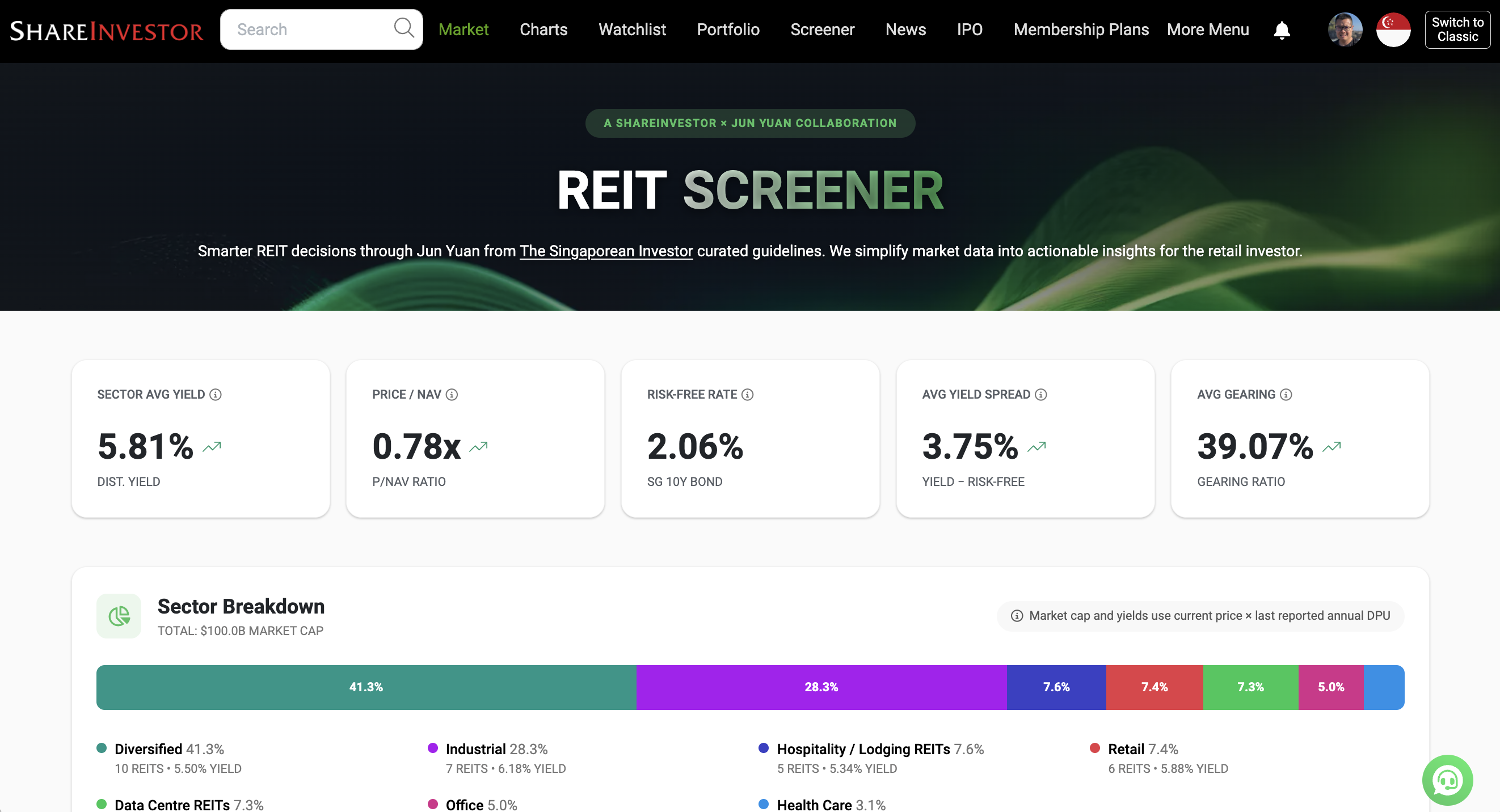
That's the problem the REIT Screener was built to solve.
Developed through a collaboration between ShareInvestor and The Singaporean Investor, the REIT Screener consolidates many of the key metrics and indicators I personally use when analysing REITs into one easy-to-use platform. Instead of spending hours extracting data manually every earnings season, you can now monitor the REITs you own and research new opportunities in just a few clicks.
If you're serious about REIT investing but don't have the time to manually track quarterly developments, the REIT Screener could be the shortcut you've been looking for:
Take a closer look at the REIT Screener here...



Comments (0)