Brief Overview:
Mapletree Logistics Trust (SGX: M44U), or MLT, focuses its investments on logistics properties.
As at 31 December 2025, the REIT’s 174 properties are located in the Asia Pacific region (Singapore, Australia, China, Hong Kong, India, Japan, Malaysia, South Korea, and Vietnam) worth S$13.0 billion.
Financial Figures (3Q FY2024/25 vs. 3Q FY2025/26):
| 3Q FY2024/25 | 3Q FY2025/26 | % Gain/Loss | |
| Gross Revenue (S$’mil) | $182.4m | $176.8m | -3.1% |
| Property Operating Expenses (S$’mil) | $25.2m | $24.8m | -1.6% |
| Net Property Income (S$’mil) | $157.2m | $152.0m | -3.3% |
| Distributable Income to Unitholders (S$’mil) | $101.3m | $92.7m | -8.5% |
MLT’s financial performance on a year-on-year basis is much in-line with the 1st and 2nd quarters, where its gross revenue and net property income fell by a low-single digit percentage, while its distributable income to unitholders fell by a high-single digit percentage.
The lower gross revenue and net property income (which fell by 3.1% and 3.3% year on year to S$176.8 million and S$152.0 million respectively) can be attributed to a weaker South Korean Won, Japanese Yen, Vietnamese Dong, and Hong Kong Dollar against the strong Singapore Dollar, along with lower contributions from its existing properties in China. However, this was partially offset by contributions from the completed redevelopment of Mapletree Joo Koon Logistics Hub, and higher contributions from existing properties in Singapore, Japan, and Vietnam.
Property operating expenses decreased by 1.6% year on year to S$24.8 million from the depreciation of various currencies against the Singapore Dollar, as well as the absence of property expenses from divested properties. This was partly offset by contributions from Mapletree Joo Koon Logistics Hub.
The REIT’s distributable income to unitholders declined by 8.5% year on year to S$92.7 million due to a lower net property income, as well as the absence in contributions from divested properties.
Financial Figures (9M FY2024/25 vs. 9M FY2025/26):
| 9M FY2024/25 | 9M FY2025/26 | % Gain/Loss | |
| Gross Revenue (S$’mil) | $547.4m | $531.7m | -2.9% |
| Property Operating Expenses (S$’mil) | $74.9m | $73.0m | -2.5% |
| Net Property Income (S$’mil) | $472.5m | $458.7m | -2.9% |
| Distributable Income to Unitholders (S$’mil) | $307.3m | $277.1m | -9.8% |
For the first 9 months of the financial year, MLT’s gross revenue and net property income both declined by 2.9% on a year-on-year basis to S$531.7 million and S$458.7 million respectively due to the effect of depreciation of the Hong Kong Dollar, South Korean Won, Chinese Yuan, Australian Dollar, and Vietnamese Dong against the Singapore Dollar, together with the absence of contribution from divested properties, and weaker contribution from properties in China and South Korea.
However, this was partially offset by a full period contribution from acquisitions in Malaysia and Vietnam completed in 1Q FY2024/25, contribution from completed redevelopment of Mapletree Joo Koon Logistics Hub, along with higher contributions from existing properties in Singapore, Japan, Vietnam, and Hong Kong.
Property operating expenses fell by 2.9% year on year to S$73.0 million mainly due to the effect from the depreciation of various currencies against the Singapore Dollar, absence of property expenses from divested properties, lower property-related expenses, and lower loss allowance due to partial recovery from tenants. This was partly offset by contribution from Mapletree Joo Koon Logistics Hub and full period contribution from acquisitions completed in 1Q FY2024/25.
Portfolio Occupancy Profile (2Q FY2025/26 vs. 3Q FY2025/26):
| 2Q FY2025/26 | 3Q FY2025/26 | |
| Portfolio Occupancy (%) | 96.1% | 96.4% |
| Portfolio WALE (by Net Lettable Area – years) | 2.7 years | 2.6 years |
| Rental Reversion (%) | +0.6% | +1.1% |
MLT’s portfolio occupancy is a very healthy one, at 96.4%, with its properties in Australia, Malaysia, Vietnam, and India achieving a 100% occupancy, and properties in the other geographical locations including Singapore, China, Hong Kong, Japan, and South Korea having an occupancy rate of between 93.8% and 98.1%.
Rental reversions for new and/or renewed leases were all in positive percentages (ranging between +0.4% and +4.0%). The only country with a negative rental reversion was China, at -2.2% for the quarter under review – despite of that, it was still a slight improvement from a rental reversion of -3.0% in the previous quarter. However, the occupancy rate of its China properties saw a slight 0.2 percentage point (pp) dip to 93.8% (from 94.0% in the previous quarter).
On lease expiry, they are considered (at least in my opinion) to be well-spaced out – in the final quarter of FY2025/26, 8.1% of the leases will be due for renewal. In the next 3 financial years (between FY2026/27 and FY2028/29), an average of about 24.2% of leases will be due for renewal each year, with the remaining 19.4% of leases only due for renewal in FY2029/30 or later.
Debt Profile (2Q FY2025/26 vs. 3Q FY2025/26):
| 2Q FY2025/26 | 3Q FY2025/26 | |
| Aggregate Leverage (%) | 41.1% | 40.7% |
| Interest Coverage Ratio (times) | 2.9x | 2.9x |
| Average Cost of Debt (%) | 2.6% | 2.6% |
| Average Term to Debt Maturity (years) | 3.6 years | 3.5 years |
| % of Borrowings Hedged at Fixed Rates (%) | 84% | 84% |
Compared to the previous quarter, MLT’s debt profile remains more or less unchanged – apart from a slight 0.4pp drop in its aggregate leverage to 40.7%, primarily due to the repayment of loans during the quarter with divestment proceeds.
Debt profile is well-spread out over the years – in the final quarter of the current financial year 2025/26, it has 2% of borrowings due for refinancing. Over the next 5 financial years (between FY2026/27 and FY2030/31), it has an average of 17% of borrowings due for refinancing each year, with the remaining 14% of borrowings due for refinancing only in FY2031/32 or later.
Distribution Payout to Unitholders (3Q FY2024/25 vs. 3Q FY2025/26):
| 3Q FY2024/25 | 3Q FY2025/26 | % Gain/Loss | |
| Distribution Per Unit (S$’cents) | 2.003 cents | 1.816 cents | -9.3% |
The 9.3% year-on-year decline in MLT’s distribution per unit to 1.816 cents can be attributed to a lower net property income, along with a larger unit base.
If you are a unitholder of MLT, do take note of the following dates on its latest distribution payout:
Ex-Date: 2 February 2026
Record Date: 3 February 2026
Payout Date: 18 March 2026
Distribution Payout to Unitholders (9M FY2024/25 vs. 9M FY2025/26):
| 9M FY2024/25 | 9M FY2025/26 | % Gain/Loss | |
| Distribution Per Unit (S$’cents) | 6.098 cents | 5.443 cents | -10.7% |
CEO Ms Jean Kam’s Comments & Outlook (from the REIT’s Press Release)
“In 3Q FY25/26, we maintained a stable DPU quarter-on-quarter, underpinned by our geographically diversified portfolio. Despite ongoing macroeconomic and tariff-related uncertainties, the logistics sector in the region remains resilient, with structural trends that support long-term growth. We will continue to execute our portfolio rejuvenation strategy and grow our regional footprint to capture the growing demand for well-located, modern logistics space.”
Closing Thoughts
MLT’s latest set of results was very much in my expectations – with the REIT’s financial performance continued to be weighed down by weaker foreign currency in some of the Asian countries it has properties in against the Singapore Dollar.
As far as the performance of its properties in China goes, it was a bit of a mixed bag – with weaker contributions from existing properties continuing to weigh down on its financial results, along with a slight dip in its portfolio occupancy compared to the previous quarter (94.0% in 2Q FY2025/26 vs. 93.8% in 3Q FY2025/26 – despite of that, the occupancy rate continues to be at a healthy level). On rental reversion, even though they have improved slightly (-3.0% in 2Q FY2025/26 vs. -2.2% in 3Q FY2025/26), but they are still in negative percentages.
Apart from that, I’m sure you’ll agree with me the occupancy rate of MLT’s properties are very healthy – where the occupancy rates of its properties in 4 out of 9 geographic locations are fully occupied, and for the remaining locations, they are at above 90%.
Finally, on its debt profile, it continues to remain in a healthy position – with its aggregate leverage of 40.7% still a safe distance to the regulatory limit of 50%. Average term to debt expiry is also well-spread out over the years.
Looking at the quarter ahead, barring unforeseen circumstances, the REIT’s 4th quarter financial figures should also be around the same as the previous 3 quarters – with its gross revenue and net property income down by a low single-digit percentage (weighed down by a weaker foreign currency in the Asian countries against the strong Singapore Dollar), with its distributable income to unitholders and distribution per unit down by a high single-digit percentage (from a weaker net property income, along with a higher unit base).
Other Mapletree REITs in Focus:
Mapletree Industrial Trust (SGX: ME8U): 3Q & 9M FY2025/26 Results Review
Related Documents
Press Release
Financial Statements
Presentation Slides
Disclaimer: At the time of writing, I am a unitholder of Mapletree Logistics Trust.
Join Me for a FREE Live Online Chit-Chat on Thursday, 12 November, from 8–9pm (SGT)!

It's been quite some time since I last had a live chit-chat with the investing community, and I’m excited to be back for another session! A big thank you to my friend, Dinah Poehlmann from Your Finance Mind, for inviting me once again!
This time, we’re taking a little break from REITs and exploring some interesting topics surrounding investing, including my go-to investing resources, when is a stock considered 'investable', my thoughts about using AI for stock analysis and trading, and much more.
Whether you're just starting your investing journey or have been investing for years, I hope this session will offer some useful perspectives and practical takeaways that you can apply to your own investing journey.
Best of all, the session is completely FREE to attend! All you need to do is register in advance to receive the Zoom link:
👉 Click here to reserve your spot!
Stop Spending Hours Reading REIT Reports Every Quarter!
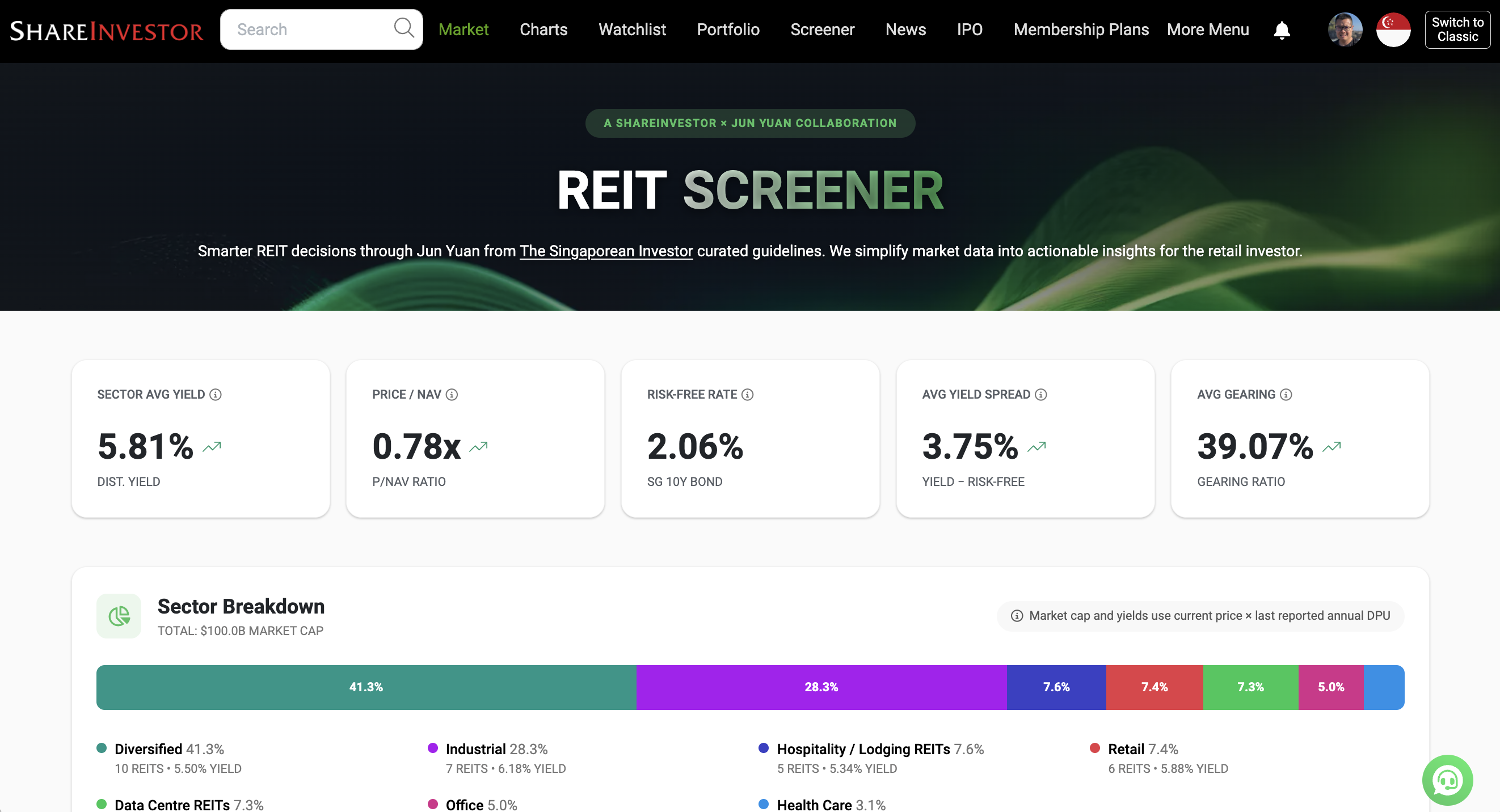
What if you could assess a REIT's portfolio occupancy, debt profile, valuation, and overall health in less than 30 seconds - without having to comb through a single quarterly report?
That's the problem the REIT Screener was built to solve.
Developed through a collaboration between ShareInvestor and The Singaporean Investor, the REIT Screener consolidates many of the key metrics and indicators I personally use when analysing REITs into one easy-to-use platform. Instead of spending hours extracting data manually every earnings season, you can now monitor the REITs you own and research new opportunities in just a few clicks.
If you're serious about REIT investing but don't have the time to manually track quarterly developments, the REIT Screener could be the shortcut you've been looking for:
Take a closer look at the REIT Screener here...



Comments (0)