CapitaLand Integrated Commercial Trust (SGX: C38U), or CICT for short, is not just Singapore’s largest REIT, but it is also Asia’s largest (where it overtook Hong Kong-listed Link REIT following a private placement exercise in October 2025; however, in terms of portfolio size in local currency terms, Link REIT is still larger compared to CICT).
For the uninitiated, CICT invests in commercial properties used primarily for retail and/or office purposes, with its portfolio currently comprising 21 properties in Singapore, 2 in Frankfurt, Germany, and 3 in Sydney, Australia, with a total property value of S$25.9 billion as at 31 December 2024.
This morning (28 October), CICT released its business update for the 3rd quarter as well as for the first 9 months of FY2025 ended 30 September, and in this post, you’ll find my review of its latest set of financial figures, as well as its portfolio occupancy and debt profile:
Financial Figures (3Q FY2024 vs. 3Q FY2025, and 9M FY2024 vs. 9M FY2025)
3Q FY2024 vs. 3Q FY2025:
| Q3 FY2024 | Q3 FY2025 | % Variance | |
| Gross Revenue (S$’mil) | $397.9m | $404.0m | +1.5% |
| Property Operating Expenses (S$’mil) | $108.1m | $109.5m | +1.4% |
| Net Property Income (S$’mil) | $289.8m | $294.3m | +1.6% |
After 2 consecutive quarters (in the 1st as well as in the 2nd quarter) of slight declines on a year on year basis, mainly due to the absence of contribution from 21 Collyer Quay which was divested in November 2024, CICT’s gross revenue and net property income once again reported year-on-year improvements – albeit just slightly by 1.5% and 1.6% respectively.
Contributions for all 3 of its property types (retail, office, and integrated developments) all saw growth in their gross revenue and net property income.
9M FY2024 vs. 9M FY2025:
| 9M FY2024 | 9M FY2025 | % Variance | |
| Gross Revenue (S$’mil) | $1,189.9m | $1,191.6m | +0.1% |
| Property Operating Expenses (S$’mil) | $317.7m | $317.4m | -0.1% |
| Net Property Income (S$’mil) | $872.2m | $874.2m | +0.2% |
As far as its financial numbers for the 1st 9 months of FY2025 is concerned, its pretty much muted – with its gross revenue and net property income only inching up by 0.1% and 0.2% compared to a year ago – with a year-on-year improvement for the 3rd quarter partially offset by declines in the 1st as well as in the 2nd quarter.
Portfolio Occupancy Profile (2Q FY2025 vs. 3Q FY2025)
CICT boosts a very strong portfolio occupancy profile over the quarters, where its retail, office, and integrated development properties have maintained an occupancy rate of more than 90%. Additionally, they have also managed to record a positive rental reversion for new and/or renewed leases, which will help to maintain a stable growth in its financial figures.
Has CICT managed to maintain this feat for the current quarter under review (3Q FY2025 ended 30 September 2025)? Let us find out in the table below, where you’ll find a comparison of the statistics against that reported in the previous quarter 3 months ago (2Q FY2025 ended 30 June 2025), as follows:
| 2Q FY2025 | 3Q FY2025 | |
| Portfolio Occupancy (Retail) (%) | 98.6% | 98.7% |
| WALE (Retail) (by GRI) (years) | 2.0 years | 2.0 years |
| Rental Reversion (Retail) (%) | +7.7% | +7.8% |
| Portfolio Occupancy (Office) (%) | 94.6% | 96.2% |
| WALE (Office) (by GRI) (years) | 3.4 years | 3.3 years |
| Rental Reversion (Office) (%) | +4.8% | +6.5% |
| Portfolio Occupancy (Integrated Development) (%) | 97.8% | 97.3% |
| Rental Reversion (Integrated Development) (%) | 4.5 years | 4.5 years |
Apart from a slight decline in the occupancy of its integrated development properties (by 0.5pp to 97.3%), all the other numbers were positive – including improvements in the occupancy rates of its retail and office properties, along with positive rental reversions being recorded for new and/or renewed leases (which will contribute toward the growth of its financial performances in the quarters ahead).
As far as lease expiries goes, in the final quarter of FY2025, there are only 1.9% of retail leases and 1.8% of office leases due for renewal. In the next 3 financial years (between FY2026 and FY2028), an average of 14.9% of retail leases and 8.6% of office leases will be due for renewal each year (which is rather well-spread out), with the remaining 7.9% of retail leases and 13.6% of office leases due for renewal only in FY2029 or later.
Debt Profile (2Q FY2025 vs. 3Q FY2025)
Moving on, let us have a look at CICT’s debt profile – just like how I have reviewed its portfolio occupancy profile in the previous section, you’ll also find a comparison of the REIT’s debt profile recorded for the current quarter under review (i.e., 3Q FY2025) against that recorded in the previous quarter 3 months ago (i.e., 2Q FY2025), as follows:
| 2Q FY2025 | 3Q FY2025 | |
| Aggregate Leverage (%) | 37.9% | 39.2% |
| Interest Coverage Ratio (times) | 3.3x | 3.5x |
| Average Cost of Debt (%) | 3.4% | 3.3% |
| Average Term to Debt Maturity (years) | 4.0 years | 3.9 years |
| % of Borrowings Hedged at Fixed Rates | 81.0% | 74.0% |
The only slight negative here is the 1.3 percentage point (pp) increase in its aggregate leverage to 39.2% – however, even at this rate, it is still a healthy distance away from the regulatory limit of 50.0%.
CICT’s average cost of debt have continued to decline since hitting a high of 3.6% in 3Q FY2024, where it has gradually slid since then and its now at 3.3% (as of 30 September 2025) – which is a positive, as lower financing cost will contribute to an improvement to its distribution payout.
Another plus to note is its debt maturity profile, which is well-spread out over the years – in the final quarter of FY2025, it only have 1% of borrowings due for refinancing, with an average of 14.6% of borrowings due for refinancing each year over the next 5 years (between FY2026 and FY2030), and the remaining 26% of borrowings only due for refinancing in FY2031 or later.
Closing Thoughts
It was a stable quarter as far as the latest numbers reported by CICT is concerned – with its financial figures for the 3rd quarter reporting a low single-percentage year-on-year improvement after 2 consecutive quarters of decline (mainly due to the absence of contribution from the divested 21 Collyer Quay), occupancy figures for all its property types remaining at above 90%, with lease expiries well-spread out over the next few years, along with a healthy debt profile (no doubt its aggregate leverage inched up slightly, but its still a good distance away from the regulatory limit; on top of that, its average cost of debt have also saw a gradual decline in recent quarters).
Finally, as CICT has a half-yearly distribution payout frequency, there are no distribution payouts declared for the current quarter under review.
With that, I have come to the end of my post where I shared my review of CICT’s latest 3Q and 9M FY2025 business update in terms of its latest financial figures, as well as its portfolio occupancy and debt profile. While I hope you have found the contents presented above useful, do take note that all the opinions within are purely mine which I’m sharing for educational purposes only. They are not meant as any buy or sell calls for the REIT’s units. Please do your own due diligence before you make any investment decisions.
Related Documents
Disclaimer: At the time of writing, I am a unitholder of CapitaLand Integrated Commercial Trust.
Join Me for a FREE Live Online Chit-Chat on Thursday, 12 November, from 8–9pm (SGT)!

It's been quite some time since I last had a live chit-chat with the investing community, and I’m excited to be back for another session! A big thank you to my friend, Dinah Poehlmann from Your Finance Mind, for inviting me once again!
This time, we’re taking a little break from REITs and exploring some interesting topics surrounding investing, including my go-to investing resources, when is a stock considered 'investable', my thoughts about using AI for stock analysis and trading, and much more.
Whether you're just starting your investing journey or have been investing for years, I hope this session will offer some useful perspectives and practical takeaways that you can apply to your own investing journey.
Best of all, the session is completely FREE to attend! All you need to do is register in advance to receive the Zoom link:
👉 Click here to reserve your spot!
Stop Spending Hours Reading REIT Reports Every Quarter!
What if you could assess a REIT's portfolio occupancy, debt profile, valuation, and overall health in less than 30 seconds - without having to comb through a single quarterly report?
That's the problem the REIT Screener was built to solve.
Developed through a collaboration between ShareInvestor and The Singaporean Investor, the REIT Screener consolidates many of the key metrics and indicators I personally use when analysing REITs into one easy-to-use platform. Instead of spending hours extracting data manually every earnings season, you can now monitor the REITs you own and research new opportunities in just a few clicks.
If you're serious about REIT investing but don't have the time to manually track quarterly developments, the REIT Screener could be the shortcut you've been looking for:
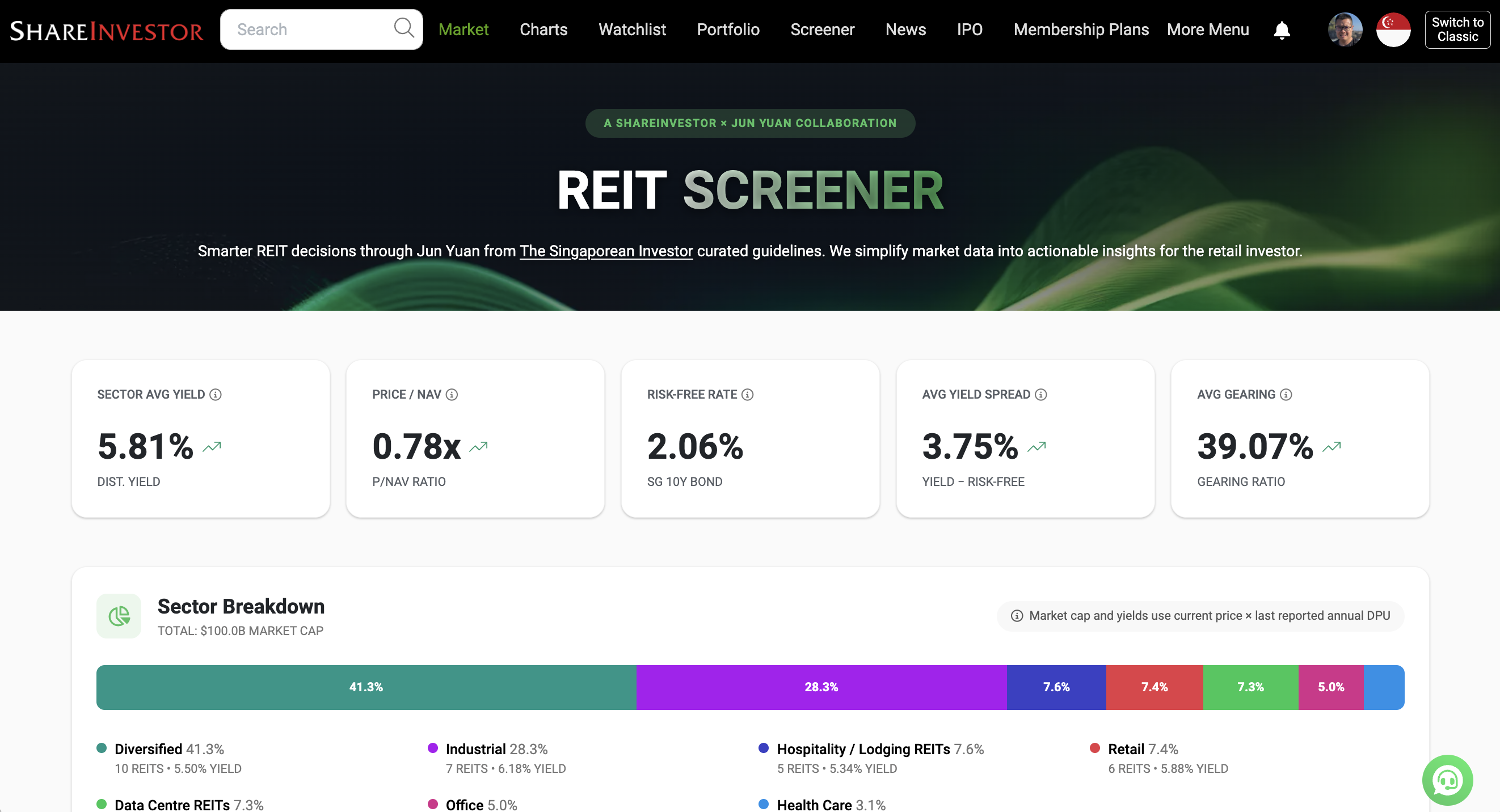
Take a closer look at the REIT Screener here...



Comments (0)