All the 3 Mapletree REITs sponsored by Mapletree Investments Pte Ltd have a financial year end on 31 March 2025.
Following the release of their 4th quarter and full year results back in April, Mapletree Logistics Trust was the first among the trio to release its annual report last Friday (20 June 2025), and if you like to read a summary of the report which I’ve compiled, you can do so here.
This morning (25 June), Mapletree Industrial Trust (SGX: ME8U), or MIT, was the next to do so.
For the uninitiated, MIT invests in industrial (such as hi-tech buildings, business park buildings, flatted factories, stack-up/ramp-up buildings, and light industrial buildings) and data centre properties in Singapore, North America, and Japan.
As of 31 March 2025, its portfolio comprised 56 properties in North America (including 13 data centres held through the joint venture with its sponsor), 83 properties in Singapore, and 2 properties in Japan, with a total asset under management (AUM) of S$9.1 billion (data centres comprised 55.3% of the REIT’s total AUM), with industrial properties comprising the remaining 44.7%).
Among the 3 Mapletree REITs, this is the one that has the least headwinds in my opinion (likely the other 2, where it headwinds related to occupancy and weaker foreign currencies, which impact its financial results and distribution payouts) – for the overall occupancy rate of its properties continue to remain high (above 90%), and in terms of demand, both the asset types (industrial and data centre properties) continue to remain strong.
Since the REIT reported its 4th quarter and full year results, some of the notable updates include the completion of the final phase of fitting-out works in its data centre in Osaka, Japan, the completion of divestment of a data centre in the United States (2775 Northwoods Parkway, Norcross, Georgia) in May, as well as the proposed divestment of 3 industrial properties in Singapore (at a 2.6% premium to market valuation and 22.1% increase from original investment cost, with proceeds to be used to repay outstanding borrowings to reduce aggregate leverage ratio and borrowing costs) – all of which were reported in May.
In this post, you’ll find key takeaways from MIT’s latest annual report (which I’ve compiled for the benefit of those who do not have the time to go through it), along with details of its upcoming annual general meeting (AGM):
Key Takeaways from MIT’s Latest Annual Report
Key Performance Highlights:
- Gross revenue increased by 2.1% year on year to S$711.8 million (FY2023/24: S$697.3 million), which can be attributed to revenue contributions from the completion of the second (on 25 June 2024) and third (on 2 May 2025) phases of fitting-out works of the Osaka Data Centre and the freehold mixed-use facility in Tokyo, on top of new leases and renewals across various Singapore property clusters. However, this was partially offset by the loss of income from the divestment of the Tanglin Halt cluster, and the non-renewal of leases in the North American portfolio.
- Data centres contributed 41.7% towards MIT’s gross revenue, with industrial properties contributing the remaining 58.3%.
- Net property income rose by a slightly lower percentage compared to its gross revenue, at 2.0% year on year to S$531.5 million (FY2023/24: S$521 million), due to higher property maintenance, recoverable utility expenses, as well as marketing expenses from the leasing activities in FY2024/25.
- The amount available for distribution to unitholders saw a 3.5% year-on-year improvement to S$388.1 million (FY2023/24: S$375.1 million) as a result of a higher net property income, lower net borrowing costs, and distribution of net divestment gains from the Tanglin Halt cluster. However, this is partially offset by lower distribution from the joint venture (i.e., Mapletree Rosewood Data Centre Trust), and an increase in interest expense on new borrowings taken to fund the acquisition of the mixed-use facility in Tokyo, with its distribution per unit also up by 1.0% year on year to S$0.1357 (FY2023/24: S$0.1343).
- MIT’s overall portfolio occupancy improved to 92.1% (FY2023/24: 92.6%), with a positive weighted average rental reversion rate of about +9.2% (driven by positive rental reversions for renewal leases across all property segments and higher average rental rate for new leases in the financial year). The occupancy rate of its Singapore properties remained healthy at 93.2%, while the occupancy rate for its North American properties dipped slightly to 89.3% (FY2023/24: 90.3%) due to non-renewal of leases (at 2000 Kubach Road, Philadelphia and 2055 East Technology Circle, Tempe).
- Aggregate leverage inched up to 40.1% (FY2023/24: 38.7%). However, its average borrowing cost improved slightly to 3.1% (FY2023/24: 3.2%).
Updates on Portfolio Rebalancing Efforts:
- Acquired a freehold mixed-use facility in Tokyo for JPY14.5 billion (a 3.3% discount to 2 independent valuations obtained) on 29 October 2024, which presents a future redevelopment opportunity into a data centre. The property is fully leases to an established Japanese conglomerate with a weighted average lease expiry of 5 years.
- Completion of 2 phases of fitting out works in its Osaka Data Centre (which was acquired on 28 September 2023) on 25 June 2024 and 2 May 2025, with revenue from both phases expected to contribute positively to MIT.
- Divestment of 2775 Northwoods Parkway, Norcross, Georgia (at US$11.8 million, which is 18.6% above the independent valuation of US$9.95 million), and a portfolio of 3 industrial properties in Singapore (with divestment expected to be completed by the 3rd quarter of 2025).
Environmental, Sustainability, and Governance (ESG) Efforts:
- Completion of Phase 3 of solar panel installation project, which increased the MIT’s solar generating capacity by 4,106 kWp to 12,453 kWp in 37 properties across its 23 properties clusters in Singapore. This surpassed its FY2029/30 target of 10,000 kWp.
- Attained 3 BCA Green Mark re-certifications and 2 WELL Health-Safety Ratings for its properties in Singapore and North America respectively.
- Female representation on the Board was at 42%, which affirmed MIT’s aspiration to achieve at least 25% of female representation on the Board by 2025, and 30% by 2030.
Priorities Ahead:
- The REIT’s management opined that the stability of its Singapore and Japan portfolio would cushion headwinds from the North American portfolio (from the non-renewal of leases, to which they is looking at various options, including divestments, engaging tenants ahead of their lease expirations, prospect tenants from various sectors and evaluate possible repositioning of the properties, to manage the impact).
- Moving forward, they remain disciplined in diversifying its data centre presence through accretive acquisitions in key markets across Asia Pacific and Europe.
Details of MIT’s 15th AGM
When? Friday, 25 July 2025
Where? 20 Pasir Panjang Road, Mapletree Business City, Town Hall – Auditorium, Singapore 117439
Time? 2.30pm
The AGM will be held in a wholly physical format, with no options for unitholders to attend virtually.
For unitholders whose units are held in a CDP account, no pre-registration is needed, as verification of unitholding is done on the spot. For unitholders who units are held in a custodian account, and would like to attend the AGM, you’ll need to reach out to your brokerage to appoint you to do so as a proxy.
Closing Thoughts
2 things I like about the REIT – first is its improving financial results and distribution payout (for information, MIT is one of the few among the 40+ Singapore REITs that reported a year-on-year improvement in its financial results and distribution payout for the full year); and second is the fact that MIT remains one of the few that continues to maintain a quarterly distribution payout frequency.
In terms of MIT’s portfolio occupancy, no doubt the occupancy rate of its North American data centres dipped slightly, but on the whole, occupancy rate is still at a rather healthy level at 89.3% – so I’m not too concerned there, at least for now. As for the occupancy rate of its Singapore properties, it remained at a high level of 93.2%. Rental reversion for new and/or renewed leases for the financial year was also at a good high-single digit percentage at +9.2% – which will definitely contribute to some stability in terms of growth of the REIT’s financial results in the coming quarters.
Finally, even though its aggregate leverage inched up slightly (to 40.1%), but it is still at a very healthy level, and a good distance to the regulatory limit of 50% – again, I’m not too concerned at this point of time (the reason is because, following the completion of the divestment of the 3 Singapore industrial properties and proceeds being used to repay debts, the REIT’s aggregate leverage will be brought down to 37%).
With that, I have come to the end of my summary of MIT’s latest annual report for the financial year ended 31 March 2025, along with sharing my thoughts about its latest full-year performance. Do note that all the opinions are purely mine, which I’m sharing for educational purposes only. They do not represent any buy or sell calls for the REIT’s units. You are strongly advised to do your own due diligence before making any investment decisions.
Related Documents
- Annual Report for FY2024/25
- Sustainability Report for FY2024/25
- Notice of AGM
- Proxy Form
- Appendix A – Proposed Change of Auditor of MIT
- Appendix B – Proposed Renewal of the Unit Buy-Back Mandate
Disclaimer: At the time of writing, I am a unitholder of Mapletree Industrial Trust.
Join Me for a FREE Live Online Chit-Chat on Thursday, 12 November, from 8–9pm (SGT)!
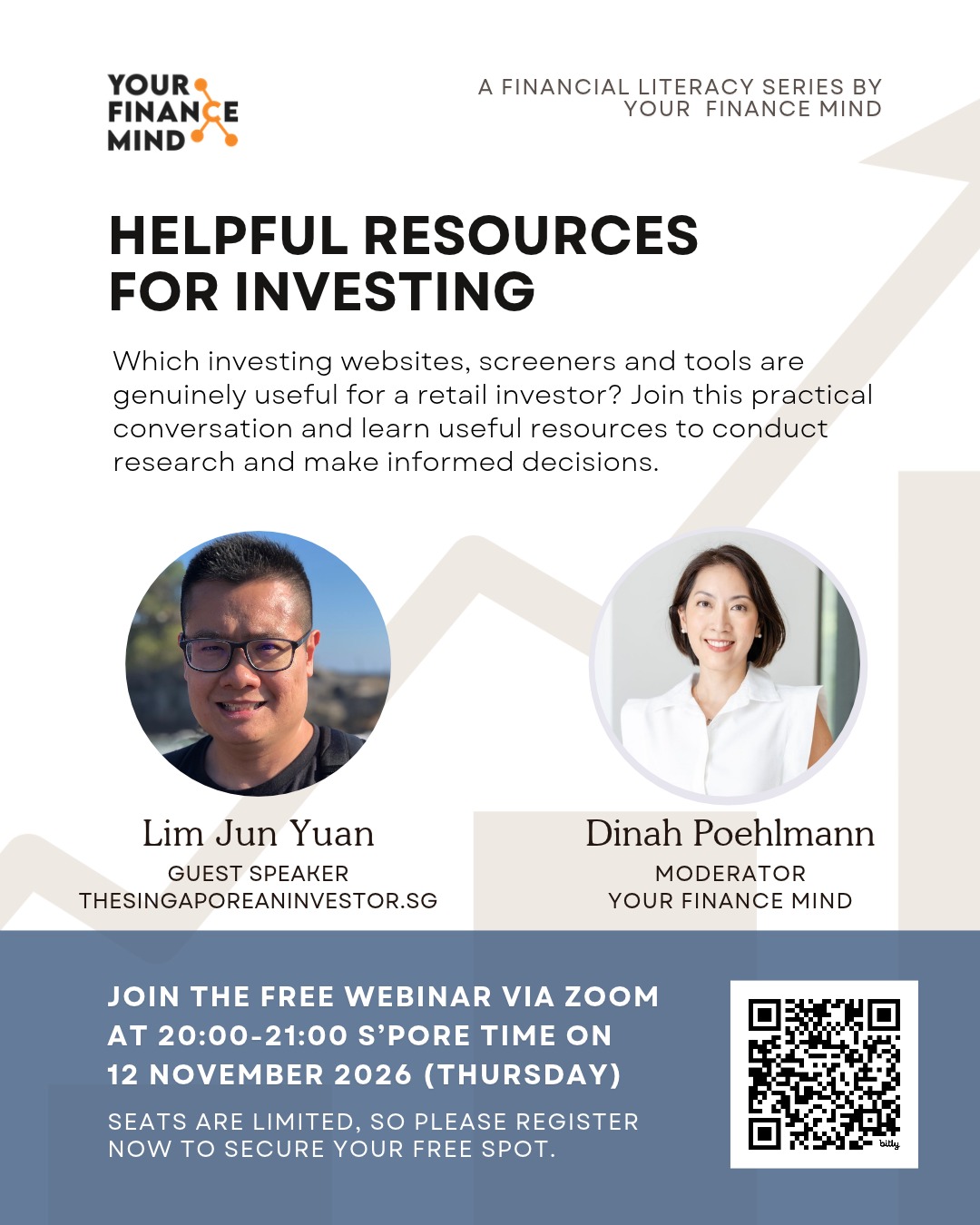
It's been quite some time since I last had a live chit-chat with the investing community, and I’m excited to be back for another session! A big thank you to my friend, Dinah Poehlmann from Your Finance Mind, for inviting me once again!
This time, we’re taking a little break from REITs and exploring some interesting topics surrounding investing, including my go-to investing resources, when is a stock considered 'investable', my thoughts about using AI for stock analysis and trading, and much more.
Whether you're just starting your investing journey or have been investing for years, I hope this session will offer some useful perspectives and practical takeaways that you can apply to your own investing journey.
Best of all, the session is completely FREE to attend! All you need to do is register in advance to receive the Zoom link:
👉 Click here to reserve your spot!
Are You Worried about Not Having Enough Money for Retirement?
You're not alone. According to the OCBC Financial Wellness Index, only 62% of people in their 20s and 56% of people in their 30s are confident that they will have enough money to retire.
But there is still time to take action. One way to ensure that you have a comfortable retirement is to invest in real estate investment trusts (REITs).
In 'Building Your REIT-irement Portfolio' which I've authored, you will learn everything you need to know to build a successful REIT investment portfolio, including a list of 9 things to look at to determine whether a REIT is worthy of your investment, 1 simple method to help you maximise your returns from your REIT investment, 4 signs of 'red flags' to look out for and what you can do as a shareholder, and more!

You can find out more about the book, and grab your copy (ebook or physical book) here...


Comments (0)