Following OCBC, which released its results for the 2nd quarter and for the 1st half of FY2025 last Friday (you can read my review of its results here), UOB and DBS are the next to do so early this morning (07 August) – for information, I’ll first be sharing about UOB’s results in this post, followed by DBS’ in a separate post (which I will publish in a while).
United Overseas Bank Limited (SGX: U11), or UOB, is another Singapore headquartered bank that all of us should be familiar, where we can find the bank’s branches and ATM machines scattered across the island.
However, the bank’s presence is more than just in Singapore. It also has a business presence in more than 19 markets in Asia Pacific, Europe, and North America. But its focus is in ASEAN.
In this post, you’ll find my review of UOB’s latest financial results and ratios, along with its dividend payout to shareholders:
Financial Results (2Q FY2024 vs. 2Q FY2025, 1H FY2024 vs. 1H FY2025)
2Q FY2024 vs. 2Q FY2025:
| 2Q FY2024 | 2Q FY2025 | % Variance | |
| – Net Interest Margin (S$’mil) | $2,401m | $2,336m | -2.7% |
| – Net Fee & Commission Income (S$’mil) | $618m | $636m | +2.9% |
| – Other Non-Interest Income (S$’mil) | $457m | $493m | +7.9% |
| Total Revenue (S$’mil) | $3,476m | $3,465m | -0.3% |
| Total Expenses (S$’mil) | $1,534m | $1,535m | +0.1% |
| Net Profit Attributable to Shareholders (S$’mil) | $1,425m | $1,338m | -6.1% |
In my opinion, it was a mixed set of results reported by UOB for the 2nd quarter.
First the positives – the 2.9% year-on-year increase in the bank’s net fee and commission income to S$636 million was due to a broad-based growth across wealth management, loan-related services and credit card fees; its other non-interest income was also up by 7.9% year on year to S$493 million from higher customer-related treasury income and improved trading and liquidity management performance.
On the other hand, net interest income fell by 2.7% year on year to S$2.34 billion from a lower net interest margin; at the same time, its net profit attributable to shareholders decreased by 6.1% year on year to S$1.34 billion from a higher amortisation of intangible assets (which rose by 39% year on year from S$7 million to S$9 million), and allowance of credit and other losses (which increased by 20% year on year from S$232 million to S$279 million).
Lastly, UOB’s total expenses remained relatively unchanged.
1H FY2024 vs. 1H FY2025:
| 1H FY2024 | 1H FY2025 | % Variance | |
| – Net Interest Margin (S$’mil) | $4,763m | $4,745m | -0.4% |
| – Net Fee & Commission Income (S$’mil) | $1,198m | $1,330m | +11.0% |
| – Other Non-Interest Income (S$’mil) | $1,038m | $1,047m | +0.9% |
| Total Revenue (S$’mil) | $6,998m | $7,121m | +1.8% |
| Total Expenses (S$’mil) | $3,105m | $3,094m | -0.4% |
| Net Profit Attributable to Shareholders (S$’mil) | $2,912m | $2,828m | -2.9% |
Similar to its results for the 2nd quarter, for the first half of the year, it was also a mixed set of results – with improvements seen in its net fee and commission income, as well as other non-interest income, but some slight declines seen in its net interest income and in its net profit attributable to shareholders.
The small 0.4% year-on-year dip in UOB’s net interest income to S$4.75 billion was due to a 0.08 percentage point (pp) drop in its net interest margin (from 2.04% in 1H FY2024 to 1.96% to 1.96% in 1H FY2025), but partially offset by asset growth.
Net fee and commission income grew by 11.0% year on year to S$1.33 billion from higher wealth management, loan-related and credit card fees.
Other non-interest income increased by 0.9% year on year to S$1.05 billion due to stronger customer-related treasury income, partially offset by softer performance in its trading and liquidity management activities.
UOB’s net profit attributable to shareholders fell by 2.9% year on year to S$2.83 billion due to a higher amortisation of intangible assets (which jumped by 21% from S$13 million to S$16 million), as well as in its allowance for credit and other losses (which leapt by 44% from S$395 million to S$569 million).
Key Financial Ratios (1Q FY2025 vs. 2Q FY2025)
In the table below, you’ll find UOB’s key financial ratios reported for the current quarter under review (i.e., 2Q FY2025 ended 30 June 2025) against that reported in the previous quarter (i.e., 1Q FY2025 ended 31 March 2025) to find out if it has continued to remain at healthy levels.
| 1Q FY2025 | 2Q FY2025 | Difference (in Percentage Points – pp) | |
| Net Interest Margin (%) | 2.00% | 1.91% | -0.09pp |
| Return on Equity (%) | 12.3% | 11.1%^^ | -1.2pp |
| Non-Performing Loans Ratio (%) | 1.6% | 1.6% | – |
^^ – UOB did not provide its Return on Equity for 2Q FY2025. I have computed it based on the figures in 1Q FY2025, as well as in 1H FY2025.
Net interest margin fell by 0.09pp to 1.91% due to lower asset yields amid falling benchmark rates.
Non-performing loans ratio remains unchanged at 1.6%, even though there’s a slight increase in non-performing assets (by 0.5% year on year from S$5.36 million to S$5.39 million).
Dividend Payout to Shareholders
The management of UOB pays out a dividend to the shareholders on a semi-annual basis.
For the 1st half of FY2025, a total dividend payout of 110.0 cents/share (comprising of 85 cents/share of ordinary dividends, plus 25.0 cents/share of special dividends – which the bank declared when it reported its full year results in February under the bank’s capital distribution strategy to reward its shareholders).
While its interim dividend (of 110.0 cents/share) was a 25% year-on-year increase from its payout of 88.0 cents/share paid out a year ago, but if special dividends was excluded, UOB’s dividend payout actually saw a 3.4% year on year decline.
If you are a shareholder of UOB, do take note of the following dates on its dividend payout:
Ex-Date: 15 August 2025
Record Date: 18 August 2025
Payout Date: 28 August 2025
CEO Mr Wee Ee Cheong’s Comments & Outlook (Extracted from the Bank’s Press Release)
“The Group delivered a steady set of results driven by our core businesses, including robust fee growth across our diversified franchise. Asset quality was resilient, and our balance sheet remained strong, underpinned by healthy capital and liquidity levels.
As the global landscape transitions towards a multipolar world order, ASEAN continues to demonstrate resilient growth. We remain confident in the region’s long-term prospects, anchored by sound fundamentals. With regional integration, trade diversification and rising foreign direct investments, ASEAN is well-positioned to thrive in the evolving global economy.
Our regional franchise has gained significant scale following the Citigroup acquisition, expanding our customer base across ASEAN to more than 8.4 million. We are progressing well in reshaping our business model towards a more diversified and fee-driven revenue mix – leveraging our connectivity strength and regional scale. As a long-term player, we are committed to supporting clients through uncertainties and investing in capabilities for sustainable growth.”
Closing Thoughts
On the whole, it was a rather mixed set of results reported by UOB this time round – with a slight decline reported in its net interest income for the 2nd quarter, as well as for the 1st half of FY2025 as a result of a drop in net interest margin (by 0.14pp in the 2nd quarter, and by 0.08pp in the 1st half of the year, compared to the respective time periods a year ago).
At the same time, net profit attributable to shareholders also fell by a single-digit percentage in both periods due to a jump in amortisation of intangible assets, as well as allowance for credit and other losses. This led to its interim dividend recording a 3.4% year-on-year dip to 85.0 cent/share – even though at this level, it represented a payout ratio of 50%, in-line with the management’s guidance on dividend payouts).
On the other hand, improvements were recorded in the bank’s net fee and commission income, as well as in the other non-interest income for both the 2nd quarter, and the 1st half of the year.
Not the best of quarters for the bank I must say (however, I’m always of the opinion that 1 or 2 quarters of weaker results does not break a company). However, in terms of business fundamentals, it continue to remain very sound, and as a shareholder of the bank, I will continue to remain invested in it.
With that, I have come to the end of my review of UOB’s latest results for the 2nd quarter, as well as for the 1st half of FY2025. Please note that all the opinions expressed in this post are purely mine, which I’m sharing for educational purposes only. They do not represent any buy or sell calls for the company’s shares. You are strongly encouraged to do your own due diligence before making any investment decisions.
Related Documents
Disclaimer: At the time of writing, I am a shareholder of United Overseas Bank Limited.
Join Me for a FREE Live Online Chit-Chat on Thursday, 12 November, from 8–9pm (SGT)!

It's been quite some time since I last had a live chit-chat with the investing community, and I’m excited to be back for another session! A big thank you to my friend, Dinah Poehlmann from Your Finance Mind, for inviting me once again!
This time, we’re taking a little break from REITs and exploring some interesting topics surrounding investing, including my go-to investing resources, when is a stock considered 'investable', my thoughts about using AI for stock analysis and trading, and much more.
Whether you're just starting your investing journey or have been investing for years, I hope this session will offer some useful perspectives and practical takeaways that you can apply to your own investing journey.
Best of all, the session is completely FREE to attend! All you need to do is register in advance to receive the Zoom link:
👉 Click here to reserve your spot!
Stop Spending Hours Reading REIT Reports Every Quarter!
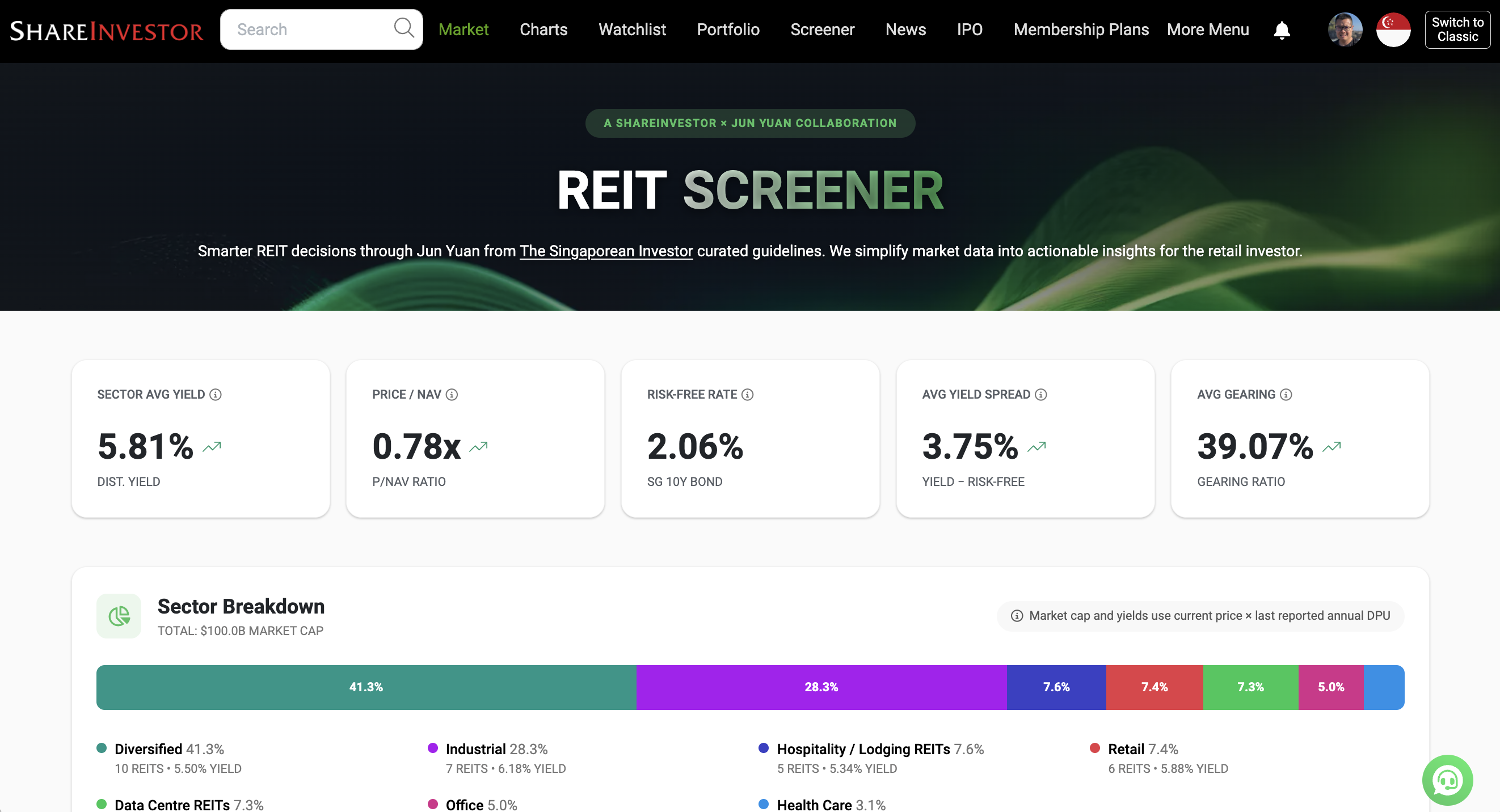
What if you could assess a REIT's portfolio occupancy, debt profile, valuation, and overall health in less than 30 seconds - without having to comb through a single quarterly report?
That's the problem the REIT Screener was built to solve.
Developed through a collaboration between ShareInvestor and The Singaporean Investor, the REIT Screener consolidates many of the key metrics and indicators I personally use when analysing REITs into one easy-to-use platform. Instead of spending hours extracting data manually every earnings season, you can now monitor the REITs you own and research new opportunities in just a few clicks.
If you're serious about REIT investing but don't have the time to manually track quarterly developments, the REIT Screener could be the shortcut you've been looking for:
Take a closer look at the REIT Screener here...



Comments (0)