We are in the middle of another round of earnings season – following the REITs (where they have reported their business update/financial results from the 3rd week of April), the banks are next – and speaking of which, there are 3 of them listed on the Singapore Exchange: DBS, UOB, and OCBC (and they need no further introduction, as you can find the banks’ branches and ATM machines scattered all across the country).
This time round, UOB is the first to release its business update for the 1st quarter of FY2025 ended 31 March early this morning (07 May), followed by DBS tomorrow (08 May) morning, and then OCBC a day after (09 May).
A quick introduction about United Overseas Bank (SGX: U11), or UOB – Apart from being one of the major banks in Singapore, it, is also one of the leading banks in Asia. Currently, the Singapore-headquartered bank has over 470 branches and offices in 19 markets in Asia Pacific, Europe, and North America. However, its focus is in ASEAN (where, apart from its head office in Singapore, it also has banking subsidiaries in Indonesia, Malaysia, Thailand, and Vietnam).
In this post, you will find my review of UOB’s latest business update for 1Q FY2025 in terms of its key financial figures and ratios:
Key Financial Figures (1Q FY2024 vs. 1Q FY2025)
| 1Q FY2024 | 1Q FY2025 | % Variance | |
| – Net Interest Income (S$’mil) | $2,362m | $2,409m | +2.0% |
| – Net Fee & Commission Income (S$’mil) | $580m | $694m | +19.7% |
| – Other Non-Interest Income (S$’mil) | $581m | $554m | -4.6% |
| Total Income (S$’mil) | $3,523m | $3,657m | +3.8% |
| Total Expenses (S$’mil) | $1,475m | $1,559m | 5.7% |
| Net Profit (S$’mil) | $1,487m | $1,490m | +0.2% |
Overall, it was a stable set of financial figures reported by UOB for the 1st quarter, with the standout being the 19.7% year-on-year jump in its net fee and commission income to S$694 million, led by a strong growth in its loan fees (which reached a new record of S$312 million), along with a healthy wealth (which grew by 29.9% year on year to S$213 million) and card fees (which increased by 10.6% year on year to S$281 million) momentum.
Net interest income saw a 2.0% year-on-year improvement to about S$2.4 billion, from a robust loan growth of 6% compared to a year ago.
However, UOB’s other non-interest income fell by 4.6% year on year to S$554 million from lower trading and investment income.
Key Financial Ratios (4Q FY2024 vs. 1Q FY2025)
For those of you who focus on my reviews of the banks’ quarterly updates, you probably know I always look at 3 key financial ratios in particular: net interest margin, return on equity, and non-performing loans ratio.
Also, my preference is to compare the statistics reported for the current quarter under review against that reported in the previous quarter 3 months ago.
In the table below, you’ll find a comparison of UOB’s net interest margin, return on equity, and non-performing loans ratio reported for the current quarter (i.e., 1Q FY2025 ended 31 March 2025) against that reported in the previous quarter (i.e., 4Q FY2024 ended 31 December 2024):
| 4Q FY2024 | 1Q FY2025 | Difference (in Percentage Points – pp) | |
| Net Interest Margin (%) | 2.00% | 2.00% | – |
| Return on Equity (%) | 13.1% | 12.3% | -0.8pp |
| Non-Performing Loans Ratio (%) | 1.5% | 1.6% | +0.1pp |
As far as its key financial ratios are concerned, its a slight negative, with its return on equity down by 0.8pp to 12.3%, and its non-performing loans inching up by 0.1pp to 1.6% (from a 6.1% year-on-year increase in its non-performing assets to about S$5.4 billion).
CEO Mr Wee Ee Cheong’s Comments & Outlook (from the Bank’s Press Release)
“The Group achieved a solid set of results for the first quarter, supported by broad-based income growth, record fee income and robust loan growth.
Macroeconomic uncertainties from the US tariffs have triggered significant market volatility and disruptions in global trade. We anticipate a slowdown in global growth in the near term and remain vigilant amid the uncertain global outlook.
We believe in ASEAN’s resilience and long-term potential. The region’s competitive edge in manufacturing and commodities will ensure its relevance as global supply chains reconfigure. We expect flows within ASEAN and between ASEAN and the rest of the world to continue growing as countries seek new ways to prosper.
With our robust balance sheet, healthy capital and strong liquidity positions, we are well-equipped to address risks and seize the right opportunities for growth. We stand ready to support our customers and community through these extraordinary times.”
Closing Thoughts
In my personal opinion, UOB’s latest 1st quarter business update as far as its financial figures and key financial ratios are concerned was a mixed bag.
On one hand, its financial figures recorded a stable growth – with improvements recorded in its net interest income, as well as in its net fee and commissions income (particularly, its loan fees for the quarter, at S$312 million, was a record for the bank). Net profit was more or less the same compared to a year ago, at S$1.49 billion.
However, the 3 financial ratios I always look at when I review a bank’s quarterly figures weakened compared to the previous quarter (i.e., 4Q FY2024 ended 31 December 2024) – to recap, its return on equity fell by 0.8pp to 12.3%, and its non-performing loans ratio inching up to 1.6% once again (as a result of a 6.1% year-on-year increase in its non-performing assets).
Last but not least, as the bank have a half-yearly dividend payout frequency, no dividend payouts are declared this time round.
With that, I have come to the end of my review of UOB’s latest business update for the 1st quarter of FY2025. While I certainly hope the post have given you a good update on the bank’s latest performance, but do note that all the opinions expressed within are purely for educational purposes only. They are not any buy or sell calls for the bank’s shares. You should always do your own due diligence before making any investment decisions.
Related Documents
Disclaimer: At the time of writing, I am a shareholder of United Overseas Bank Limited.
Join Me for a FREE Live Online Chit-Chat on Thursday, 12 November, from 8–9pm (SGT)!

It's been quite some time since I last had a live chit-chat with the investing community, and I’m excited to be back for another session! A big thank you to my friend, Dinah Poehlmann from Your Finance Mind, for inviting me once again!
This time, we’re taking a little break from REITs and exploring some interesting topics surrounding investing, including my go-to investing resources, when is a stock considered 'investable', my thoughts about using AI for stock analysis and trading, and much more.
Whether you're just starting your investing journey or have been investing for years, I hope this session will offer some useful perspectives and practical takeaways that you can apply to your own investing journey.
Best of all, the session is completely FREE to attend! All you need to do is register in advance to receive the Zoom link:
👉 Click here to reserve your spot!
Stop Spending Hours Reading REIT Reports Every Quarter!
What if you could assess a REIT's portfolio occupancy, debt profile, valuation, and overall health in less than 30 seconds - without having to comb through a single quarterly report?
That's the problem the REIT Screener was built to solve.
Developed through a collaboration between ShareInvestor and The Singaporean Investor, the REIT Screener consolidates many of the key metrics and indicators I personally use when analysing REITs into one easy-to-use platform. Instead of spending hours extracting data manually every earnings season, you can now monitor the REITs you own and research new opportunities in just a few clicks.
If you're serious about REIT investing but don't have the time to manually track quarterly developments, the REIT Screener could be the shortcut you've been looking for:
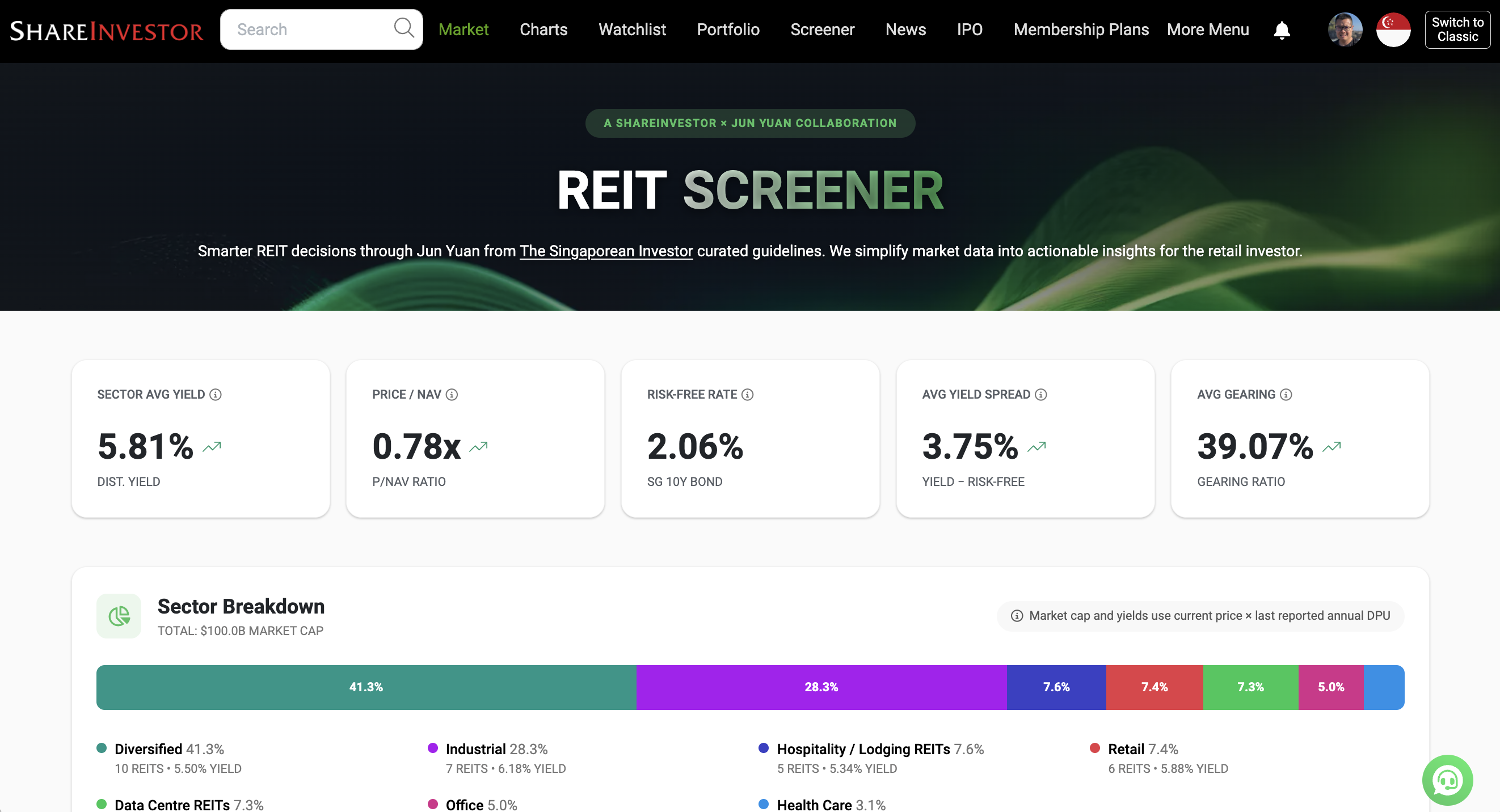
Take a closer look at the REIT Screener here...



Comments (0)