Oversea-Chinese Banking Corporation (SGX:O39), or OCBC, is the last of the 3 Singapore-listed banks to publish its first quarter business updates for the quarter ended 31 March 2021 this morning (07 June 2021.)
Both DBS (you can check out my review here) and UOB (you can check out my review here) reported an improved set of results. So, is OCBC’s latest set of results an improved one as well? In my post today, you will read about my review and thoughts about the bank’s most recent set of key financial statistics as well as ratios.
Let’s begin…
Key Financial Results (Q1 FY2020 vs. Q1 FY2021)
| Q1 FY2020 | Q1 FY2021 | % Variance | |
| – Net Interest Income (S$’mil) | $1,626m | $1,441m | -11.4% |
| – Net Fee & Commission Income (S$’mil) | $546m | $585m | +7.1% |
| – Other Non- Interest Income (S$’mil) | $318m | $888m | > 100.0% |
| Total Income (S$’mil) | $2,490m | $2,914m | +17.0% |
| Total Expenses (S$’mil) | $1,109m | $1,149m | +3.6% |
| Net Profit Attributable to Shareholders (S$’mil) | $698m | $1,501m | > 100.0% |
At one glance, I must say that OCBC’s latest set of results, when compared to the same quarter last year, is an impressive one – particularly on the huge jump in its other non-interest income, due to its net trading income skyrocketing to S$316m (Q1 FY2020: S$18m) from higher customer flow income, along with a huge rise in its profit from life insurance (from S$106m in Q1 FY2020 to S$422m in Q1 FY2021) as a result of mark-to-market gains from favourable market conditions. This led to a huge increase in its net profit attributable to shareholders.
On the other hand, the 3.6% increase in its total expenses was largely driven by a rise in staff costs associated with an increase in business activities.
Key Financial Ratios (Q4 FY2020 vs. Q1 FY2021)
In this section, you will find some of the key financial ratios reported by the bank as at the end of the first quarter of FY2021, and I will be comparing these ratios against that reported in the previous quarter recorded 3 months ago – i.e. the fourth quarter of FY2020 ended 31 December 2020, to find out if it has improved, remained consistent, or deteriorated:
| Q4 FY2020 | Q1 FY2021 | Difference (in Percentage Points – pp) | |
| Net Interest Margin (%) | 1.56% | 1.56% | – |
| Return on Assets (%) | 1.07% | 1.44% | +0.37pp |
| Return on Equity (%) | 9.3% | 12.4% | +3.1pp |
| Non-Performing Loans Ratio (%) | 1.5% | 1.5% | – |
My Observations: Compared to the previous quarter, the bank’s key financial ratios (particularly its return on assets, as well as its return on equity) have improved (especially the latter, which have once again returned to double digits), which is encouraging to note.
Another positive is that both its net interest margin and non-performing loans ratio have remained unchanged from the previous quarter.
Closing Thoughts
There’s nothing not to like about OCBC’s latest ‘report card.’ The drop in its net interest income was expected due to the current low interest rate environment, but its total revenue recorded a year-on-year rise due to improvements recorded in its other businesses, which led to its net profit attributable to shareholders going up as well.
Finally, there are no dividend payouts declared by the bank for the current quarter under review as it pays out a dividend on a half-yearly basis – the next dividend payout will be when the bank releases its second quarter results.
Related Documents
Disclaimer: At the time of writing, I am a shareholder of Oversea-Chinese Banking Corporation Limited.
Join Me for a FREE Live Online Chit-Chat on Thursday, 12 November, from 8–9pm (SGT)!

It's been quite some time since I last had a live chit-chat with the investing community, and I’m excited to be back for another session! A big thank you to my friend, Dinah Poehlmann from Your Finance Mind, for inviting me once again!
This time, we’re taking a little break from REITs and exploring some interesting topics surrounding investing, including my go-to investing resources, when is a stock considered 'investable', my thoughts about using AI for stock analysis and trading, and much more.
Whether you're just starting your investing journey or have been investing for years, I hope this session will offer some useful perspectives and practical takeaways that you can apply to your own investing journey.
Best of all, the session is completely FREE to attend! All you need to do is register in advance to receive the Zoom link:
👉 Click here to reserve your spot!
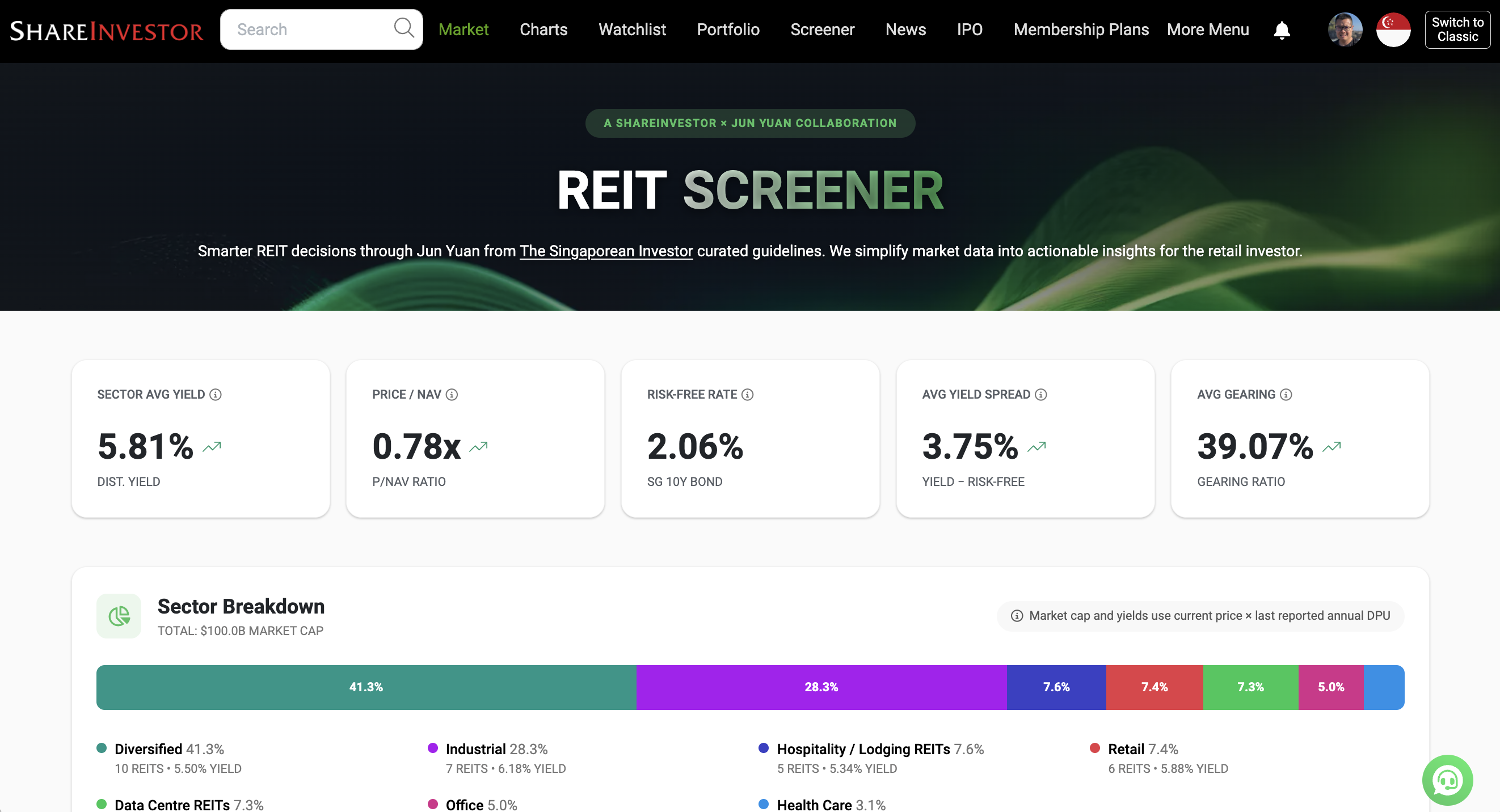
Stop Spending Hours Reading REIT Reports Every Quarter!
What if you could assess a REIT's portfolio occupancy, debt profile, valuation, and overall health in less than 30 seconds - without having to comb through a single quarterly report?
That's the problem the REIT Screener was built to solve.
Developed through a collaboration between ShareInvestor and The Singaporean Investor, the REIT Screener consolidates many of the key metrics and indicators I personally use when analysing REITs into one easy-to-use platform. Instead of spending hours extracting data manually every earnings season, you can now monitor the REITs you own and research new opportunities in just a few clicks.
If you're serious about REIT investing but don't have the time to manually track quarterly developments, the REIT Screener could be the shortcut you've been looking for:
Take a closer look at the REIT Screener here...



Comments (0)