All 3 Singapore-listed banks have released their financial results for 4Q & FY2025, and you can find out my review for each of them in the respective links below:
- DBS Group Holdings Limited (SGX: D05): 4Q & FY2025 Results Review
- United Overseas Bank Limited (SGX: U11): 4Q & FY2025 Results Review
- Oversea-Chinese Banking Corporation Limited (SGX: O39): 4Q & FY2025 Results Review
In this post, I’ll compare the latest results of the 3 banks to determine which one showed the strongest growth. I’ll examine their financial performance and dividend payouts on a year-on-year basis for both the 4th quarter and the full year, along with key financial ratios for the 4th quarter compared to the 3rd quarter on a quarter-on-quarter basis.
Additionally, I’ll analyse their current valuations to identify which of the 3 is the ‘cheapest’ and which is the ‘most expensive.’
Financial Results Comparison: 4Q FY2024 vs. 4Q FY2025
Net Interest Income:
| DBS | UOB | OCBC | |
| Net Interest Income | Down -3.6% 4Q FY2024: S$3,728m 4Q FY2025: S$3,593m | Down -4.3% 4Q FY2024: S$2,451m 4Q FY2025: S$2,346m | Down -6.5% 4Q FY2024: S$2,455m 4Q FY2025: S$2,296m |
Due to a decrease in benchmark borrowing rates, it is not surprising that all 3 banks reported a decline in net interest income for the 4th quarter. However, the extent of the decline varies, with DBS experiencing the smallest drop (3.6%), followed by UOB (4.3%), and OCBC with the largest decline (6.5%).
Net Fee & Commission Income:
| DBS | UOB | OCBC | |
| Net Fee & Commission Income | Up +13.5% 4Q FY2024: S$968m 4Q FY2025: S$1,099m | Up +10.2% 4Q FY2024: S$567m 4Q FY2025: S$625m | Up +16.4% 4Q FY2024: S$517m 4Q FY2025: S$602m |
Each of the 3 banks experienced double-digit percentage growth in their net fee and commission income, with OCBC leading at 16.4%, followed by DBS at 13.5%, and UOB at 10.2%.
Other Non-Interest Income:
| DBS | UOB | OCBC | |
| Other Non- Interest Income | Down -21.0% 4Q FY2024: S$809m 4Q FY2025: S$639m | Down -28.0% 4Q FY2024: S$443m 4Q FY2025: S$319m | Up +61.7% 4Q FY2024: S$444m 4Q FY2025: S$718m |
OCBC was the only bank to record growth in its other non-interest income, which soared by 61.7%, driven by a significant increase in net trading income and higher earnings from its insurance business (Great Eastern).
Net Profit Attributable to Shareholders:
| DBS | UOB | OCBC | |
| Net Profit Attributable to Shareholders | Down -10.5% 4Q FY2024: S$2,522m 4Q FY2025: S$2,258m | Down -7.4% 4Q FY2024: S$1,523m 4Q FY2025: S$1,410m | Up +3.4% 4Q FY2024: S$1,687m 4Q FY2025: S$1,745m |
OCBC was the only bank to show an increase in net profit attributable to shareholders, driven by a 5.9% year-on-year rise in total income and a slight decrease of 0.1% in total expenses compared to the previous year.
Financial Results Comparison: FY2024 vs. FY2025
Net Interest Income:
| DBS | UOB | OCBC | |
| Net Interest Income | Up +0.5% FY2024: S$14,424m FY2025: S$14,500m | Down -3.3% FY2024: S$9,674m FY2025: S$9,355m | Down -6.2% FY2024: S$9,755m FY2025: S$9,150m |
DBS was the only bank to achieve an increase in its net interest income for FY2025, despite the declining interest rate environment, thanks to record deposit growth and proactive balance sheet hedging.
Net Fee & Commission Income:
| DBS | UOB | OCBC | |
| Net Fee & Commission Income | Up +17.5% FY2024: S$4,168m FY2025: S$4,898m | Up +7.3% FY2024: S$2,395m FY2025: S$2,569m | Up +22.4% FY2024: S$1,970m FY2025: S$2,411m |
Each of the 3 banks experienced growth in their net fee and commission income. However, OCBC led the pack with a 22.4% increase, followed by DBS at 17.5%, and UOB at 7.3%.
Other Non-Interest Income:
| DBS | UOB | OCBC | |
| Other Non- Interest Income | Down -5.5% FY2024: S$3,705m FY2025: S$3,502m | Down -15.3% FY2024: S$2,225m FY2025: S$1,884m | Up +11.1% FY2024: S$2,748m FY2025: S$3,053m |
OCBC was the only bank to report a year-on-year increase in other non-interest income, driven by higher trading and insurance income.
Net Profit Attributable to Shareholders:
| DBS | UOB | OCBC | |
| Net Profit Attributable to Shareholders | Down -3.2% FY2024: S$11,289m FY2025: S$10,933m | Down -22.5% FY2024: S$6,045m FY2025: S$4,682m | Down -2.2% FY2024: S$7,587m FY2025: S$7,422m |
All 3 banks experienced a drop in net profit attributable to shareholders for FY2025. However, OCBC saw the smallest decline at only 2.2%, followed by DBS with a 3.2% decrease, and UOB, which saw the largest drop at 22.5%.
Key Financial Ratios Comparison: 3Q FY2025 vs. 4Q FY2025
Net Interest Margin:
| DBS | UOB | OCBC | |
| Net Interest Margin | Down -0.03pp 3Q FY2025: 1.96% 4Q FY2025: 1.93% | Up +0.02pp 3Q FY2025: 1.82% 4Q FY2025: 1.84% | Up +0.02pp 3Q FY2025: 1.84% 4Q FY2025: 1.86% |
UOB and OCBC both recorded modest quarter-on-quarter increases in their net interest margin, rising by 0.02 percentage points. However, OCBC edged ahead with a slightly higher net interest margin of 1.86%, compared to UOB’s 1.84%.
Return on Equity:
| DBS | UOB^^ | OCBC | |
| Return on Equity | Down -3.6pp 3Q FY2025: 17.1% 4Q FY2025: 13.5% | Up +8.2pp 3Q FY2025: 3.5% 4Q FY2025: 11.7% | Down -1.8pp 3Q FY2025: 13.4% 4Q FY2025: 11.6% |
^^ – UOB did not provide its return on equity for 4Q FY2025. The figure is self-computed.
UOB experienced a notable increase in its return on equity compared to the previous quarter, which had fallen due to a sharp rise in allowances for credit and other losses. However, when comparing the return on equity across the three banks, DBS leads with the highest at 13.5%, followed by UOB at 11.7%, and OCBC at 11.6%.
Non-Performing Loans Ratio:
| DBS | UOB | OCBC | |
| Non-Performing Loans Ratio | No Change 3Q FY2025: 1.0% 4Q FY2025: 1.0% | Down -0.1pp 3Q FY2025: 1.6% 4Q FY2025: 1.5% | No Change 3Q FY2025: 0.9% 4Q FY2025: 0.9% |
UOB was the only bank to record a slight decrease in its non-performing loans ratio, which fell to 1.5%. However, OCBC stood out with a much lower ratio of just 0.9%, compared to 1.0% for DBS and 1.5% for UOB.
Dividend Payout Comparison: 2H FY2024 vs. 2H FY2025
| DBS ** | UOB | OCBC | |
| Dividend Per Share | Up +36.8% 2H FY2024: 114.0 cents 2H FY2025: 156.0 cents | Down -39.3% 2H FY2024: 117.0 cents 2H FY2025: 71.0 cents | Up +1.8% 2H FY2024: 57.0 cents 2H FY2025: 58.0 cents |
** – DBS’ dividend payout for 2H FY2024 included 54.0 cents for 3Q FY2024 and 60.0 cents for 4Q FY2024. In comparison, the 2H FY2025 dividend payout consisted of 75.0 cents for 3Q FY2025 and 81.0 cents for 4Q FY2025.
Although both DBS and OCBC experienced growth in their dividend payouts for 2H FY2025, DBS saw a significantly higher increase of 36.8%, while OCBC’s growth was just 1.8%.
Dividend Payout Comparison: FY2024 vs. FY2025
| DBS | UOB | OCBC | |
| Dividend Per Share | Up +37.8% FY2024: 222.0 cents FY2025: 306.0 cents | Down -11.7% FY2024: 205.0 cents FY2025: 181.0 cents | Down -2.0% FY2024: 101.0 cents FY2025: 99.0 cents |
DBS was the only bank to achieve not just an improvement in its annual dividend payout, but a remarkable one, rising by 37.8%.
Which Bank Came Out on Top for 4Q & FY2025?
In my view, OCBC edged out DBS this time, as it led the way in terms of growth in net fee and commission income, other non-interest income, and net profit attributable to shareholders for 4Q FY2025. For the full year, OCBC also saw the strongest growth in net fee & commission income and other non-interest income, as well as the smallest drop in net profit attributable to shareholders. This is in addition to the bank having the highest net interest margin among the 3 banks, and recorded the lowest non-performing loans.
As for DBS, it saw the smallest decline in net interest income for 4Q FY2025. Additionally, it saw the highest growth in both net interest income for FY2025. On top of that, DBS boasted the highest return on equity and the most significant increase in its dividend payout for 2H & FY2025.
Valuation Comparison (Based on Market Close on 25 February 2026)
| DBS | UOB | OCBC | |
| Share Price | S$57.69 | S$36.98 | S$21.40 |
| P/E Ratio | 14.89 | 10.97 | 13.01 |
| P/B Ratio | 2.34 | 1.27 | 1.58 |
| Dividend Yield !! | 5.30% | 4.89% | 4.63% |
!! – Dividend yield was computed based on the full year dividend payout of S$3.06/share for DBS, S$1.81 for UOB, and S$0.99 for OCBC.
DBS remains the ‘priciest’ of the three, with the highest P/E and P/B ratios. On the other hand, UOB stands as the ‘most affordable,’ boasting the lowest P/E and P/B ratios.
Closing Thoughts
DBS’ strong financial performance comes as little surprise (at least in my view), given that it has consistently delivered solid growth over the past several quarters, and this latest set of results is no different. The bank has clearly maintained its momentum.
As for OCBC, if you’ve been following my quarterly side-by-side comparisons of the 3 banks, you would have noticed that it has been steadily closing the gap, particularly in recent quarters where its growth has been almost on par with DBS. In my opinion, former CEO Ms Helen Wong deserves significant credit for this progress. I now look forward to Mr Tan Teck Long building on the foundation she laid and steering Singapore’s oldest bank towards even greater achievements in the years ahead.
UOB, on the other hand, had a more challenging year. Its financial performance weakened, marking the first time since FY2020 that the bank reported a decline in both total revenue and net profit attributable to shareholders. Growth momentum has also been tapering off progressively since FY2023. This is a trend I will be monitoring closely in the coming quarters to assess whether the bank can regain its footing.
Disclaimer: At the time of writing, I am a shareholder of DBS, UOB, and OCBC.
REITs vs Banks: Which Investment Delivers More for Income Seekers?
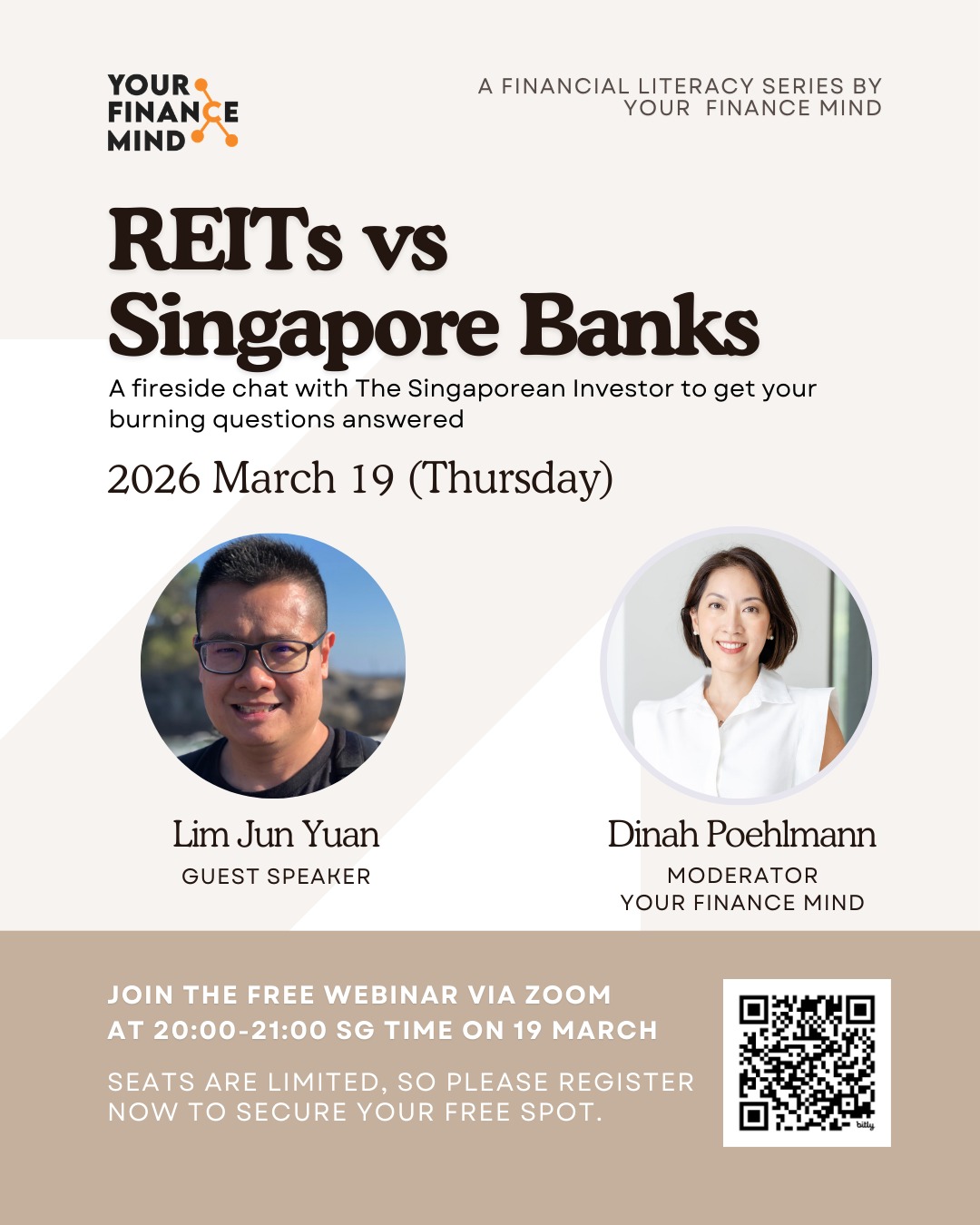
If you thought 2025 was a wild ride for the stock market, wait until you see 2026! With not only the uncertainty of interest rate changes and geopolitical tensions but also a military operation by Israel and the United States against Iran, it's set to be even more turbulent.
So, with all this in mind, which is the better choice for income investors: REITs or banks?
I'm honoured to be re-invited by Dinah Poehlmann from Your Finance Mind for a fireside chat on Zoom this year, where I'll be sharing my insights on this topic.
Join me on Thursday, 19 March 2026, from 8pm to 9pm, as I offer my thoughts and answer any questions you may have.
Best part? Registration is completely free! Secure your spot now through the link below:
👉 Sign Up Now and Mark Your Calendars
Are You Worried about Not Having Enough Money for Retirement?
You're not alone. According to the OCBC Financial Wellness Index, only 62% of people in their 20s and 56% of people in their 30s are confident that they will have enough money to retire.
But there is still time to take action. One way to ensure that you have a comfortable retirement is to invest in real estate investment trusts (REITs).
In 'Building Your REIT-irement Portfolio' which I've authored, you will learn everything you need to know to build a successful REIT investment portfolio, including a list of 9 things to look at to determine whether a REIT is worthy of your investment, 1 simple method to help you maximise your returns from your REIT investment, 4 signs of 'red flags' to look out for and what you can do as a shareholder, and more!

You can find out more about the book, and grab your copy (ebook or physical book) here...


Comments (2)