Brief Overview:
Mapletree Industrial Trust (SGX: ME8U), or MIT, has an investment focus on industrial (with its range of properties including hi-tech and business space buildings, along with general industrial buildings), and data centres.
As at 31 December 2025, MIT’s portfolio comprises 55 properties in North America (with the number inclusive of the 13 data centres held through the joint venture with its Sponsor, Mapletree Investments Pte Ltd), 79 properties in Singapore, and 2 properties in Japan.
In total, its properties are valued at S$8.5 billion.
Notable Developments Since the REIT’s 2Q FY2025/26 Business Update:
January 2026: The REIT received “AA-” credit ratings with a stable outlook from Japan Credit Rating Agency (JCR) and Rating and Investment Information (R&I).
Financial Figures (3Q FY2024/25 vs. 3Q FY2025/26):
| 3Q FY2024/25 | 3Q FY2025/26 | % Gain/Loss | |
| Gross Revenue (S$’mil) | $177.3m | $163.1m | -8.0% |
| Property Operating Expenses (S$’mil) | $44.1m | $40.3m | -8.6% |
| Net Property Income (S$’mil) | $133.2m | $122.8m | -7.8% |
| Distributable Income to Unitholders (S$’mil) | $97.1m | $90.5m | -6.8% |
MIT’s financial figures for the 3rd quarter on a year-on-year basis was a weaker one, with its gross revenue, net property income, and distributable income to unitholders all down by a mid- to high-single digit percentage, similar to the 2nd quarter.
The 8.0% and 7.8% year-on-year decline in its gross revenue and net property income to S$163.1 million and S$122.8 million was due to a combination of factors, including the absence of income from the divestment of 3 properties in Singapore completed in August 2025, non-renewal of leases in its North American Portfolio, as well as a weaker US Dollar against the Singapore Dollar.
However, this was partly offset by higher contribution from the Tokyo Property acquired in October 2024, and the completion of the final phase of fitting-out works at the Osaka Data Centre.
Property operating expenses was down by 8.6% year on year to S$40.3 million due to the absence of expenses in the 3 properties in Singapore which were divested, along with lower utility and property expenses at its Singapore Portfolio. This was partially offset by higher utility expenses at its North American Portfolio.
Finally, the 6.8% year-on-year tumble in MIT’s distributable income to unitholders to S$90.5 million was largely due to the absence of distribution of net gain from the divestment of the Tanglin Halt cluster.
Financial Figures (9M FY2024/25 vs. 9M FY2025/26):
| 9M FY2024/25 | 9M FY2025/26 | % Gain/Loss | |
| Gross Revenue (S$’mil) | $534.0m | $509.2m | -4.6% |
| Property Operating Expenses (S$’mil) | $133.7m | $128.8m | -3.7% |
| Net Property Income (S$’mil) | $400.2m | $380.4m | -4.9% |
| Distributable Income to Unitholders (S$’mil) | $291.4m | $274.8m | -5.7% |
Just like for the 3rd quarter, MIT’s financial figures for the first 9 months of FY2025/26 also fell compared to a year ago.
The REIT’s gross revenue and net property income fell by 4.6% and 4.9% year on year to S$509.2 million and S$380.4 million respectively for pretty much the same reasons as the 3rd quarter – the absence of income from the 3 properties in Singapore which were divested in August 2025, non-renewal of leases at its North American Portfolio, along with the depreciation of US Dollar against the Singapore Dollar. This was partially offset by higher revenue from the Tokyo property acquired in October 2024, and the completion of the final phase of fitting-out works at the Osaka Data Centre in May 2025.
Property operating expenses saw a 3.7% year-on-year drop to S$128.8 million, mainly attributed to lower property expenses with the divestment of 3 properties in Singapore, as well as lower utilities at its Singapore Portfolio, partially offset by higher market costs for new and renewal leases in the various clusters in Singapore, and higher property expenses from its Japan Portfolio.
Distributable income to unitholders was down by 5.7% year on year to S$274.8 million mainly due to the absence of distribution of net divestment gain from the Tanglin Halt cluster, and lower distribution from its joint venture (Mapletree Rosewood Data Centre Trust) as a result of higher borrowing costs from the repricing of matured interest rate swaps.
Portfolio Occupancy Profile (2Q FY2025/26 vs. 3Q FY2025/26):
| 2Q FY2025/26 | 3Q FY2025/26 | |
| Portfolio Occupancy (%) | 91.3% | 91.4% |
| Portfolio WALE (years) | 4.6 years | 4.5 years |
MIT’s portfolio occupancy inched up by 0.1 percentage point (pp) to 91.4% as a result of slight improvements in the occupancy rates of its Singapore properties (up from 92.6% in 2Q FY2025/26 to 93.0% in 3Q FY2025/26).
On the occupancy rate of its North American properties, it continued its downward decline every single quarter since 2Q FY2024/25 (at 90.9%) to 87.5% in the current quarter under review (3Q FY2025/26). I have sought clarifications from the REIT’s investors’ relations, along with their plans to navigate through the headwinds, when it released its financial results last quarter, and you can read all about it here.
Lease expiries are well-spaced out – where it has just 2.9% of leases due for renewal in the final quarter of FY2025/26, an average of 17.8% of leases due for renewal each year in the next 3 financial years (between FY2026/27 and FY2028/29), and 43.7% of leases due for renewal only in FY2029/30 or later.
Debt Profile (2Q FY2025/26 vs. 3Q FY2025/26):
| 2Q FY2025/26 | 3Q FY2025/26 | |
| Aggregate Leverage (%) | 37.3% | 37.2% |
| Interest Coverage Ratio (times) | 3.9x | 3.9x |
| Average Cost of Debt (%) | 3.0% | 3.1% |
| Average Term to Debt Maturity (years) | 3.0 years | 2.9 years |
| % of Borrowings Hedged at Fixed Rates (%) | 92.9% | 88.6% |
Total borrowings inched down by 0.3% compared to the previous quarter, resulting in a 0.1pp improvement in its aggregate leverage to 37.2%.
Debt maturity is well-staggered out in the financial years ahead – with 15%, 17%, and 25% of borrowings due for refinancing in 4Q FY2025/26, FY2026/27 and FY2027/28 respectively, and the remaining 43% of borrowings only due for refinancing in FY2028/29 or later.
Distribution Payout to Unitholders (3Q FY2024/25 vs. 3Q FY2025/26):
| 3Q FY2024/25 | 3Q FY2025/26 | % Gain/Loss | |
| Distribution Per Unit (S$’cents) | 3.41 cents | 3.17 cents | -7.0% |
Personally, the weakness in its distribution payout was expected, as in my last discussion with the IR (once again, you can read about it in full here), it was shared that weakness in the REIT’s distribution payout is likely to persist till the end of next financial year, due to the absence of divested properties, and lower occupancy at its data centre properties in North America.
If you are a unitholder of MIT, do take note of the following dates on its latest distribution payout:
Ex-Date: 04 February 2026
Record Date: 05 February 2026
Payout Date: 12 March 2026
Distribution Payout to Unitholders (9M FY2024/25 vs. 9M FY2025/26):
| 9M FY2024/25 | 9M FY2025/26 | % Gain/Loss | |
| Distribution Per Unit (S$’cents) | 10.21 cents | 9.62 cents | -5.8% |
CEO Ms Lily Ler’s Comments & Outlook (from the REIT’s Press Release):
“Our Singapore Portfolio and Japan Portfolio continued to provide a stable base for MIT’s performance supported by resilient occupancies and positive rental reversions. In the near term, we remain focused on managing the impact of downtime from non-renewal of leases in the North American Portfolio while executing strategic divestments and acquisitions to strengthen portfolio quality and resilience. We remain committed to achieving our divestment target of S$500 million to S$600 million in North America. As we execute our portfolio rebalancing strategy, we may see near-term transitional effects, which are temporary and necessary to drive sustainable returns.”
Closing Thoughts:
MIT’s latest quarter results was very much within my expectations, with its financial figures being impacted by weakness in its North American Portfolio (and this headwind is likely going to persist for another financial year, as the management look to divest or backfill the vacant spaces).
Occupancy rates of its properties in my opinion is very strong, where apart from its properties in North America (where the occupancy rate was 87.5%), its Singapore properties was at 93.0% and its Japan properties was fully occupied. Lease expiries in the years ahead are also well-spaced out, with no one single year where there is a huge percentage of leases due for renewal.
Finally, on its debt profile, it continues to be very healthy, with its aggregate leverage at 37.2%, with close to 90% of borrowings at fixed rates. Debt maturity is also well spread out, with more than 40% of its borrowings only due for refinancing in FY2028/29 or later.
Looking ahead at the 4th and final quarter, I expect MIT’s financial figures to be somewhere along the lines of the 3rd quarter, with its gross revenue, net property income, and distributable income down by a mid- to high-single digit percentage, due to the absence of income from the divested properties in Singapore, continued weakness in its North American portfolio, and a weaker US Dollar against the Singapore Dollar.
Other Mapletree REITs in Focus:
Mapletree Logistics Trust (SGX: M44U): 3Q & 9M FY2025/26 Results Review
Related Documents
Press Release
Financial Statements
Presentation Slides
Disclaimer: At the time of writing, I am a unitholder of Mapletree Industrial Trust.
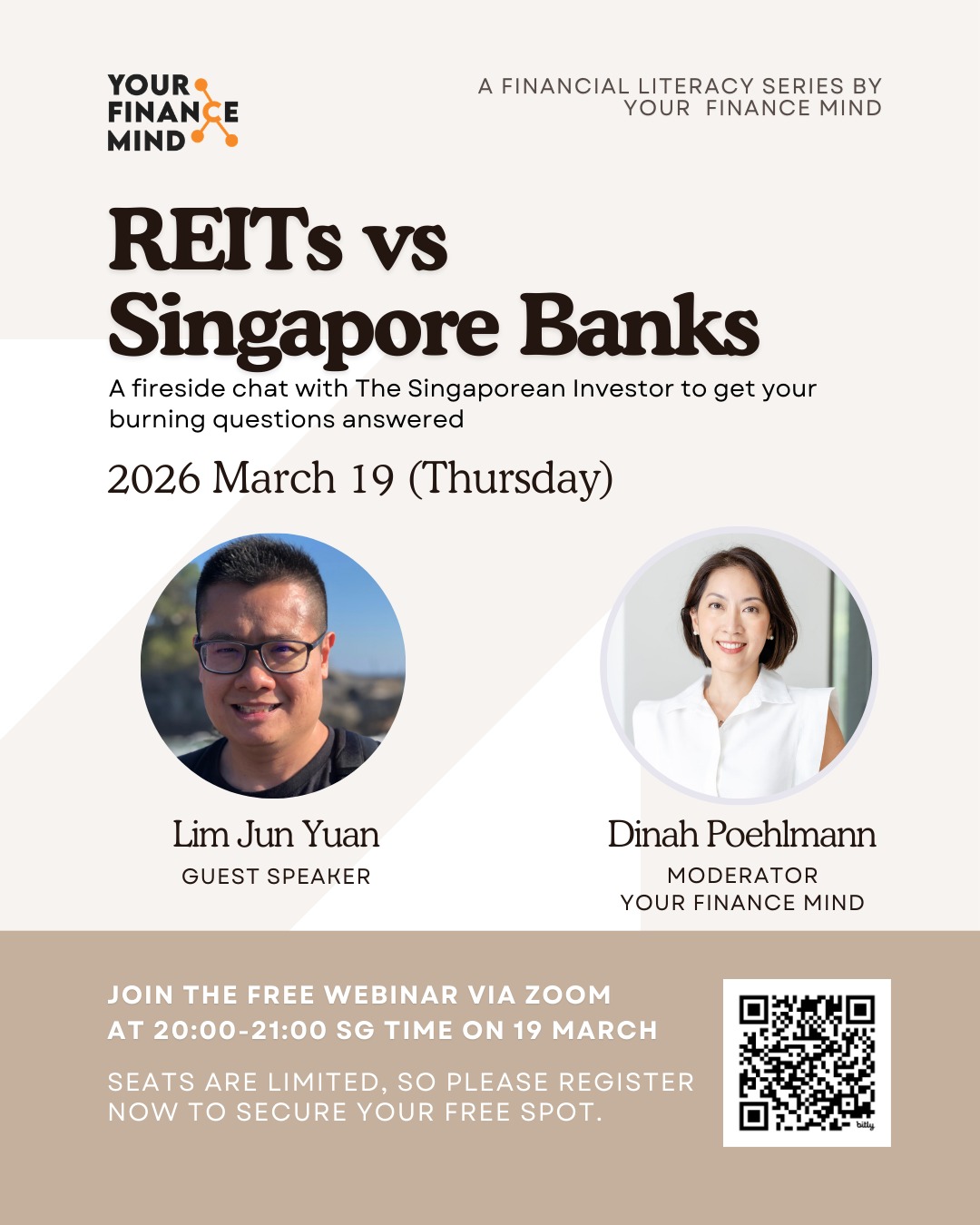
REITs vs Banks: Which Investment Delivers More for Income Seekers?
If you thought 2025 was a wild ride for the stock market, wait until you see 2026! With not only the uncertainty of interest rate changes and geopolitical tensions but also a military operation by Israel and the United States against Iran, it's set to be even more turbulent.
So, with all this in mind, which is the better choice for income investors: REITs or banks?
I'm honoured to be re-invited by Dinah Poehlmann from Your Finance Mind for a fireside chat on Zoom this year, where I'll be sharing my insights on this topic.
Join me on Thursday, 19 March 2026, from 8pm to 9pm, as I offer my thoughts and answer any questions you may have.
Best part? Registration is completely free! Secure your spot now through the link below:
👉 Sign Up Now and Mark Your Calendars
Are You Worried about Not Having Enough Money for Retirement?
You're not alone. According to the OCBC Financial Wellness Index, only 62% of people in their 20s and 56% of people in their 30s are confident that they will have enough money to retire.
But there is still time to take action. One way to ensure that you have a comfortable retirement is to invest in real estate investment trusts (REITs).
In 'Building Your REIT-irement Portfolio' which I've authored, you will learn everything you need to know to build a successful REIT investment portfolio, including a list of 9 things to look at to determine whether a REIT is worthy of your investment, 1 simple method to help you maximise your returns from your REIT investment, 4 signs of 'red flags' to look out for and what you can do as a shareholder, and more!

You can find out more about the book, and grab your copy (ebook or physical book) here...


Comments (0)