The final earnings season in the calendar year is currently underway. Following the REITs, the banks’ results are next in focus.
First up were DBS (SGX: D05) and UOB (SGX: U11), where they released their business update for the 3rd quarter and for the first 9 months of FY2025 last Thursday (06 November). This was followed by OCBC (SGX: O39) a day later (07 November). If you’ve missed out my review when they were posted, you can read them via the respective links below:
DBS: How Did DBS Group Holdings Limited Fare in 3Q and 9M FY2025?
UOB: My Analysis of United Overseas Bank Limited’s 3Q and 9M FY2025 Business Update
OCBC: Key Takeaways for Investors from OCBC’s 3Q and 9M FY2025 Business Update
A quick update – it was another resilient set of results reported by DBS, where they once again hit new highs on several fronts, particularly in its net fee and commission income, as well as in its total income for 3Q & 9M FY2025; OCBC also displayed a stable set of results, with its wealth management income hitting new highs for 3Q & 9M FY2025, along with its non-interest income for 9M FY2025.
What about UOB? If you ask me, it was a quarter to forget for the bank, where all its 3 reportable business segments (its net interest income, net fee & commission income, and its other non-interest income) all declined in 3Q. Not only that, the bank reported a huge spike in its allowance for credit and other losses, resulting in its net profit for 3Q reporting a 72.5% plunge compared to last year – for information, I’ve sent an email to the bank’s investors to seek clarification on this, as well as about its final dividend payout, and you can read about their response here.
Today, my focus is not on dissecting each of the bank’s results, as I’ve done so in my previous posts. Rather, my focus is on putting their percentage growth/decline side by side to find out which of the 3 Singapore banks had the strongest growth for the 3rd quarter, as well as for the first 9 months of FY2025.
At the same time, I’ll also be putting their current valuations side-by-side to do a comparison to find out which of the 3 Singapore banks is currently the ‘cheapest’, as well as the ‘most expensive’.
Let’s get started:
Financial Figures (3Q FY2024 vs. 3Q FY2025)
Net Interest Income:
| DBS | UOB | OCBC | |
| Net Interest Income | Down -0.5% 3Q FY2024: S$3,597m 3Q FY2025: S$3,578m | Down -7.9% 3Q FY2024: S$2,460m 3Q FY2025: S$2,265m | Down -8.5% 3Q FY2024: S$2,433m 3Q FY2025: S$2,226m |
With interest rates on a downward descent, it’s no surprise that all 3 banks saw a decline in their net interest income. However, among them, DBS had the smallest percentage decline.
Net Fee & Commission Income:
| DBS | UOB | OCBC | |
| Net Fee & Commission Income | Up +22.4% 3Q FY2024: S$1,109m 3Q FY2025: S$1,357m | Down -2.4% 3Q FY2024: S$630m 3Q FY2025: S$615m | Up +34.4% 3Q FY2024: S$508m 3Q FY2025: S$683m |
Only UOB saw a -2.4% year-on-year dip in its net fee & commission income due to card rewards expenses, while DBS and OCBC reported healthy year-on-year jumps. However, among the 2, OCBC had the stronger growth at +34.4%, compared to DBS’ +22.4%.
Other Non-Interest Income:
| DBS | UOB | OCBC | |
| Other Non- Interest Income | Down -4.8% 3Q FY2024: S$1,047m 3Q FY2025: S$997m | Down -30.4% 3Q FY2024: S$744m 3Q FY2025: S$518m | Up +3.0% 3Q FY2024: S$861m 3Q FY2025: S$887m |
Only OCBC saw an improvement in its other non-interest income (albeit just slightly, by +3.0%), from a higher trading income and in its insurance business.
Net Profit Attributable to Shareholders:
| DBS | UOB | OCBC | |
| Net Profit Attributable to Shareholders | Down -2.4% 3Q FY2024: S$3,027m 3Q FY2025: S$2,954m | Down -72.5% 3Q FY2024: S$1,610m 3Q FY2025: S$443m | Up +0.2% 3Q FY2024: S$1,974m 3Q FY2025: S$1,978m |
Once again, only OCBC saw a slight improvement in its net profit attributable to shareholders (by +0.2%), while the other 2 banks saw declines – for the case of DBS, it was due to the global minimum tax, and for UOB, it was due to the huge allowance for credit and other losses.
Financial Figures (9M FY2024 vs. 9M FY2025)
Net Interest Income:
| DBS | UOB | OCBC | |
| Net Interest Income | Up +2.0% 9M FY2024: S$10,696m 9M FY2025: S$10,907m | Down -3.0% 9M FY2024: S$7,223m 9M FY2025: S$7,009m | Down -6.1% 9M FY2024: S$7,300m 9M FY2025: S$6,854m |
As far as growth in its net interest income for 9M FY2025 goes, only DBS saw a slight +2.0% gain, while the other 2 banks saw declines.
Net Fee & Commission Income:
| DBS | UOB | OCBC | |
| Net Fee & Commission Income | Up +18.7% 9M FY2024: S$3,200m 9M FY2025: S$3,799m | Up +6.4% 9M FY2024: S$1,828m 9M FY2025: S$1,945m | Up +24.5% 9M FY2024: S$1,454m 9M FY2025: S$1,809m |
While all 3 banks saw an improvement in its net fee & commission income for 9M FY2025, but OCBC had the strongest growth, at +24.5%, followed by DBS, at +18.7%.
Other Non-Interest Income:
| DBS | UOB | OCBC | |
| Other Non- Interest Income | Down -1.1% 9M FY2024: S$2,896m 9M FY2025: S$2,863m | Down -12.2% 9M FY2024: S$1,782m 9M FY2025: S$1,565m | Up +1.3% 9M FY2024: S$2,304m 9M FY2025: S$2,335m |
OCBC is the ‘clear winner’ in this category, as they are the only bank that recorded an improvement in its other non-interest income (by +1.3%), while the other 2 banks’ other non-interest income declined.
Net Profit Attributable to Shareholders:
| DBS | UOB | OCBC | |
| Net Profit Attributable to Shareholders | Down -1.0% 9M FY2024: S$8,767m 9M FY2025: S$8,675m | Down -27.7% 9M FY2024: S$4,522m 9M FY2025: S$3,271m | Down -3.8% 9M FY2024: S$5,900m 9M FY2025: S$5,677m |
While all 3 banks saw declines in their net profit attributable to shareholders, but DBS has the recorded the smallest percentage of decline (at just -1.0%), compared to OCBC (at -3.8%).
Key Financial Ratios (2Q FY2025 vs. 3Q FY2025)
Let’s take a quick score at which bank edged out in terms of improvements in their financial performance for the 3Q and 9M FY2025 – it seems like OCBC ‘won’ quite handsomely this time round for having the strongest improvement in their net fee & commission income, and in its other non-interest income for 3Q and 9M FY2025, as well as in its net profit attributable to shareholders for 3Q.
Now, let us have a look at the banks’ key financial ratios. Will OCBC pull a further gap away from the other 2 banks? Let us find out below:
Net Interest Margin:
| DBS | UOB | OCBC | |
| Net Interest Margin | Down -0.09pp 2Q FY2025: 2.05% 3Q FY2025: 1.96% | Down -0.09pp 2Q FY2025: 1.91% 3Q FY2025: 1.82% | Down -0.08pp 2Q FY2025: 1.92% 3Q FY2025: 1.84% |
While all 3 banks saw their net interest margins decline, but OCBC edged out here by having a slightly smaller decline compared to DBS and UOB.
However, in terms of net interest margin, DBS has the highest, at 1.96%, compared to 1.84% for OCBC, and 1.82% for UOB.
Return on Equity:
| DBS | UOB | OCBC | |
| Return on Equity | Up +0.4pp 2Q FY2025: 16.7% 3Q FY2025: 17.1% | Down -7.6pp 2Q FY2025: 11.1% 3Q FY2025: 3.5% | Up +1.1pp 2Q FY2025: 12.3% 3Q FY2025: 13.4% |
In terms of return on equity, both DBS and OCBC saw improvements compared to the previous quarter. However, between the 2, OCBC saw a stronger growth (by +1.1pp).
However, in terms of which of the 3 banks had the highest return on equity, the honours go to DBS, at 17.1%, way ahead of the 2nd placed OCBC, at 13.4%.
Non-Performing Loans Ratio:
| DBS | UOB | OCBC | |
| Non-Performing Loans Ratio | No Change 2Q FY2025: 1.0% 3Q FY2025: 1.0% | No Change 2Q FY2025: 1.6% 3Q FY2025: 1.6% | No Change 2Q FY2025: 0.9% 3Q FY2025: 0.9% |
All 3 banks’ non-performing loans ratio remained unchanged from the previous quarter (which is a positive). However, among the 3, OCBC has the lowest non-performing ratio at just 0.9%.
Which of the 3 Singapore Banks Had the Strongest Growth in 3Q & 9M FY2025?
The answer is… OCBC, for having the strongest improvement in their net fee & commission income, and in its other non-interest income for 3Q and 9M FY2025, as well as in its net profit attributable to shareholders for 3Q.
At the same time, the bank also recorded the strongest improvement in its return on equity, smallest decline in its net interest margin, as well as having the lowest non-performing loans ratio.
Which of the 3 Singapore Banks is Currently the Cheapest, as well as the Most Expensive
To find out, let us put their valuations based on their closing prices at close last Friday, 07 November, side-by-side, as follows:
| DBS | UOB | OCBC | |
| Share Price | S$54.98 | S$33.86 | S$17.78 |
| P/E Ratio | 13.43 | 10.07 | 10.45 |
| P/B Ratio | 2.19 | 1.16 | 1.25 |
| Dividend Yield^^ | 4.04% | 6.05% | 5.68% |
^^ – The dividend yields for the 3 banks are computed based on their dividend payouts for FY2024 as follows: S$2.22/share for DBS, S$2.05/share for UOB, and S$1.01/share for OCBC.
No surprises as far as which bank is currently the ‘most expensive’ – once again its DBS, where it has the highest P/E and P/B ratios, and at the same time, the lowest dividend yield, compared to the other 2 banks.
What about at the other end of the spectrum – this time round, UOB is the ‘cheapest’, with its P/E and P/B ratios the lowest, and its dividend yield the highest among the 3 banks.
Closing Thoughts
Slow and steady wins the race – this is best said for OCBC, which emerged the ‘winner’ in terms of improvements in their financial figures and key financial ratios for the 3rd quarter, as well as for the first 9 months of FY2025.
As for valuations, OCBC is no longer the ‘cheapest’ this time round, but rather, it is UOB – where it has the lowest P/E and P/B ratios, and at the same time, the highest dividend yield among the 3 banks.
Personally, DBS and OCBC’s results are very much within my expectations, and I was disappointed with UOB’s numbers this time round. But I’m always someone with the belief that ‘one weak quarter does not break a company’. In terms of business fundamentals, UOB continues to remain very sound, and I’m satisfied with the reply by their investors’ relations on questions relating to the huge bump in allowances, as well as in its final dividend payout (you can read about it in a separate post here). That said, I’ll be monitoring its financial performances, and any latest developments surrounding the bank closely, and will raise relevant questions with the investors’ relation should the need to do so arises once again.
With that, I have come to the end of my post, where I compared the 3 banks’ latest 3Q and 9M FY2025 side-by-side to find out which has the strongest growth, and also which is currently the ‘cheapest’ and ‘most expensive’. Do note that all the opinions expressed in this post are purely mine which I’m sharing for educational purposes only. They do not constitute any buy or sell calls for any of the banks’ shares. You should always do your due diligence before you make any investment decisions.
Disclaimer: At the time of writing, I am a shareholder of DBS, UOB, and OCBC.
REITs vs Banks: Which Investment Delivers More for Income Seekers?
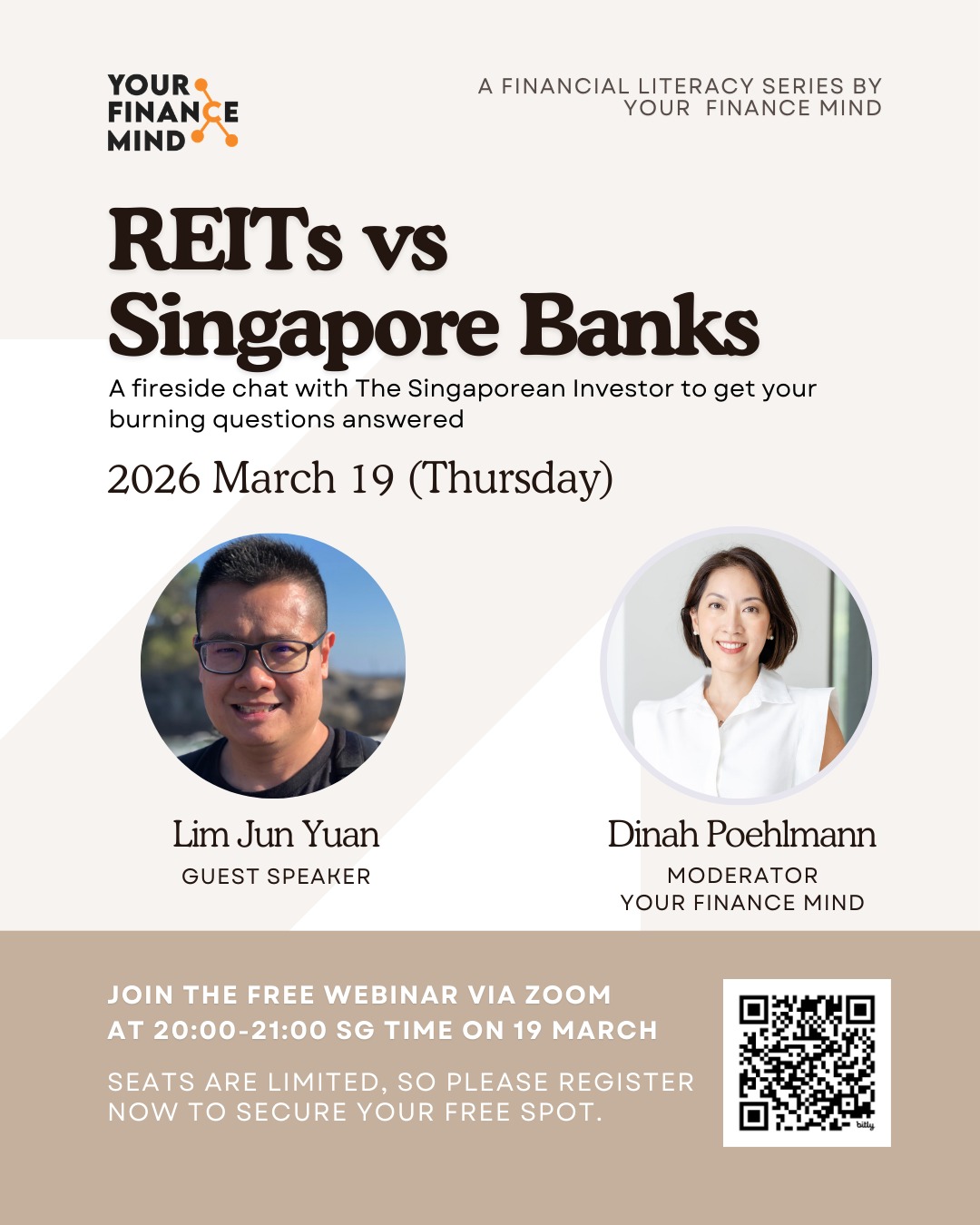
If you thought 2025 was a wild ride for the stock market, wait until you see 2026! With not only the uncertainty of interest rate changes and geopolitical tensions but also a military operation by Israel and the United States against Iran, it's set to be even more turbulent.
So, with all this in mind, which is the better choice for income investors: REITs or banks?
I'm honoured to be re-invited by Dinah Poehlmann from Your Finance Mind for a fireside chat on Zoom this year, where I'll be sharing my insights on this topic.
Join me on Thursday, 19 March 2026, from 8pm to 9pm, as I offer my thoughts and answer any questions you may have.
Best part? Registration is completely free! Secure your spot now through the link below:
👉 Sign Up Now and Mark Your Calendars
Are You Worried about Not Having Enough Money for Retirement?
You're not alone. According to the OCBC Financial Wellness Index, only 62% of people in their 20s and 56% of people in their 30s are confident that they will have enough money to retire.
But there is still time to take action. One way to ensure that you have a comfortable retirement is to invest in real estate investment trusts (REITs).
In 'Building Your REIT-irement Portfolio' which I've authored, you will learn everything you need to know to build a successful REIT investment portfolio, including a list of 9 things to look at to determine whether a REIT is worthy of your investment, 1 simple method to help you maximise your returns from your REIT investment, 4 signs of 'red flags' to look out for and what you can do as a shareholder, and more!

You can find out more about the book, and grab your copy (ebook or physical book) here...


Comments (2)