Founded in 1935 by 7 businessmen to serve the merchant community in Singapore, today, United Overseas Bank Limited (SGX: U11), or UOB as its more commonly known, currently have a global network of more than 470 offices in 19 markets in the Asia Pacific, Europe, and North America, with the bank currently ranked as one of the leading banks in Asia.
On top of that, it has also received high credit rating from the top credit rating agencies in the world – Aa1 by Moody’s Investors Service, and AA- by both S&P Global Ratings and Fitch Ratings.
The bank’s focus is on building the future of ASEAN – for the people and businesses within, as well as connecting with the region.
Similar to DBS (you can read my review of its 3Q & 9M FY2025 business update here), UOB also released its business update for the 3rd quarter, as well as for the first 9 months of FY2025 (ended 30 September) early this morning (06 November).
In this post, you will find my review of UOB’s latest financial figures, as well as its key financial ratios:
Financial Figures (3Q FY2024 vs. 3Q FY2025, and 9M FY2024 vs. 9M FY2025)
3Q FY2024 vs. 3Q FY2025:
| 3Q FY2024 | 3Q FY2025 | % Variance | |
| – Net Interest Income (S$’mil) | $2,460m | $2,265m | -7.9% |
| – Net Fee & Commission Income (S$’mil) | $630m | $615m | -2.4% |
| – Other Non-Interest Income (S$’mil) | $744m | $518m | -30.4% |
| Total Income (S$’mil) | $3,834m | $3,398m | -11.4% |
| Total Expenses (S$’mil) | $1,626m | $1,535m | -5.6% |
| Net Profit Attributable to Shareholders (S$’mil) | $1,610m | $443m | -72.5% |
Its obvious that UOB’s latest 3rd quarter results was a weaker one – with declines recorded in all 3 of its business segments.
Particularly, the 7.9% year-on-year drop in its net interest income to S$2,265 million was due to margin compression (as net interest margin fell by 0.23 percentage points to 1.82%). Net fee & commission income was down by 2.4% year on year to S$615 million from card rewards expenses, but partially offset by a strong growth in loan-related, wealth, and card activities. Other non-interest income plunged by 30.4% year on year to S$518 million from lower trading and investment income against record high levels last year.
Net profit attributable to shareholders sunk by 72.5% year-on-year to S$443 million due to a huge jump in allowance for credit and other losses (by close to 350% to S$1,361 million, from just S$304 million a year ago).
9M FY2024 vs. 9M FY2025:
| 9M FY2024 | 9M FY2025 | % Variance | |
| – Net Interest Income (S$’mil) | $7,223m | $7,009m | -3.0% |
| – Net Fee & Commission Income (S$’mil) | $1,828m | $1,945m | +6.4% |
| – Other Non-Interest Income (S$’mil) | $1,782m | $1,565m | -12.2% |
| Total Income (S$’mil) | $10,832m | $10,519m | -2.9% |
| Total Expenses (S$’mil) | $4,730m | $4,629m | -2.1% |
| Net Profit Attributable to Shareholders (S$’mil) | $4,522m | $3,271m | -27.7% |
Apart from its net fee & commission income (which improved by 6.4% year on year to S$1,945 million, a new high for the bank, driven by record contributions from wealth management and loan-related fees amid improving market sentiment and renewed consumer optimism), its net interest income and other non-interest income both declined. The same can also be said for its total revenue and net profit attributable to shareholders.
The 3.0% year-on-year decline in its net interest income was due to a 13 basis point contraction in its net interest margin to 1.91%, reflecting the impact of falling benchmark rates, while UOB’s other non-interest income fell by 12.2% year on year to S$1,565 million as trading and investment income normalised from last year’s exceptional levels.
As a result of a lower total income, and a huge jump in its allowance for credit and other losses (which skyrocketed 176.1% year on year to S$1,930 million, reflecting pre-emptive provisioning to strengthen coverage against macroeconomic uncertainties and sector-specific headwinds, alongside higher specific allowance for a few non-systemic corporate accounts), the bank’s net profit attributable to shareholders plunged by 27.7% year on year to S$3,271 million.
Key Financial Ratios (2Q FY2025 vs. 3Q FY2025)
Moving on to the key financial ratios (I’ll be looking at its net interest margin, return on equity, and its non-performing loans ratio), in the table below, you’ll find a comparison of these 3 ratios reported by UOB for the current quarter under review (i.e., 3Q FY2025 ended 30 September 2025) against that reported in the previous quarter 3 months ago (i.e., 2Q FY2025 ended 30 June 2025):
| 2Q FY2025 | 3Q FY2025 | Difference (in Percentage Points – pp) | |
| Net Interest Margin (%) | 1.91% | 1.82% | -0.09pp |
| Return on Equity (%) | 11.1%^^ | 3.5% | -7.6pp |
| Non-Performing Loans Ratio (%) | 1.6% | 1.6% | – |
^^ – This was self-calculated based on its return on equity for 1Q FY2025, as well as for 1H FY2025.
The 0.09pp drop in net interest margin was of no surprise, given the gradual decline in benchmark rates.
On the other hand, as a result of a plunge in UOB’s profit attributable to shareholders (by 66.9% compared to the previous quarter) from a surge in allowance for credit and other losses, its return on equity fell by 7.6pp to a multi-year low of 3.5%.
Finally, as far as non-performing assets are concerned, compared to the previous quarter, it was up by 7.8% to S$5,809 million. However, its non-performing loans ratio still remained at 1.6%.
CEO Mr Wee Ee Cheong’s Comments & Outlook (from the Bank’s Press Release)
“The Group achieved resilient third quarter results, reflecting the strength of our core franchise with continued momentum across loans, deposits, wealth AUM and fees.
From this position of strength, we proactively set aside general allowances to significantly enhance provision coverage, backed by our strong capital base. This move reinforces resilience and flexibility to navigate headwinds and sustain long term growth. By prioritising balance sheet strength, we stand ready to act, support customers and seize strategic growth opportunities. For shareholders, our share buyback and dividend commitments remain intact, and the pre-emptive allowance will not impact this year’s final dividend.
Looking ahead, ASEAN remains a key growth engine despite global uncertainties. We will continue to invest with discipline, stay nimble, and play to our strengths. We remain committed to growing our franchise, supporting our clients and delivering sustainable long-term value. We move forward with purpose and a clear strategy to deliver on our plans.”
Closing Thoughts
Overall, it was a disappointing set of ‘report card’ from UOB this time round – with the huge plunge in its profit attributable to shareholders (by 72.5% in the 3rd quarter, as well as by 27.7% in the 1st 9 months of FY2025, compared to a year ago) from a surge in allowances for credit and other losses was a negative surprise.
Of course, its all not negative for the bank – a slight positive can be seen in its net fee & commission income, as well as in its customer-related treasury income for 9M FY2025, which were at new highs for the bank.
Finally, as the bank has a half-yearly dividend payout policy, no dividends are declared this time round.
This brings me to the end of my review of UOB’s latest 3Q and 9M FY2025 business update. Do note that all the opinions found in this post are purely mine which I’m sharing for educational purposes only, and are not meant as any buy or sell calls for the bank’s shares. You are strongly advised to do your own due diligence before making any investment decisions.
Related Documents
Disclaimer: At the time of writing, I am a shareholder of United Overseas Bank Limited.
REITs vs Banks: Which Investment Delivers More for Income Seekers?
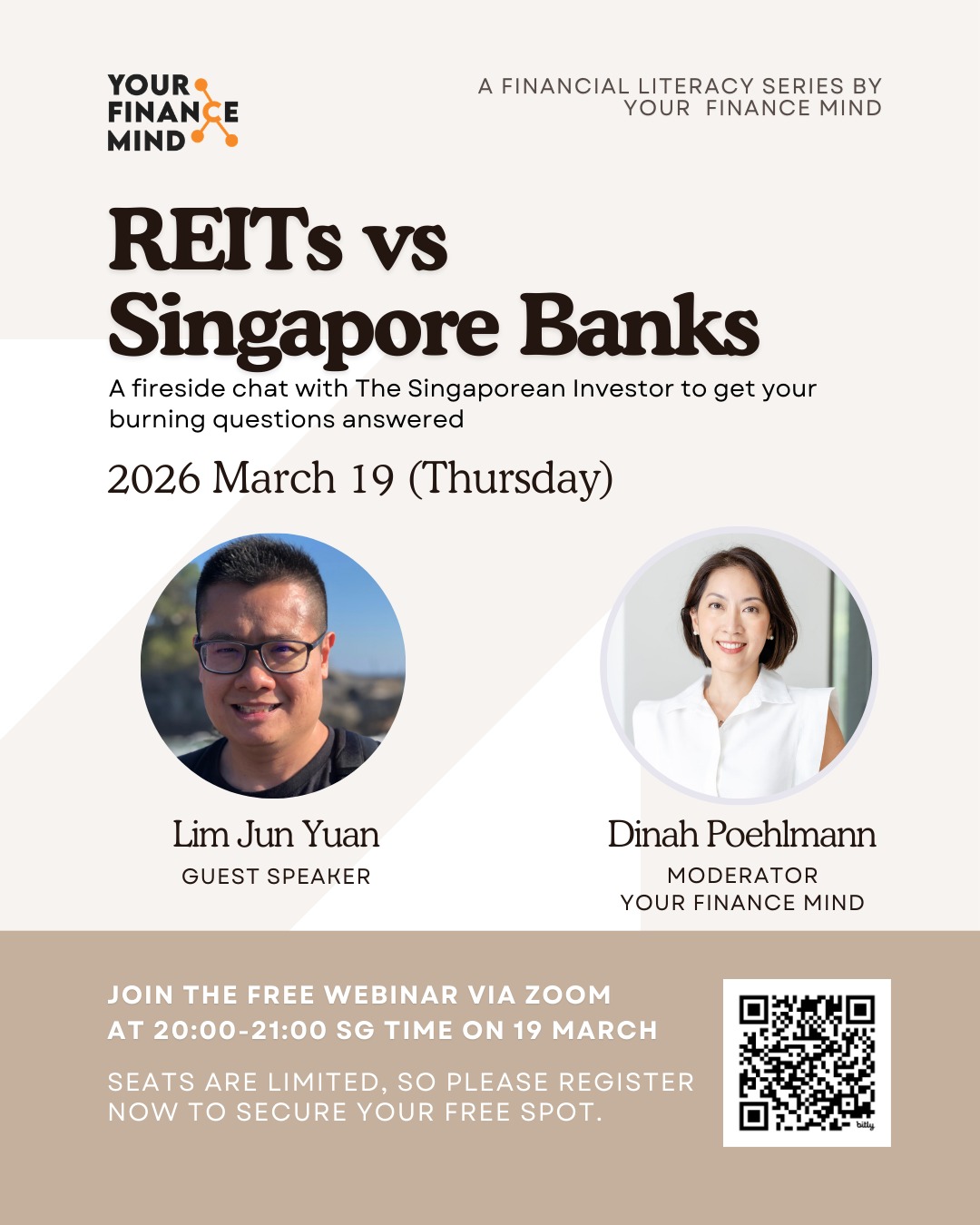
If you thought 2025 was a wild ride for the stock market, wait until you see 2026! With not only the uncertainty of interest rate changes and geopolitical tensions but also a military operation by Israel and the United States against Iran, it's set to be even more turbulent.
So, with all this in mind, which is the better choice for income investors: REITs or banks?
I'm honoured to be re-invited by Dinah Poehlmann from Your Finance Mind for a fireside chat on Zoom this year, where I'll be sharing my insights on this topic.
Join me on Thursday, 19 March 2026, from 8pm to 9pm, as I offer my thoughts and answer any questions you may have.
Best part? Registration is completely free! Secure your spot now through the link below:
👉 Sign Up Now and Mark Your Calendars
Are You Worried about Not Having Enough Money for Retirement?
You're not alone. According to the OCBC Financial Wellness Index, only 62% of people in their 20s and 56% of people in their 30s are confident that they will have enough money to retire.
But there is still time to take action. One way to ensure that you have a comfortable retirement is to invest in real estate investment trusts (REITs).
In 'Building Your REIT-irement Portfolio' which I've authored, you will learn everything you need to know to build a successful REIT investment portfolio, including a list of 9 things to look at to determine whether a REIT is worthy of your investment, 1 simple method to help you maximise your returns from your REIT investment, 4 signs of 'red flags' to look out for and what you can do as a shareholder, and more!

You can find out more about the book, and grab your copy (ebook or physical book) here...


Comments (0)