Listed on the Mainboard of the Singapore Exchange in December 2010, and subsequently included as one of the constituents of the country’s benchmark Straits Time Index (STI) in June 2020, Mapletree Industrial Trust (SGX: ME8U), or MIT, has an investment focus on real estate assets used for industrial (including hi-tech buildings, business space, and general industrial buildings), as well as for data centre purposes.
As of 30 September 2025 (2Q FY2025/26), MIT’s portfolio comprises 55 properties in North America (including 13 data centres held through the joint venture with its sponsor, Mapletree Investments Pte Ltd), 79 properties in Singapore, and 2 properties in Japan, worth a total of S$8.5 billion.
Since the release of its results for 1Q FY2025/26 in end-July (you can read my review about it here), the REIT has completed the divestment of 3 properties in Singapore (The Strategy, The Synergy, and the Woodlands Central Cluster) in mid-August, with the transaction amount at a 2.6% premium to its market valuation, and 22.1% increase from the original investment cost of the properties. Net proceeds of the divestments were used to repay outstanding borrowings (and this is projected to lower the REIT’s aggregate leverage from 40.1% as at 31 March 2025 to 37.0%, as well as improving its interest coverage ratio for the trailing 12 months from 4.3x to 5.1x).
Following Mapletree Logistics Trust (which released its 2Q & 1H FY2025/26 results on Tuesday (28 October) evening, and you can read my review about it here), MIT was next to do so last evening (29 October). In this post, you’ll find my review of the REIT’s latest set of financial figures, portfolio occupancy and debt profile, as well as its distribution payout to unitholders:
Financial Figures (2Q FY2024/25 vs. 2Q FY2025/26, and 1H FY2024/25 vs. 1H FY2025/26)
2Q FY2024/25 vs. 2Q FY2025/26:
| 2Q FY2024/25 | 2Q FY2025/26 | % Variance | |
| Gross Revenue (S$’mil) | $181.4m | $170.2m | -6.2% |
| Property Operating Expenses (S$’mil) | $46.9m | $46.2m | -1.5% |
| Net Property Income (S$’mil) | $134.5m | $124.0m | -7.8% |
| Distributable Income to Unitholders (S$’mil) | $96.4m | $91.0m | -5.6% |
It was a weaker set of results reported by MIT, with its gross revenue, net property income, and distributable income to unitholders all slid by around a mid-single digit percentage.
The 6.2% year-on-year drop in its gross revenue to S$170.2 million is mainly attributed to the loss of income from the divestment of 3 industrial properties in Singapore (with the transaction completed on 15 August 2025), non-renewal of leases in the North American portfolio, along with the depreciation of the United States Dollar against the Singapore Dollar. However, this was partially offset by higher revenue from the freehold mixed-use facility in Tokyo acquired on 29 October 2024, along with the completion of the final phase of fitting out works of the Osaka Data Centre on 2 May 2025.
MIT’s property operating expenses inched down by 1.5% year on year to S$46.2 million due to lower property expenses with the divestment of 3 industrial properties in Singapore, and lower utility expenses in its properties in Singapore. However, this was partially offset by higher property maintenance costs incurred by its Singapore properties during the quarter.
Finally, a 7.8% year-on-year decline in net property income (to S$124.0 million), absence of distribution of net gain from the divestment of the Tanglin Halt sector (115A & 115B Commonwealth Drive), lower cash distribution declared by the joint venture, Mapletree Rosewood Data Centre Trust, as a result of higher borrowing costs from the repricing of matured interest rate swaps and pre-termination of lease at one of the joint venture properties in the prior year, have resulted in the REIT’s distributable income to unitholders recording a 5.6% year-on-year drop to S$91.0 million.
1H FY2024/25 vs. 1H FY2025/26:
| 1H FY2024/25 | 1H FY2025/26 | % Variance | |
| Gross Revenue (S$’mil) | $356.7m | $346.1m | -3.0% |
| Property Operating Expenses (S$’mil) | $89.7m | $88.4m | -1.4% |
| Net Property Income (S$’mil) | $267.0m | $257.7m | -3.5% |
| Distributable Income to Unitholders (S$’mil) | $194.4m | $184.7m | -5.0% |
For the 1st half of FY2025/26, MIT’s financial figures also saw a low- to mid-single digit percentage drop.
Particularly, the 3.0% year on year dip in its gross revenue to S$346.1 million can be attributed to lower revenue from the North American portfolio due to the non-renewal of leases and the depreciation of the United States Dollar against the Singapore Dollar, along with the loss of income from the 3 industrial properties in Singapore which were divested. However, this was partially offset by higher revenue from the freehold mixed-use facility in Tokyo acquired in October 2024, along with the completion of the final phase of fitting-out works at Osaka Data Centre completed in May 2025.
Property operating expenses fell by 1.4% year on year to S$88.4 million from lower expenses incurred by its properties in Singapore and lower utility expenses, partially offset by higher marketing costs for new and renewal leases in the various Singapore clusters.
Distribution payout to unitholders declined by 5.0% year on year to S$184.7 million due to a lower net property income (which saw a 3.5% year-on-year drop to S$257.7 million), the absence of distribution of net divestment gains from the Tanglin Halt sector, and lower distribution from joint venture, Mapletree Rosewood Data Centre Trust, as a result of higher borrowing costs from the repricing of matured interest rate swaps and pre-termination of lease at one of the joint venture properties in the prior year.
Portfolio Occupancy Profile (1Q FY2025/26 vs. 2Q FY2025/26)
One headwind faced by MIT in recent quarters was the gradual decline of the occupancy rate of its properties in the United States – where it fell from a high of 90.9% in 2Q FY2024/25 (ended 30 September 2024) to a low of 88.0% in 1Q FY2025/26 (ended 30 June 2025). However, in terms of rental reversions, they are still in positive percentages.
The occupancy rates of the REIT’s properties in Singapore and Japan continue to remain at high levels – at 92.6% and at 100% respectively in 1Q FY2025/26.
In the table below, you’ll find a comparison of MIT’s portfolio occupancy profile for the current quarter under review (i.e., 2Q FY2025/26 ended 30 September 2025) compared against the previous quarter 3 months ago (i.e., 1Q FY2025/26 ended 30 June 2025):
| 1Q FY2025/26 | 2Q FY2025/26 | |
| Portfolio Occupancy (%) | 91.4% | 91.3% |
| Portfolio WALE (years) | 4.5 years | 4.6 years |
One thing to highlight – MIT’s portfolio occupancy have been on a gradual decline since a year ago (i.e., 2Q FY2024/25 ended 30 September 2024), where its occupancy rate was at 92.9%), to 91.3% in the current quarter under review.
Another area of concern was the continued decline in the occupancy of its properties in North America – where it inched down by another 0.2 percentage points (pp) to 87.8%.
Apart from that, the occupancy rates of its Singapore and Japan properties continue to remain at healthy levels – at 92.6% and 100.0% respectively, unchanged from the previous quarter.
As far as lease expiries ahead is concerned, they are well-spaced out – with 4.6% of leases due for renewal in the 2nd half of FY2025/26. Over the next 3 financial years (between FY2026/27 and FY2028/29), an average of 17.9% of leases will be due for renewal each year, with a bulk of leases (at 41.6%) only due for renewal only in FY2029/30 or later.
Debt Profile (1Q FY2025/26 vs. 2Q FY2025/26
Similar to how I have reviewed the REIT’s portfolio occupancy profile in the previous section, I will also be reviewing its debt profile by comparing the statistics reported for the current quarter under review (i.e., 2Q FY2025/26) against that reported in the previous quarter 3 months ago (i.e., 1Q FY2025/26), as follows:
| 1Q FY2025/26 | 2Q FY2025/26 | |
| Aggregate Leverage (%) | 40.1% | 37.3% |
| Interest Coverage Ratio (times) | 3.9x | 3.9x |
| Average Cost of Debt (%) | 3.1% | 3.0% |
| Average Term to Debt Maturity (years) | 3.2 years | 3.0 years |
| % of Borrowings Hedged at Fixed Rates (%) | 79.7% | 92.9% |
MIT’s debt profile have improved from the previous quarter – with its aggregate leverage down by 2.8pp to 37.3%, as divestment proceeds were used to pare down debt; at this level, it is a very healthy debt headroom to the regulatory limit of 50.0%.
Another notable improvement was the percentage of borrowings hedged at fixed rates, which jumped by 13.2pp to a high of 92.9% – at this level, MIT has the highest percentage of borrowings hedged at fixed rates among all the 40+ REITs and business trusts listed on the Singapore Exchange (to my knowledge).
The REIT’s debt maturity was also well-spread out – with 17% of borrowings due for refinancing in the 2nd half of FY2025/26, an average of 17% of borrowings due for refinancing each year over the next 3 financial years (between FY2026/27 and FY2028/29), and the remaining 31% of borrowings due for refinancing only in FY2029/30 or later.
Distribution Payout to Unitholders
MIT is one of the few Singapore REITs and business trusts that have continued to maintain a quarterly distribution payout frequency, since the Singapore Exchange removed the requirement for listed companies to report their full financial results on a quarterly basis in February 2020.
For the current quarter under review (i.e., 2Q FY2025/26), a distribution of 3.18 cents/unit was declared – a 5.6% drop from its payout of 3.37 cents/unit declared in the same time period a year ago (i.e., 2Q FY2024/25). This can be attributed to the absence of divestment gains from the Tanglin Halt cluster (with net gains distributed between 1Q FY2024/25 and 4Q FY2024/25). Excluding it, MIT’s distribution would have been down by 2.2% year on year.
If you are a unitholder of MIT, do take note of the following dates on its upcoming distribution payout:
Ex-Date: 05 November 2025
Record Date: 06 November 2025
Payout Date: 10 December 2025
Together with its payout of 3.27 cents/unit in the 1st quarter, MIT’s distribution payout for the 1st half of FY2025/26 amounts to 6.45 cents/unit – when compared against its payout of 6.80 cents/unit in 1H FY2024/25, this represented a 5.1% year-on-year decline.
CEO Ms Lily Ler’s Comments & Outlook (from the REIT’s Press Release)
“Against a backdrop of global macroeconomic uncertainty, we continue to strengthen MIT’s financial and operational resilience through proactive portfolio and capital management. During the quarter, we completed the divestment of three industrial properties in Singapore, further streamlining the portfolio and enhancing financial flexibility to pursue new growth opportunities. We remain committed to our expansion plan into data centre markets in Europe and Asia Pacific as we rebalance the portfolio for greater resilience. Looking ahead, our priorities remain centred on improving occupancies and redeploying capital into assets and markets through strategic divestments and acquisitions to drive sustainable returns.”
Closing Thoughts
It was a rather disappointing set of results reported by MIT this time round – with the only positive being its debt profile (where its aggregate leverage improved to a very healthy level of 37.3%, as divestment proceeds were used to pare down debt, along with the REIT having 92.9% of borrowings hedged to fixed rates).
In terms of its financial performance, the single-digit percentage drop can be attributed to weakness in its properties in North America, along with a weaker United States Dollar against the Singapore Dollar. And speaking of which, the occupancy rates for the properties there have continued to decline in the current quarter under review (compared against the previous quarter) – by 0.2pp to 87.8%. This has dragged down the REIT’s overall portfolio occupancy – where between 2Q FY2024/25 (ended 30 September 2024) and Q FY2025/26 (ended 30 September 2025), it has gone on a slow decline from 92.9% to 91.3%.
With the concerns about the REIT’s weakening performance of its North American properties in mind, I have submitted the following questions to its investors’ relation to seek for some clarifications (I’ll be updating this post with their response when I receive them):
[Update on 14 November 2025: I’ve had a discussion session with MIT’s Investor Relations team on the questions below, and you can find a summary of it here.]
1. I noticed that the occupancy rate of the North American properties has declined for consecutive quarters since 2Q FY2024/25 (ended 30 September 2024). This trend has also contributed to a lower overall portfolio occupancy during the same period.
Could you please elaborate on the reasons behind this continued decline – especially given that the current AI-driven demand should be a positive catalyst for data centres? Additionally, I would like to understand the management’s plans to address this trend, as it appears to have affected both financial performance and distribution payouts over recent quarters.
2. I was unable to find details on the revenue contribution (in percentage terms) of the North American portfolio to the REIT’s total gross revenue. Could you please share this figure for both the full year FY2024/25 (ended 31 March 2025) and 1H FY2025/26 (ended 30 September 2025)?
Moving forward, I will continue to keep a close watch on the performance of the REIT’s North American portfolio.
This brings me to the end of my review of MIT’s latest results for 2Q & 1H FY2025/26 ended 30 September. While I hope the contents presented in this post have given you a good understanding of the latest developments surrounding the industrial and data centre REIT, but do note that all the opinions within are purely mine which I’m sharing for educational purposes only. They do not constitute any buy or sell calls for the REIT’s units. Please do your own due diligence before you make any investment decisions.
Related Documents
Disclaimer: At the time of writing, I am a unitholder of Mapletree Industrial Trust.
REITs vs Banks: Which Investment Delivers More for Income Seekers?
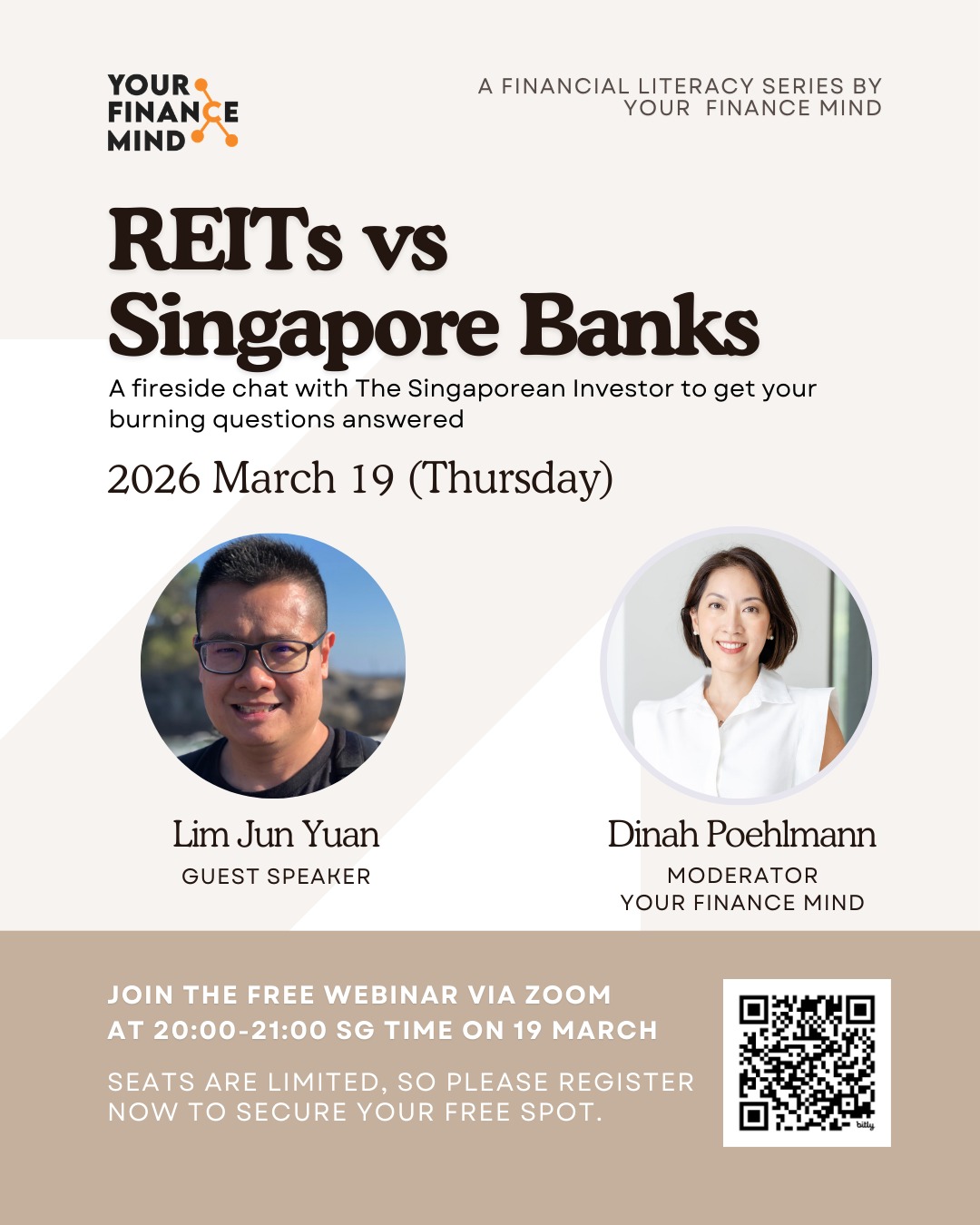
If you thought 2025 was a wild ride for the stock market, wait until you see 2026! With not only the uncertainty of interest rate changes and geopolitical tensions but also a military operation by Israel and the United States against Iran, it's set to be even more turbulent.
So, with all this in mind, which is the better choice for income investors: REITs or banks?
I'm honoured to be re-invited by Dinah Poehlmann from Your Finance Mind for a fireside chat on Zoom this year, where I'll be sharing my insights on this topic.
Join me on Thursday, 19 March 2026, from 8pm to 9pm, as I offer my thoughts and answer any questions you may have.
Best part? Registration is completely free! Secure your spot now through the link below:
👉 Sign Up Now and Mark Your Calendars
Are You Worried about Not Having Enough Money for Retirement?
You're not alone. According to the OCBC Financial Wellness Index, only 62% of people in their 20s and 56% of people in their 30s are confident that they will have enough money to retire.
But there is still time to take action. One way to ensure that you have a comfortable retirement is to invest in real estate investment trusts (REITs).
In 'Building Your REIT-irement Portfolio' which I've authored, you will learn everything you need to know to build a successful REIT investment portfolio, including a list of 9 things to look at to determine whether a REIT is worthy of your investment, 1 simple method to help you maximise your returns from your REIT investment, 4 signs of 'red flags' to look out for and what you can do as a shareholder, and more!

You can find out more about the book, and grab your copy (ebook or physical book) here...


Comments (0)