Listed on the Mainboard of the Singapore Exchange in December 2004, and currently in the Reserve List of Singapore’s Benchmark Straits Times Index (for the uninitiated, companies in this list have the potential of being included in the benchmark index should a constituent becomes ineligible), Suntec REIT (SGX: T82U) has an investment focus on retail and office properties in Singapore, Australia, as well as in the United Kingdom.
In Singapore, the REIT owns Suntec City, a 66.3% interest in Suntec Convention, as well as a one-third interest in One Raffles Quay, Marina Bay Financial Centres 1 & 2, and the Marina Bay Link Mall; In Australia, it owns 177 Pacific Highway (Sydney), 21 Harris Street (Sydney), 55 Currie Street (Adelaide), along with a 50% interest in Southgate Complex (Melbourne), and Olderfleet, 477 Collins Street (Melbourne); and finally in the United Kingdom, it owns The Minster Building (London), and a 50% interest in Nova Properties.
Since the release of its results for the 2nd quarter, as well as for the 1st half of FY2025 in late-July (you can read about it here), there are 2 updates surrounding the REIT to highlight:
- On 3rd September, the REIT disclosed that it has received a ruling that once again allowing its Australia entity, Suntec REIT (Australia) Trust, to continue enjoying the concessionary withholding tax regime of 10% or 15% on distributions (rather than the full tax rates of 30% for companies or up to 45% for trusts) – this concession was “lost” back in February as 2 major unitholders, Gordan Tang and his wife, Celine Tag, each accumulated stakes of 13.55% and 13.65% respectively, and in so doing, breaching the “< 10% foreign individual threshold” requirement for a concessionary withholding tax regime.
- After market hours on 30th September, it was announced that Ms Chew Gek Khim, will be retiring from her position as the Chairperson and non-executive director after 11 years in the position, with Mr David Matheson, who is ESR Group’s current chief investment officer, taking over with effect from 01 October 2025.
Last evening (23 October), Suntec REIT released its business update for the 3rd quarter, as well as for the first 9 months of FY2025 (ended 30 September). As an income investor, one of the things I’d be looking out for is whether the REIT is able to record a year-on-year improvement in its distribution payout once again (just like for the 1st and 2nd quarters, where its distribution payout rose by 3.4% and 4.0% on a year on year basis respectively).
In this post, you’ll find my review of its latest set of financial figures, portfolio occupancy and debt profile, along with its distribution payout to unitholders:
Financial Figures (3Q FY2024 vs. 3Q FY2025, and 9M FY2024 vs. 9M FY2025)
3Q FY2024 vs. 3Q FY2025:
| 3Q FY2024 | 3Q FY2025 | % Variance | |
| Gross Revenue (S$’mil) | $117.7m | $117.5m | -0.2% |
| Property Operating Expenses (S$’mil) | $37.9m | $39.0m | +2.9% |
| Net Property Income (S$’mil) | $79.8m | $78.5m | -1.6% |
| Distributable Income to Unitholders (S$’mil) | $46.2m | $52.4m | +13.4% |
Suntec REIT’s gross revenue and net property income dipped slightly (by -0.2% and -1.6% year on year to S$117.5 million and S$78.5 million respectively) as a result of a loss of revenue from the surrender of 3 floors at 177 Pacific Highway (Sydney) which has been backfilled, along with lower contribution from The Minster Building (London). This was partially offset by stronger operating performance in its Singapore properties.
On the other hand, its distributable income to unitholders rose by 13.4% year on year to S$52.4 million from stronger performance from its properties in Singapore, lower financing cost, along with the reversal of withholding tax provision (from the income received in its Australia properties).
9M FY2024 vs. 9M FY2025:
Suntec REIT did not provide the numbers for the first 9 months of FY2025. The following is self-compiled based on the numbers for the 1st 3 quarters of the respective financial years:
| 9M FY2024 | 9M FY2025 | % Variance | |
| Gross Revenue (S$’mil) | $344.6m | $352.0m | +2.1% |
| Property Operating Expenses (S$’mil) | $113.8m | $114.0m | +0.2% |
| Net Property Income (S$’mil) | $230.8m | $238.0m | +3.1% |
| Distributable Income to Unitholders (S$’mil) | $134.9m | $145.2m | +7.6% |
The commercial REIT’s financial figures for the first 9 months of FY2025 have recorded a stable growth, with its gross revenue and net property income improving by a low single-digit percentage (by +2.1% and +3.1% respectively), while its distributable income to unitholders increasing by a high single-digit percentage (by 7.6%).
Portfolio Occupancy Profile (2Q FY2025 vs. 3Q FY2025)
The occupancy rates of most of Suntec REIT’s properties have been maintained at a high rate of above 90%. Rental reversions for new and/or renewed leases have also been at positive rates (and this contributed to the stable growth of its financial results).
Has this trend managed to continue? Let us find out in the table below, where I’ll be comparing the occupancy statistics reported for the current quarter under review (i.e., 3Q FY2025 ended 30 September 2025) against that reported in the previous quarter 3 months ago (i.e., 2Q FY2025 ended 30 June 2025):
| 2Q FY2025 | 3Q FY2025 | Difference (in Percentage Points – pp) | |
| Singapore (Retail) | 98.0% | 99.3% | +1.3pp |
| Singapore (Office) | 99.0% | 98.5% | -1.5pp |
| Australia (Office & Retail) | 88.6% | 87.3% | -1.3pp |
| United Kingdom (Office) | 92.2% | 92.5% | +0.3pp |
As far as the occupancy rates of its properties in the various geographical location goes, it was a mixed bag – with improvements seen in its retail properties in Singapore, as well as in its office properties in London, but slight declines in its office properties in Singapore, as well as in its properties in Australia.
For its Singapore retail properties, the 1.3 percentage point (pp) improvement in its occupancy rate can be attributed to improvements recorded in both of its retail properties – for Suntec City Mall, its occupancy improved from 98.0% in 2Q FY2025 to 99.3% in 3Q FY2025, while the occupancy of Marina Bay Link Mall inched up from 97.8% in 2Q FY2025 to 98.3% in 3Q FY2025.
For its United Kingdom offices, the occupancy rate inched up by 0.3pp due to a slight improvement in The Minster Building (from 84.9% in 2Q FY2025 to 85.4% in 3Q FY2025). The Nova Properties have an occupancy rate of 100% in both quarters.
For its Singapore office portfolio, the 0.5pp dip in its occupancy rate was due to a slight decline in the occupancy rate of MBFC Towers 1 & 2 (from 99.0% in 2Q FY2025 to 96.0% in 3Q FY2025). The occupancy rates for Suntec City Office and One Raffles Quay are at 100% (an improvement from 99.5% in the previous quarter) and 97.2% (same as the previous quarter) respectively.
For its Australia portfolio, the 1.3pp dip in its occupancy rate was due to a slight decline in all of its properties (at rates of between -0.8% and -3.3%), except for 177 Pacific Highway (which remans 100% occupied).
Finally, in terms of rental reversion for new and/or renewed leases, they are all at positive percentages – at +8.6% for Singapore retail, +8.5 for Singapore office, and +11.9% for Australia retail and office – all of which will contribute to the further improvement in its financial performance in the quarters ahead.
Debt Profile (2Q FY2025 vs. 3Q FY2025)
If there’s one thing about Suntec REIT I have concerns over, it will be the debt profile – where its aggregate leverage is slightly on the high side (> 40%), and at the same time, its interest coverage ratio is on the low side (< 2.0x).
However, I noted some improvements in the previous quarter (i.e., 2Q FY2025), where its aggregate leverage dipped by 2.3pp from 43.4% in 1Q FY2025 to 41.1% in 2Q FY2025, and its interest coverage ratio also improved from 1.9x in 1Q FY2025 to 2.0x in 2Q FY2025.
Has the REIT’s debt profile continued to improve in 3Q FY2025 when compared against 2Q FY2025? Let us find out in the table below:
| 2Q FY2025 | 3Q FY2025 | |
| Aggregate Leverage (%) | 41.1% | 41.0% |
| Interest Coverage Ratio (times) | 2.0x | 2.0x |
| Average Term to Debt Maturity (years) | 3.2 years | 3.0 years |
| Average Cost of Debt (%) | 3.82% | 3.62% |
| % of Borrowings Hedged at Fixed Rates (%) | ~65% | ~66% |
Its encouraging to see Suntec REIT’s debt profile continuing to record further improvements compared to the previous quarter, in terms of its aggregate leverage, as well as in its average cost of debt – with the latter being one of the reasons for the improvement of its distribution payout.
As far as its debt maturity goes, it does not have any refinancing obligations in the final quarter of FY2025, and just 2.5% (or S$100 million) of borrowings due for refinancing in FY2026. Between FY2027 and FY2029 (a period of 3 financial years), it has an average of 28.1% of borrowings due for refinancing each year, with the remaining 13.1% of borrowings due for refinancing only in FY2030 or later.
Distribution Payout to Unitholders
Suntec REIT is one of the few Singapore REITs that have continued to declare a distribution payout to the unitholders on a quarterly basis – which is something income investors like myself desire, as we can receive our “pocket money” on a more regular basis.
As I’ve mentioned in the beginning of this post, after several quarters of year-on-year declines, the REIT’s distribution payout have finally recorded year-on-year improvements in the 1st and 2nd quarters of FY2025. How about for the 3rd quarter? Let us find out in the table below:
| 3Q FY2024 | 3Q FY2025 | % Variance | |
| Distribution Per Unit (S$’cents) | 1.580 cents | 1.778 cents | +12.5% |
As a unitholder, it’s definitely encouraging to see the REIT to be able to improve on its distribution payout for 3 consecutive quarters. Not just that, but in terms of percentage growth, it’s the highest in 3 quarters (in the first quarter, its distribution was up by 3.4%, and in the second quarter, it improved by 4.0%).
If you are a unitholder of Suntec REIT, do take note of the following dates on its distribution payout:
Ex-Date: 30 October 2025
Record Date: 31 October 2025
Payout Date: 28 November 2025
Finally, in terms of its distribution payout for the first 9 months of FY2025, its total payout of 4.933 cents/unit (comprising of 1.563 cents/unit in the 1st quarter, 1.592 cents/unit in the 2nd quarter, as well as 1.778 cents/unit in the 3rd quarter) is a 6.7% improvement compared to its total payout of 4.622 cents/unit a year ago.
CEO Mr Chong Kee Hiong’s Comments & Outlook (from the REIT’s Press Release)
“The continual growth in operating performances of the Singapore Office, Retail and Convention portfolios and stability in the United Kingdom portfolio highlight the strong fundamentals of our properties. This more than offset the weaker performances of some properties in our Australia portfolio, in line with the REIT’s diversification strategy to enhance income stability. We will continue to strengthen the operating performance of our properties to stay resilient amid challenging economic conditions.”
Closing Thoughts
On the whole, it was a positive set of numbers reported by Suntec REIT for the 3rd quarter, and for the first 9 months of FY2025 – particularly, this is the 3rd consecutive quarter where its distribution payout have recorded a year-on-year improvement (and not only that, in terms of its percentage growth, it is also the highest in 3 quarters), as well as in its debt profile (with its aggregate leverage and average cost of debt continuing to inch down). Its financial numbers for the first 9 months of FY2025 also displayed a stable growth.
However, there were some slight negatives seen in its financial figures for the 3rd quarter (which inched down slightly), along with the occupancy rate of its properties in Australia (where all but one of its properties recorded dips in its occupancy – and its something I will cast a watchful eye on in the coming quarters).
With that, I have come to the end of my review of Suntec REIT’s latest business update for the 3rd quarter, as well as for the first 9 months of FY2025. Do take note that all the opinions in this post are purely for educational purposes only. They do not serve as buy or sell recommendations for the REIT’s units. You should always do your own due diligence prior to making any investment decisions.
Related Documents
Disclaimer: At the time of writing, I am a unitholder of Suntec REIT.
REITs vs Banks: Which Investment Delivers More for Income Seekers?
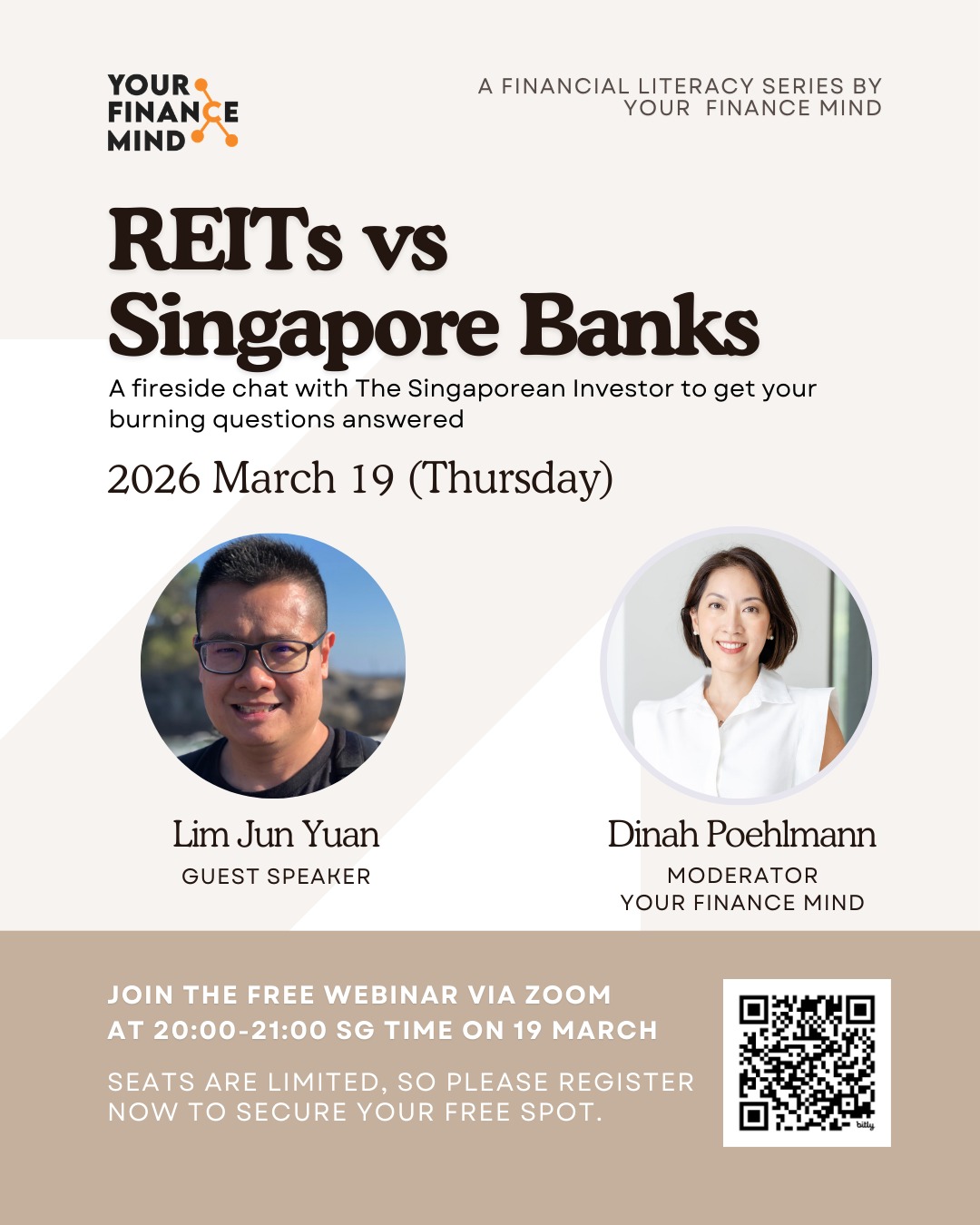
If you thought 2025 was a wild ride for the stock market, wait until you see 2026! With not only the uncertainty of interest rate changes and geopolitical tensions but also a military operation by Israel and the United States against Iran, it's set to be even more turbulent.
So, with all this in mind, which is the better choice for income investors: REITs or banks?
I'm honoured to be re-invited by Dinah Poehlmann from Your Finance Mind for a fireside chat on Zoom this year, where I'll be sharing my insights on this topic.
Join me on Thursday, 19 March 2026, from 8pm to 9pm, as I offer my thoughts and answer any questions you may have.
Best part? Registration is completely free! Secure your spot now through the link below:
👉 Sign Up Now and Mark Your Calendars
Are You Worried about Not Having Enough Money for Retirement?
You're not alone. According to the OCBC Financial Wellness Index, only 62% of people in their 20s and 56% of people in their 30s are confident that they will have enough money to retire.
But there is still time to take action. One way to ensure that you have a comfortable retirement is to invest in real estate investment trusts (REITs).
In 'Building Your REIT-irement Portfolio' which I've authored, you will learn everything you need to know to build a successful REIT investment portfolio, including a list of 9 things to look at to determine whether a REIT is worthy of your investment, 1 simple method to help you maximise your returns from your REIT investment, 4 signs of 'red flags' to look out for and what you can do as a shareholder, and more!

You can find out more about the book, and grab your copy (ebook or physical book) here...


Comments (0)