Following CapitaLand India Trust’s business update yesterday evening (you can read my review about it here), this morning (25 April), it is CapitaLand Integrated Commercial Trust’s turn to do so.
For those of you who are new to the Singapore-listed REIT, CapitaLand Integrated Commercial Trust (SGX: C38U), or CICT, is the country’s first and largest-listed REIT. It invests in real estate assets used for retail and office purposes.
As of 31 December 2024, CICT’s portfolio comprises 21 properties in Singapore, 2 properties in Frankfurt, Germany, and 3 properties in Sydney, Australia, worth a total of S$26 billion.
In this post, you’ll find my review of CICT’s latest business update for 1Q FY2025 ended 31 March (which is also the last under the current CEO, Mr Tony Tan; from 01 May 2025, the REIT will have a new CEO in Mr Tan Choon Siang, who is formerly the CEO of CapitaLand Malaysia Trust), with my focus on its latest financial figures, portfolio occupancy and debt profile:
Financial Figures (1Q FY2024 vs. 1Q FY2025)
| 1Q FY2024 | 1Q FY2025 | % Variance | |
| Gross Revenue (S$’mil) | $398.6m | $395.3m | -0.8% |
| Property Operating Expenses (S$’mil) | $104.9m | $103.8m | -1.0% |
| Net Property Income (S$’mil) | $293.7m | $291.5m | -0.7% |
CICT’s latest set of financial figures for the 1st quarter of FY2025 was a slightly weaker one, with both its gross revenue and net property income edging down by close to 1%, largely due to the absence of income from 21 Collyer Quay which was divested on 11 November 2024.
However, if you exclude the contributions from the property, the REIT’s gross revenue and net property income would have been up by 1.1% and 1.4% respectively.
Portfolio Occupancy Profile (4Q FY2024 vs. 1Q FY2025)
In the table below, you’ll find CICT’s portfolio occupancy statistics reported for the 1st quarter of FY2025 (ended 31 March 2025) compared against that reported in the previous quarter (i.e., the 4th quarter of FY2024 ended 31 December 2024):
| 4Q FY2024 | 1Q FY2025 | |
| Portfolio Occupancy (Retail) (%) | 99.3% | 98.8% |
| Portfolio WALE (Retail) (by GRI – years) | 2.0 years | 1.9 years |
| Portfolio Occupancy (Office) (%) | 94.8% | 94.7% |
| Portfolio WALE (Office) (by GRI – years) | 3.7 years | 3.5 years |
| Portfolio Occupancy (Integrated Development) (%) | 98.9% | 98.6% |
| Portfolio WALE (Integrated Development) (by GRI – years) | 4.5 years | 4.3 years |
Occupancy rates for its retail, office, and integrated development properties all inched down slightly for the current quarter under review (i.e., 1Q FY2025) compared to the previous quarter (i.e., 4Q FY2024). However, they are still maintained at well above 90%, hence I’m not concerned.
Lease expiries are also well-spread out – in the remaining 3 quarters of FY2025, it has 11.6% of retail leases and 3.9% of office leases due for renewal. Between FY2026 and FY2027 (a period of 2 financial years), it has an average of 16.2% of retail leases and 7.1% of office leases due for renewal each year. The remaining 12.3% of retail leases and 21.1% of office leases will be due for renewal only in FY2028 or later.
Finally, CICT has achieved a positive rental reversion for new/renewed leases for its retail and office properties in the quarter, at +10.4%, and +5.4% respectively.
Debt Profile (4Q FY2024 vs. 1Q FY2025)
Just like how I have reviewed CICT’s portfolio occupancy profile in the previous section, I will also be studying the REIT’s debt profile by taking the statistics reported in the current quarter under review (i.e., 1Q FY2025) and compare them against the statistics reported in the previous quarter (i.e., 4Q FY2024), and you can find them in the table below:
| 4Q FY2024 | 1Q FY2025 | |
| Aggregate Leverage (%) | 38.5% | 38.7% |
| Interest Coverage Ratio (times) | 3.1x | 3.2x |
| Average Term to Debt Maturity (years) | 3.9 years | 4.2 years |
| Average Cost of Debt (%) | 3.6% | 3.4% |
| % of Borrowings Hedged to Fixed Rates (%) | 81% | 78% |
Looking at CICT’s debt profile, it was a mixed bag – while its aggregate leverage inched up to 38.7% (a slight negative, but still a very healthy level to the regulatory limit of 50%), its average cost of debt came down by 0.2 percentage point (pp) from the previous quarter to 3.4%.
Even though there’s a slight decrease in the percentage of borrowings hedged to fixed rates (from 81% in the previous quarter to 78% in the current quarter), but its still a high level regardless.
On the REIT’s debt maturity profile, it is well-spread out over the years – in the remaining 3 quarters of FY2025 and coming financial year 2026 ahead, it has just 5% (or S$546 million) and 9% (or S$883 million) of borrowings due for refinancing respectively. Between FY2027 and FY2029 (a period of 3 financial years), it has approximately 18% of borrowings due for refinancing each year, with the remaining 33% of borrowings due for refinancing only in FY2030 or later.
Closing Thoughts
Overall, it was a slightly weaker results reported by CICT this time round.
Its gross revenue and net property income inched down by slightly (by close to 1%) due to the absence of contribution from 21 Collyer Quay, which was divested in November last year – if contributions from the property was excluded, both the REIT’s gross revenue and net property income would have been up slightly (by about 1+%).
Portfolio occupancy for the REIT’s retail, office, and integrated development properties also inched down slightly, but I’m not concerned as they are all still comfortably above 90%.
At the same time, CICT’s aggregate leverage also inched up slightly compared to the previous quarter (by 0.2pp to 38.7%), but at this level, it’s still considered very healthy – again, I’m not concerned.
Finally, in case you’re wondering, there’s no distributions declared by the management of CICT, as it pays out one on a half-yearly basis.
With that, I have come to the end of my review of CICT’s latest business update for the 1st quarter of FY2025. Do take note that all the opinions you’ve read in this post are purely mine which I’m sharing for educational purposes only. They do not represent any buy or sell calls for the REIT’s units. You should always do your own due diligence before you make any investment decisions.
Related Documents
Disclaimer: At the time of writing, I am a unitholder of CapitaLand Integrated Commercial Trust.
REITs vs Banks: Which Investment Delivers More for Income Seekers?
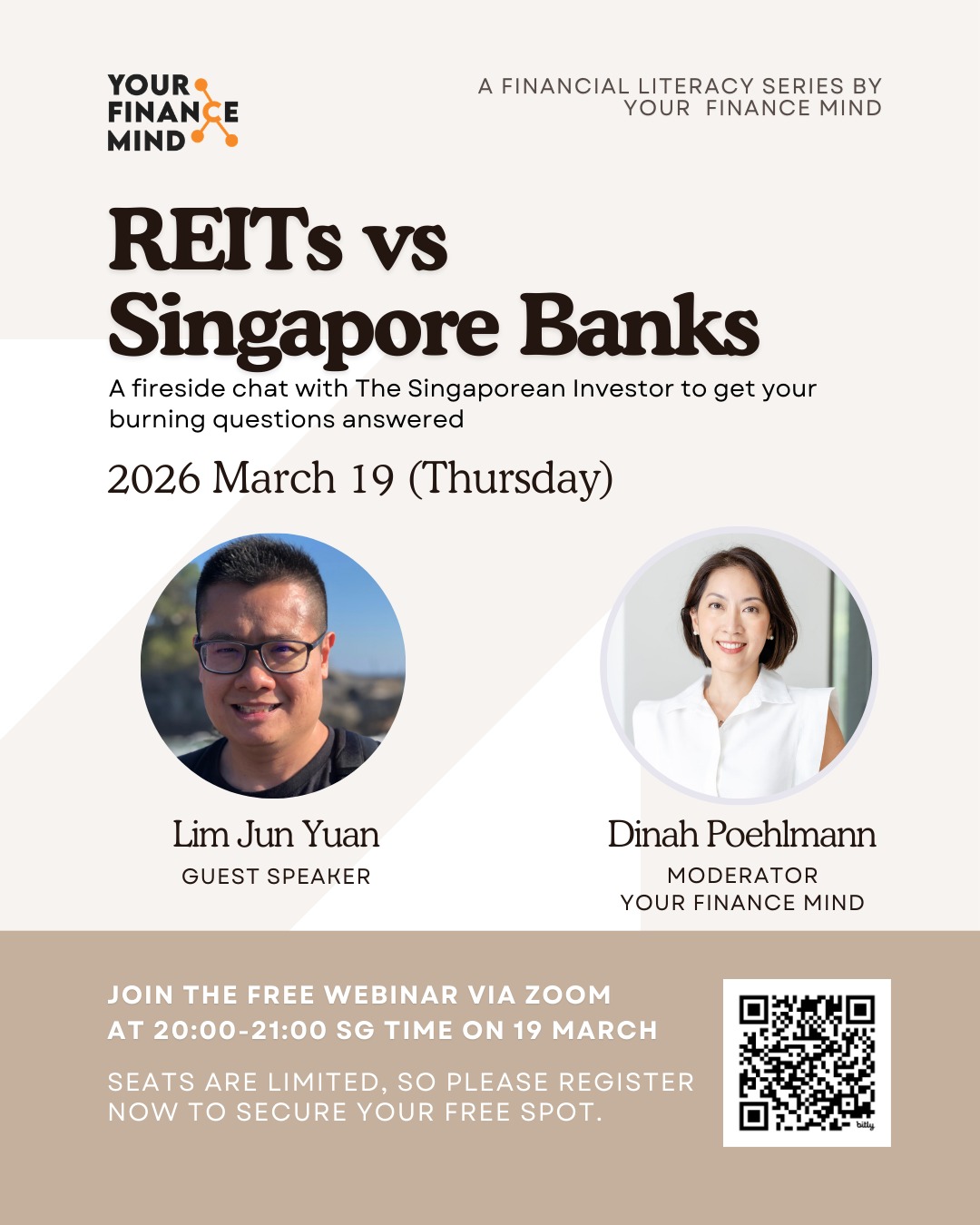
If you thought 2025 was a wild ride for the stock market, wait until you see 2026! With not only the uncertainty of interest rate changes and geopolitical tensions but also a military operation by Israel and the United States against Iran, it's set to be even more turbulent.
So, with all this in mind, which is the better choice for income investors: REITs or banks?
I'm honoured to be re-invited by Dinah Poehlmann from Your Finance Mind for a fireside chat on Zoom this year, where I'll be sharing my insights on this topic.
Join me on Thursday, 19 March 2026, from 8pm to 9pm, as I offer my thoughts and answer any questions you may have.
Best part? Registration is completely free! Secure your spot now through the link below:
👉 Sign Up Now and Mark Your Calendars
Are You Worried about Not Having Enough Money for Retirement?
You're not alone. According to the OCBC Financial Wellness Index, only 62% of people in their 20s and 56% of people in their 30s are confident that they will have enough money to retire.
But there is still time to take action. One way to ensure that you have a comfortable retirement is to invest in real estate investment trusts (REITs).
In 'Building Your REIT-irement Portfolio' which I've authored, you will learn everything you need to know to build a successful REIT investment portfolio, including a list of 9 things to look at to determine whether a REIT is worthy of your investment, 1 simple method to help you maximise your returns from your REIT investment, 4 signs of 'red flags' to look out for and what you can do as a shareholder, and more!

You can find out more about the book, and grab your copy (ebook or physical book) here...


Comments (2)