United Overseas Bank Limited, or UOB (SGX:U11) for short, was the first of the trio of Singapore Banks to have released its results for the 2nd quarter, and first half of the financial year ended 30 June 2023 early this morning (27 July 2023) – in case you’re wondering, DBS will be releasing its results next Thursday (03 August), and OCBC next Friday (04 August).
Before I proceed to look at the bank’s latest set of results, a quick introduction for those who may not be too familiar with its operations – incorporated in 1935, UOB is now not only a leading bank in Asia, but it is also rated as one of the world’s top banks (‘Aa1’ by Moody’s Investors Service and ‘AA-‘ by both S&P Global Ratings and Fitch Ratings). Operating through its head office in Singapore and banking subsidiaries in China, Indonesia, Malaysia, Thailand, and Vietnam, UOB has a global network of around 500 offices in 19 countries and territories in Asia Pacific, Europe, and North America.
In this post, you will read about my review of the Singapore-listed bank’s latest financial results and key financial ratios (Q2 FY2022 vs. Q2 FY2023, and 1H FY2022 vs. 1H FY2023), and its dividend payout to shareholders this time round.
Let’s begin:
Financial Results (1H FY2022 vs. 1H FY2023, and Q2 FY2022 vs. Q2 FY2023)
In this section, I will first review the Singapore bank’s results for the first half of the year (compared to the same time period last year), and then its results for the second quarter of the year (against that recorded in the second quarter of last year):
1H FY2022 vs. 1H FY2023:
| 1H FY2022 | 1H FY2023 | % Variance | |
| – Net Interest Income (S$’mil) | $3,549m | $4,846m | +36.5% |
| – Net Fee & Commission Income (S$’mil) | $1,139m | $1,075m | -5.6% |
| – Other Non-Interest Income (S$’mil) | $374m | $1,144m | > +100.0% |
| Total Income (S$’mil) | $5,061m | $7,065m | +39.6% |
| Total Expenses (S$’mil) | $2,241m | $2,889m | +28.9% |
| Net Profit Attributable to Shareholders (S$’mil) | $2,018m | $2,925m | +44.9% |
My Observations: Apart from a slight 5.6% dip in its net fee and commission income (as a result of softer lending and capital market activities, while cautious investor sentiments hampered wealth recovery, offset by credit card fees registering a new high, spurred by sustained card spending as well as the consolidation of Citigroup’s consumer business in 3 regional markets), I am sure you can agree with me that UOB’s results for the 1st half of FY2023 is a very strong one.
The 36.5% improvement in its net interest income can be attributed to a robust net interest margin, which expanded by 50 basis points to 2.13% on higher interest rates. Also, the surge in its other non-interest income was driven by a record high customer-related treasury income from increased hedging demands and good performance from trading and liquidity management activities.
A strong total income (which surged by 39.6% to S$7,065m), coupled with a slower rate of increase in its total expenses (by 28.9%), saw the bank’s net profit attributable to shareholders jumped by 44.9% to S$2,925m.
Q2 FY2022 vs. Q2 FY2023:
| Q2 FY2022 | Q2 FY2023 | % Variance | |
| – Net Interest Income (S$’mil) | $1,863m | $2,437m | +30.8% |
| – Net Fee & Commission Income (S$’mil) | $567m | $524m | -7.6% |
| – Other Non-Interest Income (S$’mil) | $273m | $581m | > +100.0% |
| Total Income (S$’mil) | $2,702m | $3,542m | +31.1% |
| Total Expenses (S$’mil) | $1,184m | $1,448m | +22.2% |
| Net Profit Attributable to Shareholders (S$’mil) | $1,113m | $1,415m | +27.1% |
My Observations: Looking at the Singapore bank’s results for the 2nd quarter of FY2023 (compared against the 2nd quarter of FY2022), it was also a strong one, with the only slight negative being the 7.6% decline in its net fee and commission income (as a result of lower loan-related fees and wealth management fees, as investor sentiments remained subdued; but this was offset by an increase in credit card fees).
The 30.8% growth in its net interest income was led by a 45 basis point expansion in net interest margin (from 1.67% in Q2 FY2022 to 2.12% in Q2 FY2023), while the surge in its other non-interest income was due to higher customer-related treasury income and strong performance from trading and liquidity management activities in the current quarter under review.
A higher percentage jump in its total income compared to its total expenses saw its net profit attributable to shareholders recording a 27.1% improvement to S$1,415m.
Key Financial Ratios (Q1 FY2023 vs. Q2 FY2023)
Whenever it comes to reviewing a bank’s financial ratios, I will be looking at the following:
(i) Net Interest Margin (%) – it is the difference between the interest it earns on loans, and the interest it pays on deposits;
(ii) Return on Equity (%) – it is a measure of how much profit the bank is able to generate for every shareholders’ money it uses;
(iii) Non-Performing Loans Ratio (%) – it is a financial metric to measure the percentage of a bank’s loans that are considered to be non-performing due to various reasons (e.g., borrower default, or fraud).
Also, I will compare the statistics reported for the quarter under review against the previous quarter 3 months ago (in this case, I will be comparing the key financial ratios of UOB reported for Q2 FY2023 ended 30 June 2023 against that reported in Q1 FY2023 ended 31 March 2023), and you can find the figures in the table below:
| Q1 FY2023 | Q2 FY2023 | Difference (in Percentage Points – pp) | |
| Net Interest Margin (%) | 2.14% | 2.12% | -0.02pp |
| Return on Equity (%) | 14.9% | 14.1% | -0.8pp |
| Non-Performing Loans Ratio (%) | 1.6% | 1.6% | – |
My Observations: The slight decline in its net interest margin compared to the last quarter was due to excess liquidity being deployed into higher quality lower yielding assets.
Even though return on equity saw a 0.8 percentage point (pp) decline, but in my opinion, it is still at a desirable percentage.
Dividend Payout to Shareholders (1H FY2022 vs. 1H FY2023)
For the first half of 2023, UOB’s management have declared a dividend payout of 85.0 cents/share, and a payout ratio of about 49%. Compared to its payout of 60.0 cents/share declared in the same time period last year (i.e., 1H FY2022), it represents a 41.7% increase – in-line with improvements made in its net profit attributable to shareholders.
If you are a shareholder of the bank, take note of the following dates on its dividend payout:
Ex-Date: 04 August 2023
Record Date: 07 August 2023
Payout Date: 18 August 2023
CEO Wee Ee Cheong’s Comments & Outlook (from the Bank’s Press Release)
“We have delivered a commendable set of results for the first half of the year, with record core net profit driven by strong net interest income and trading and investment income. Backed by our strong balance sheet, we see continued momentum in our client franchise expansion.
While the global outlook remains uncertain, we expect the Asean region to stay relatively resilient. Growth will be supported by a more moderate interest rate environment in this region and a pick-up in tourism and demand for services.
Our Citigroup acquisition is progressing well. Our strengthened market position and customer base open up more opportunities for global partnerships and enhanced offerings for our customers.
Amid these uncertain times, we are committed to supporting our customers and to delivering value to our stakeholders. We remain focused on investing and building our regional franchise for the long term.”
Closing Thoughts
I am pretty sure you will agree with me that UOB’s latest set of financial results (both for the 2nd quarter, as well as for the 1st half of the year) is a very strong one.
The 41.7% jump in dividend payout to 85.0 cents/share (1H FY2022: 60.0 cents/share) was a pleasant surprise for me, and looking at the comments in the various investment groups I am in, I can tell that shareholders are delighted with this.
With that, I have come to the end of my review of UOB’s results release for the first half of FY2023. Hope you have found the contents presented in this post useful, and as always, do note that all the opinion within are purely mine which I am sharing for educational purposes only, and does not imply any buy or sell calls for the bank’s shares. You are strongly encouraged to do your own due diligence before making any investment decisions.
Related Documents
Disclaimer: At the time of writing, I am a shareholder of United Overseas Bank Limited.
REITs vs Banks: Which Investment Delivers More for Income Seekers?
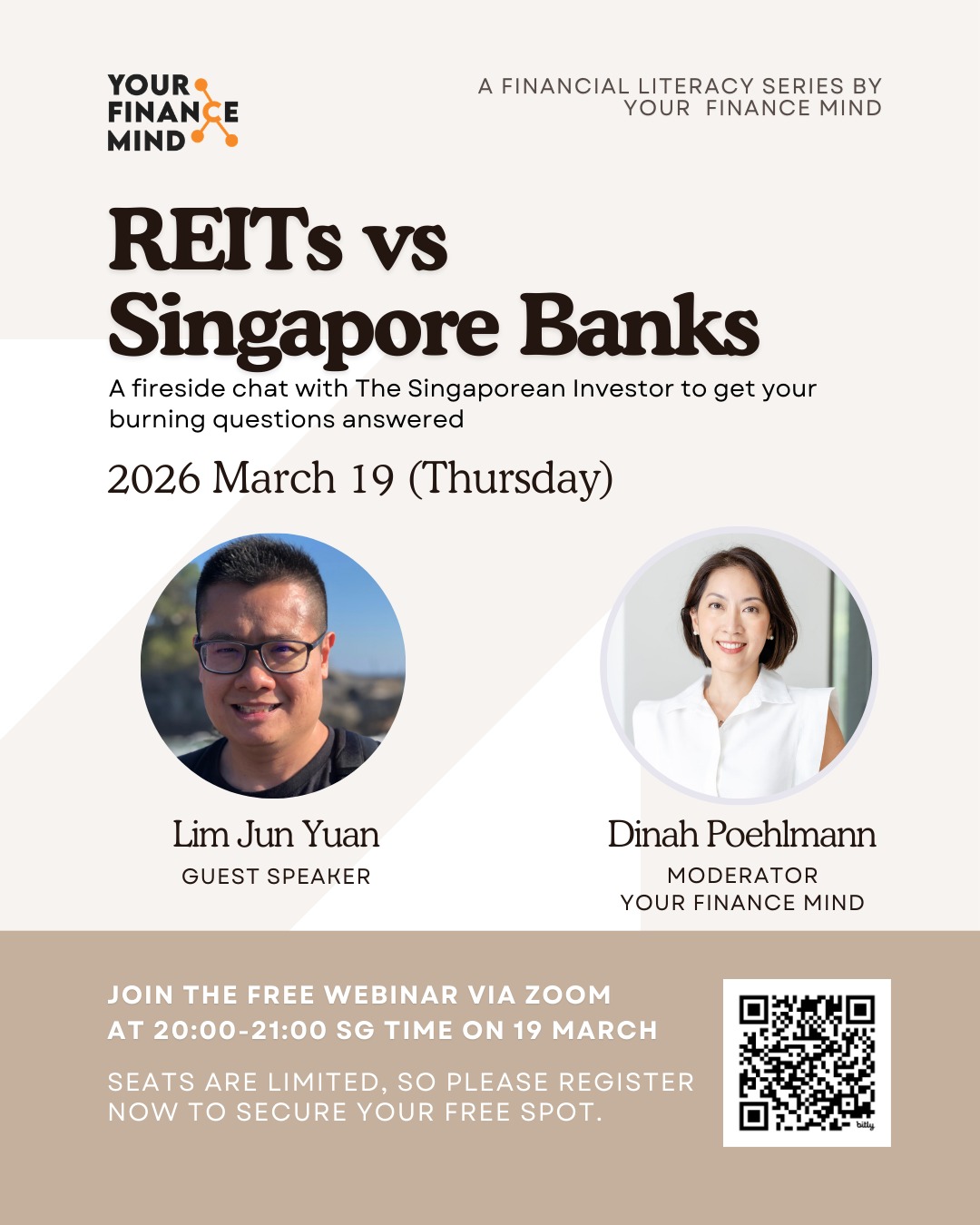
If you thought 2025 was a wild ride for the stock market, wait until you see 2026! With not only the uncertainty of interest rate changes and geopolitical tensions but also a military operation by Israel and the United States against Iran, it's set to be even more turbulent.
So, with all this in mind, which is the better choice for income investors: REITs or banks?
I'm honoured to be re-invited by Dinah Poehlmann from Your Finance Mind for a fireside chat on Zoom this year, where I'll be sharing my insights on this topic.
Join me on Thursday, 19 March 2026, from 8pm to 9pm, as I offer my thoughts and answer any questions you may have.
Best part? Registration is completely free! Secure your spot now through the link below:
👉 Sign Up Now and Mark Your Calendars
Are You Worried about Not Having Enough Money for Retirement?
You're not alone. According to the OCBC Financial Wellness Index, only 62% of people in their 20s and 56% of people in their 30s are confident that they will have enough money to retire.
But there is still time to take action. One way to ensure that you have a comfortable retirement is to invest in real estate investment trusts (REITs).
In 'Building Your REIT-irement Portfolio' which I've authored, you will learn everything you need to know to build a successful REIT investment portfolio, including a list of 9 things to look at to determine whether a REIT is worthy of your investment, 1 simple method to help you maximise your returns from your REIT investment, 4 signs of 'red flags' to look out for and what you can do as a shareholder, and more!

You can find out more about the book, and grab your copy (ebook or physical book) here...


Comments (0)