If you have been following my posts, you will probably notice how I, as a retail investor, keep track of key updates by companies I have shareholdings in (you can view my long-term investment portfolio here), where I study their latest financial results whenever they are released (and post them in separate posts, along with sharing my personal thoughts about it as a shareholder so that you can benefit from them as well.) I hope you have found my updates useful, and for those who are new to investing, you have a better idea of how you can keep track of your own investments.
After market hours last Friday (07 August), financial institution Hong Leong Finance Limited (SGX:S41) released its financial results for the first half of the financial year 2020 ended 30 June 2020 (the period of review was between 01 January and 30 June 2020.)
In this post, you will find a summary of the financial institution’s latest results release, along with my thoughts. Let’s begin…
Key Financial Results (1H FY2019 vs. 1H FY2020)
As the financial institution have switched to reporting its financial results on a half-yearly basis, there were no updates provided for the first quarter ended 31 March 2020.
Therefore, in this section you will only find a comparison of financial results recorded for 1H FY2020 against 1H FY2019, which is as follows:
| 1H FY2019 | 1H FY2020 | % Variance | |
| Total Income (S$’mil) | $109.1m | $87.1m | -20.2% |
| – Net Interest Income/ Hiring Charges (S$’mil) | $102.4m | $82.2m | -19.7% |
| – Fee & Commission Income (S$’mil) | $6.6m | $4.8m | -27.3% |
| – Other Operating Income (S$’mil) | $0.08m | $0.08m | – |
| Net Profit Attributable to Shareholders (S$’mil) | $52.5m | $36.5m | -30.5% |
Overall, the latest set of results reported by the financial institution was a weaker one on a year-on-year (y-o-y) basis.
While its other operating income remained consistent, its net interest income fell by 19.7%, which can be attributed to the softening of yields amid the plummeting interest rates environment and slowing business momentum towards the end of the second quarter due to the effects of the ongoing Covid-19 pandemic; its fee and commission income, on a y-o-y basis, tumbled by a bigger percentage (by 27.3%) as a result of lower fee income earned from both lending and non-lending activities in 2020. As such, its total income slumped by 20.2% y-o-y to S$87.1m.
Finally, as a result of the financial institution provisioning S$16.7m for net allowances for loans and other financial assets, its net profit attributable to shareholders saw a 30.5% y-o-y drop to S$36.5m.
My Thoughts: Given the current low interest rate environment, and headwinds arising as a result of the ongoing Covid-19 pandemic, the latest set of financial results was within my expectation.
I expect its financial results for the second half of 2020 to be weaker compared to 2019, where the drop in my opinion could be similar to that recorded in the first half of the year, or even worse, vastly depending on the situation of the Covid-19 pandemic.
Dividends Declared (1H FY2019 vs. 1H FY2020)
The financial institution declares a dividend payout for shareholders on a half-yearly basis, and its interim payout this time round, when compared against its interim payout for the same period last year, is as follows:
| 1H FY2019 | 1H FY2020 | % Variance | |
| Dividends Per Share (S$’cents) | 5.0 cents | 3.5 cents | -30.0% |
If you are a fellow shareholder of Hong Leong Finance, then you need to take note of the following dates:
Ex-dividend date: 24 August 2020
Record date: 25 August 2020
Payout date: 09 September 2020
Finally, just like the 3 Singapore banks, on 07 August, MAS also called on financial institutions like Hong Leong Finance to similarly cap their dividend payout in FY2020 to 60.0% of what was paid out last year, along with offering the option for shareholders to receive scrip (you can read the article regarding it on The Edge Singapore here.)
With regard to this, I understand from the financial institution’s results release that the board will review the rate of the final dividend payable for FY2020 in line with the cap.
My Thoughts: The total dividend payout for FY2019 was 15.0 cents/share. Based on a cap of 60.0% of the payout in FY2019, the total dividend payout in FY2020 will be 9.0 cents/share.
As the financial institution have already declared an interim payout of 3.5 cents/share, the final dividend should be around 5.5 cents/share (or even lesser depending on its financial performance in the second half of the year.)
In Conclusion
As I have mentioned earlier, the latest set of results did not come as a surprise to me, considering how the 3 Singapore banks also saw weaker sets of 1H results.
Related Documents
Disclaimer: At the time of writing, I am a shareholder of Hong Leong Finance Limited.
REITs vs Banks: Which Investment Delivers More for Income Seekers?
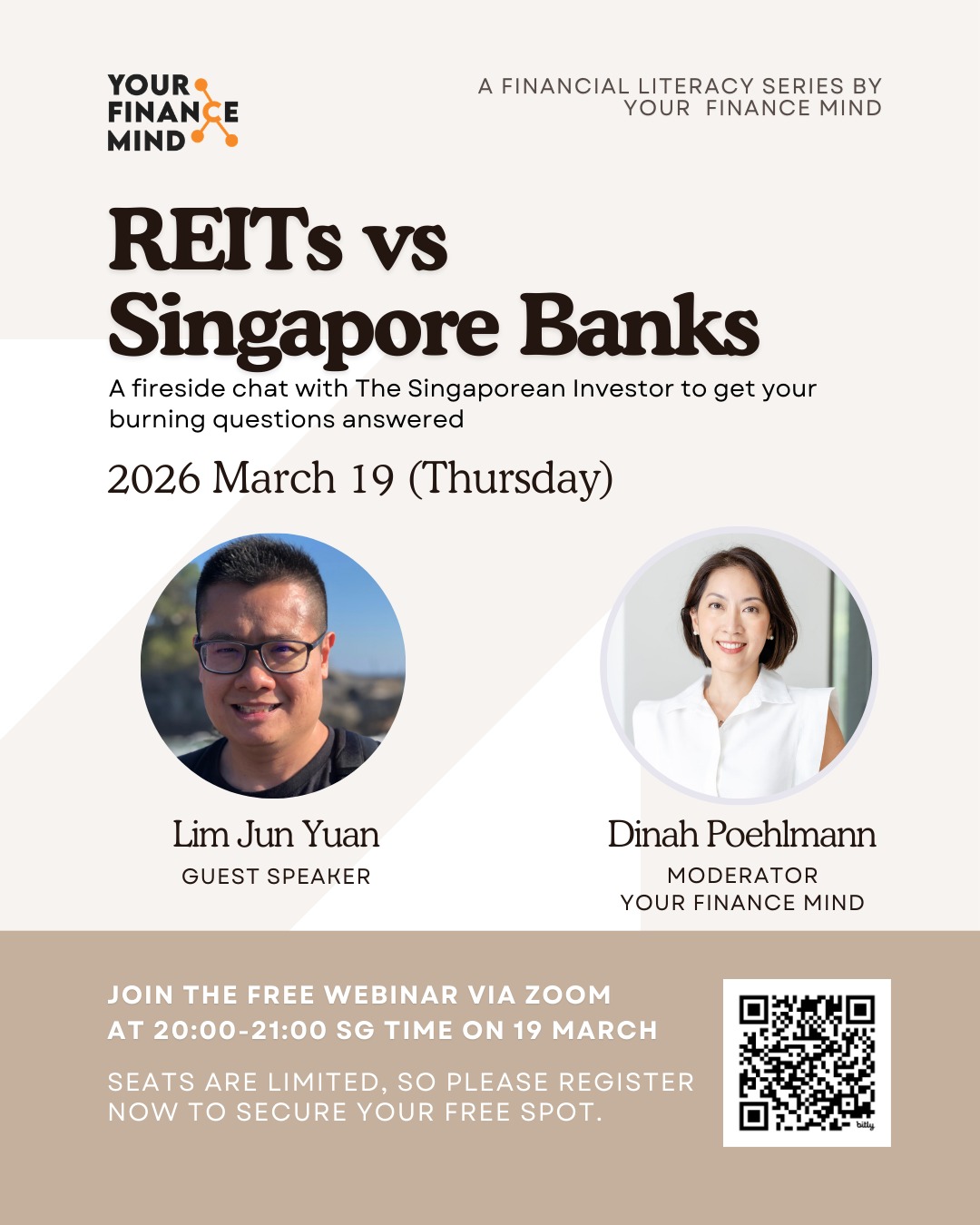
If you thought 2025 was a wild ride for the stock market, wait until you see 2026! With not only the uncertainty of interest rate changes and geopolitical tensions but also a military operation by Israel and the United States against Iran, it's set to be even more turbulent.
So, with all this in mind, which is the better choice for income investors: REITs or banks?
I'm honoured to be re-invited by Dinah Poehlmann from Your Finance Mind for a fireside chat on Zoom this year, where I'll be sharing my insights on this topic.
Join me on Thursday, 19 March 2026, from 8pm to 9pm, as I offer my thoughts and answer any questions you may have.
Best part? Registration is completely free! Secure your spot now through the link below:
👉 Sign Up Now and Mark Your Calendars
Are You Worried about Not Having Enough Money for Retirement?
You're not alone. According to the OCBC Financial Wellness Index, only 62% of people in their 20s and 56% of people in their 30s are confident that they will have enough money to retire.
But there is still time to take action. One way to ensure that you have a comfortable retirement is to invest in real estate investment trusts (REITs).
In 'Building Your REIT-irement Portfolio' which I've authored, you will learn everything you need to know to build a successful REIT investment portfolio, including a list of 9 things to look at to determine whether a REIT is worthy of your investment, 1 simple method to help you maximise your returns from your REIT investment, 4 signs of 'red flags' to look out for and what you can do as a shareholder, and more!

You can find out more about the book, and grab your copy (ebook or physical book) here...

Comments (4)