When it comes to investing in companies, my preference is towards those with a simple-to-understand business, and at the same time, has exhibited growth in its total revenue and net profit over a period of (at least) 5 years, with little or no debt (my preference is towards the latter.)
One company that came under my investment radar was this NASDAQ-listed company called iRobot Corporation (NASDAQ:IRBT) – I’m sure most of you should have heard of this company before, where they are the makers of robot vacuums.
Starting off from its Roomba vacuum in 2002, iRobot Corporation has since sold over 30 million robots and it is now the leading global consumer robot company (according to the company’s website.) Currently, their range of products consist of the following robot families: (i) Roomba vacuuming robots at varying price points based on features and performance characteristics; (ii) Brava family of automatic floor mopping robots designed specifically for hard-surface floors; (iii) Terra, a robotic lawn mower (in Terra t7), which is designed to mow as well as avoid obstacles, and cut in efficient straight lines; and (iv) Root, where, with the company’s acquisition of Root Robotics in April 2019, they now have a robot designed to help children learn how to code.
Now that you have a brief understanding of the company’s businesses, in the sections below, you will learn about its historical financial performance, along with its debt profile, and dividend payout over the past 6 years (between FY2015 and FY2020) to find out whether or not the company makes a good addition to your investment portfolio…
Financial Performance
The company has a financial year-end every Saturday closest to 31 December. In this section, you will find some of the key financial statistics recorded between FY2015 and FY2020 to take note of:
Total Revenue and Net Profit (US$’mil):
| FY2015 | FY2016 | FY2017 | FY2018 | |
| Total Revenue (US$’mil) | $617m | $661m | $884m | $1,093m |
| Net Profit (US$’mil) | $44m | $42m | $51m | $88m |
| FY2019 | FY2020 | |||
| Total Revenue (US$’mil) | $1,214m | $1,430m | ||
| Net Profit (US$’mil) | $85m | $147m |

iRobot Corporation’s total revenue have recorded year-on-year (y-o-y) improvements in all of the 6 years I have looked at – growing at a compound annual growth rate (CAGR) of 15.0%.
In terms of its net profit, small dips were seen in FY2016 and FY2019, but between FY2015 and FY2020, it still managed to grow at a CAGR of 22.2%.
Gross and Net Profit Margin (%):
The following table is iRobot Corporation’s gross and net profit margins over a 6-year period I’ve computed:
| FY2015 | FY2016 | FY2017 | FY2018 | |
| Gross Profit Margin (%) | 46.8% | 51.7% | 49.0% | 50.8% |
| Net Profit Margin (%) | 7.1% | 6.3% | 5.8% | 8.1% |
| FY2019 | FY2020 | |||
| Gross Profit Margin (%) | 44.8% | 46.9% | ||
| Net Profit Margin (%) | 7.0% | 10.3% |

The company’s gross profit margin have mostly fluctuated between 45.0% and 50.0% over the past 6 years; on the other hand, its net profit margin have recorded irregular growth in the same time period.
Return on Equity (%):
In layman terms, Return on Equity (RoE) refers to the amount of profits (in percentage terms) the company is able to generate for every dollar of shareholders’ money it uses in its businesses.
The following table is iRobot’s RoE between FY2015 and FY2020 which I’ve computed:
| FY2015 | FY2016 | FY2017 | FY2018 | |
| Return on Equity (%) | 10.6% | 10.8% | 10.8% | 16.4% |
| FY2019 | FY2020 | |||
| Return on Equity (%) | 13.1% | 18.3% |

Apart from in FY2019, where its RoE fell by 3.3 percentage points (compared to the previous year), over a 6-year period, iRobot Corporation’s RoE have grown pretty steadily – and, at 18.3% recorded in FY2020, it is also the highest.
Debt Profile
As I have shared in the beginning of this post, apart from the company’s financial performance, another area about the company I look at is its debt profile, where my preference is towards companies with little or no debt.
Looking at iRobot Corporation’s debt profile recorded over the past 6 years, I noticed the company does not have any borrowings – as such, it is in a net cash position in all of the of 6 years I have looked at.
With that, the following is the company’s net cash position recorded between FY2015 and FY2020:
| FY2015 | FY2016 | FY2017 | FY2018 | |
| Net Cash (US$’mil) | $180m | $215m | $129m | $130m |
| FY2019 | FY2020 | |||
| Net Cash (US$’mil) | $239m | $433m |

From a low of US$129m in FY2017, iRobot Corporation’s net cash position have recorded improvements every single year since, where, at US$433m in FY2020, it is also the highest over a 6-year period.
Dividend Payout
The company has not paid out any dividends over the past 6 years.
Is iRobot Corporation’s Share Price Considered ‘Cheap’ or ‘Expensive’ over the Past 6 Years?
To find out whether or not a company’s current share price is considered ‘cheap’ or ‘expensive’, I will compare its current valuations (based on its current share price) against its average valuations over the years.
The following table is iRobot Corporation’s valuations over the past 6 years (between FY2015 and FY2020) I’ve computed, along with its average:
| FY2015 | FY2016 | FY2017 | FY2018 | |
| P/E Ratio | 24.1 | 39.5 | 43.3 | 26.5 |
| P/B Ratio | 2.5 | 4.1 | 4.6 | 4.2 |
| FY2019 | FY2020 | Average | ||
| P/E Ratio | 17.6 | 15.6 | 27.8 | |
| P/B Ratio | 2.3 | 2.8 | 3.4 |
At the time of writing, iRobot Corporation was trading at US$119.15. As such, its current valuations (taken from ShareInvestor’s WebPro platform) is as follows:
P/E Ratio: 22.8
P/B Ratio: 4.2
Comparing its current valuations against its 6-year average, while its current P/B ratio is higher than its average, its current P/E ratio is lower than its average – as such, the current traded price of the company is considered to be neither ‘cheap’ nor ‘expensive.’
In Conclusion
A growing top- and bottom-line over the past 6 years, along with it being in a net cash position with no borrowings are reasons why I like the US-listed company.
If I have to name one thing I do not quite like the company, it will be its fluctuating net profit margin.
With that, I have come to the end of my share about iRobot Corporation. I hope you find the read useful and a disclaimer that everything which you’ve just read above is purely for educational purposes only, and they do not constitute any buy or sell recommendations for the shares of the company. Please do your own due diligence before you make any investment decisions.
Disclaimer: At the time of writing, I am not a shareholder of iRobot Corporation.
Stop Spending Hours Reading REIT Reports Every Quarter!
What if you could assess a REIT's portfolio occupancy, debt profile, valuation, and overall health in less than 30 seconds - without having to comb through a single quarterly report?
That's the problem the REIT Screener was built to solve.
Developed through a collaboration between ShareInvestor and The Singaporean Investor, the REIT Screener consolidates many of the key metrics and indicators I personally use when analysing REITs into one easy-to-use platform. Instead of spending hours extracting data manually every earnings season, you can now monitor the REITs you own and research new opportunities in just a few clicks.
If you're serious about REIT investing but don't have the time to manually track quarterly developments, the REIT Screener could be the shortcut you've been looking for:
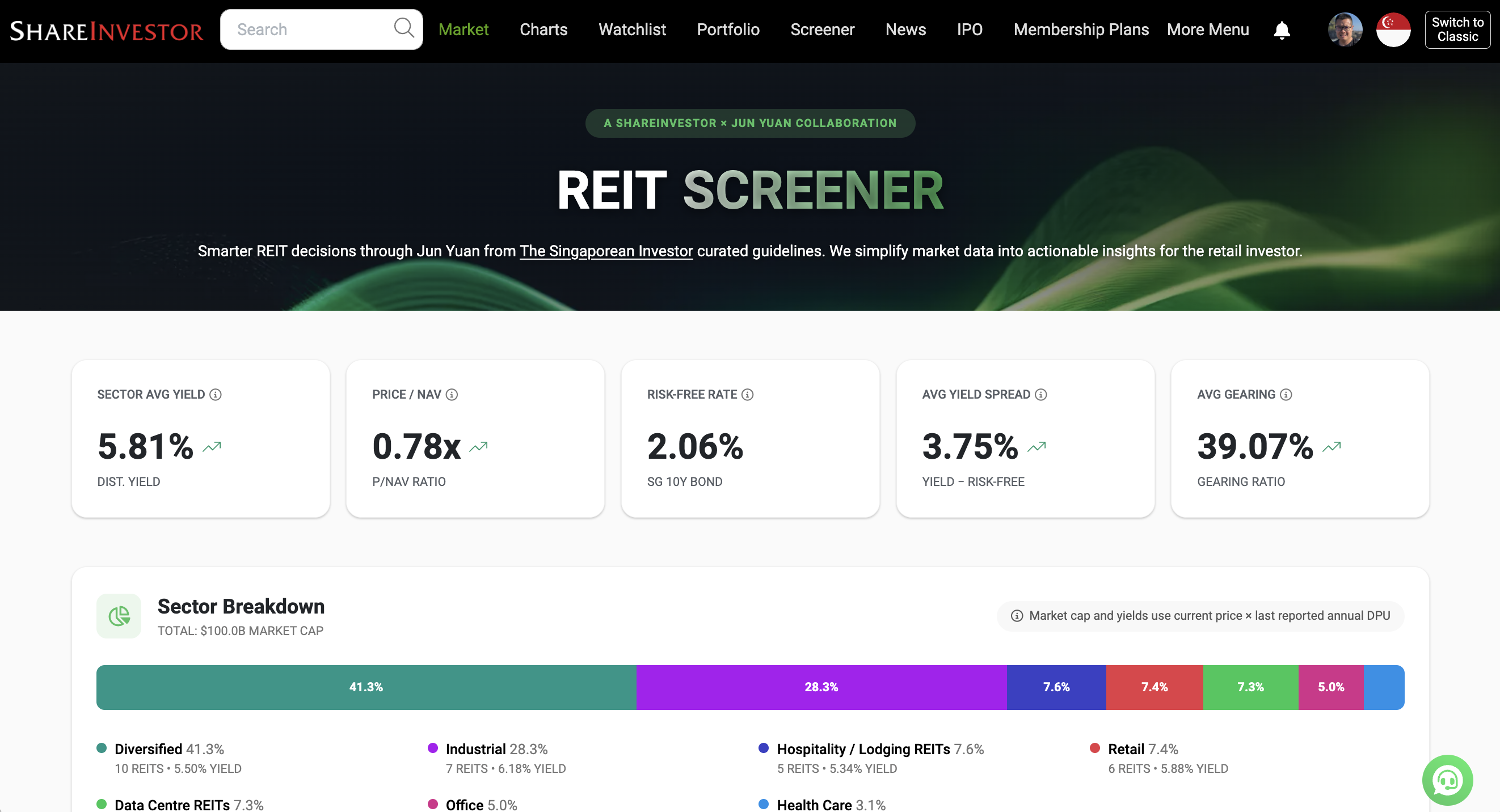
Take a closer look at the REIT Screener here...



Comments (0)